
2 Polyhedra, from Pythagoras to Alexander Graham Bell
1Jos Tomlow
2.1 INTRODUCTION
2Writing about the history of polyhedra up to the year 1900 means either lining up repetitive quotations from some 400 editions of Euclid’s Elements or—which the author prefers—making a voyage of exploration through historic objects and images of polyhedral shapes and considering the specialists involved. Indeed, the very materialization of polyhedral form as a two-dimensional image or a three-dimensional object turns out to be one of the keys to the significance of polyhedra in history.
2.2 NATURAL CRYSTALS
3The history of mathematics did not start with Pythagoras, who built upon the theoretical and practical knowledge of geometry that the Egyptians and the
4Beyond the Cube: The Architecture of Space Frames and Polyhedra, edited by J. Francois Gabriel ISBN 0–471–12261–0 © 1997 John Wiley & Sons, Inc.
5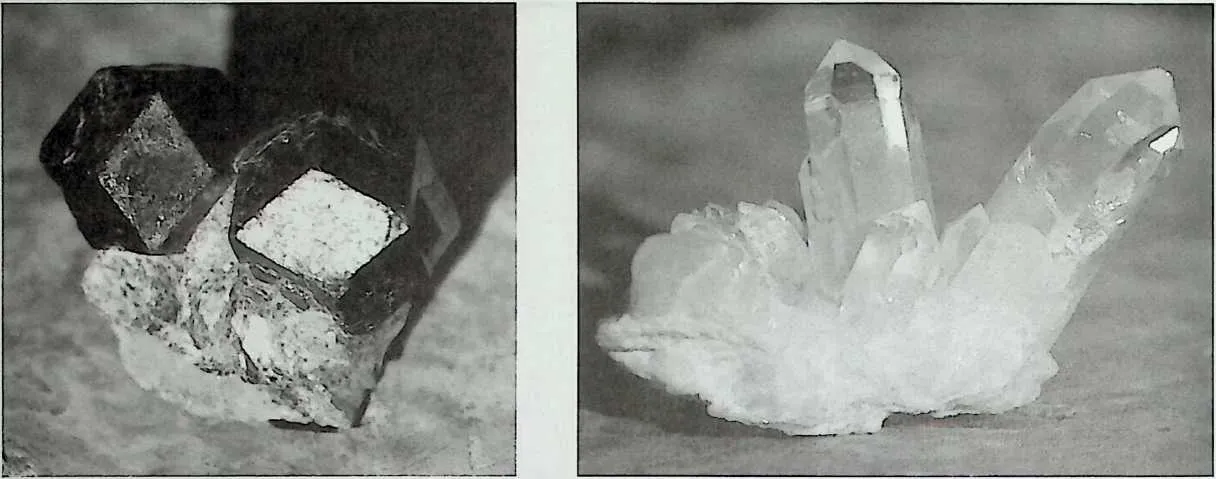 Figure1.2 Quartz, rock crystal, with prismatic shape and pyramidal ends. (Source:
Private collection. Photo: Jos Tomlow, Stuttgart.)
6Figure1.1 Natural crystals (Almadin) with the shape of a rhombic dodecahedron. (Source: Private collection. Photo: Jos Tomlow, Stuttgart.)
7 Mesopotamians had acquired. Even older are Chinese achievements in mathematics. If one wants to reconstruct the earliest human understanding of polyhedral phenomena, one has to think rather of natural polyhedra that occur in certain crystals. So, for a start, we may consider these naturally occurring manifestations that could have urged people to look further. Certain natural crystals show semi-regular or regular polyhedral forms like the rhombic dodecahedron, the tetrahedron, and even the cube.1 The transparent quartz crystal shows a polygonal prism with a pyramidal top. This may have led people to ponder on the geometric properties until someone may have conceived that six square planes fit together in a logical way into a cube.
2.3 THE EARLIEST POLYHEDRAL OBJECTS
8The next step is the man-made polyhedral object. One such ancient object is the East African foot ring, whose polyhedral ends may be even older in origin than the semi-regular polyhedral pyramids of Egypt or related forms in Mesopotamia. The material is hammered and welded silver. Women wore such lightweight rings loosely around the ankle. The open ring is hollow with two knob-like endings, shaped like cubes with snubbed vertices. This shape, called a cuboctahedron, is a semi-regular polyhedron with six squares and eight triangles. The craftsman took care to smooth some edges of the polyhedra in order to avoid hurting the foot, whereas all other surfaces are adorned with cut lines or stars. Typical °f this kind of jewelry worn by Berber women is its cultural origin and age are difficult to trace.2
9 Proof that the combination of an open ring with a cuboctahedron is truly
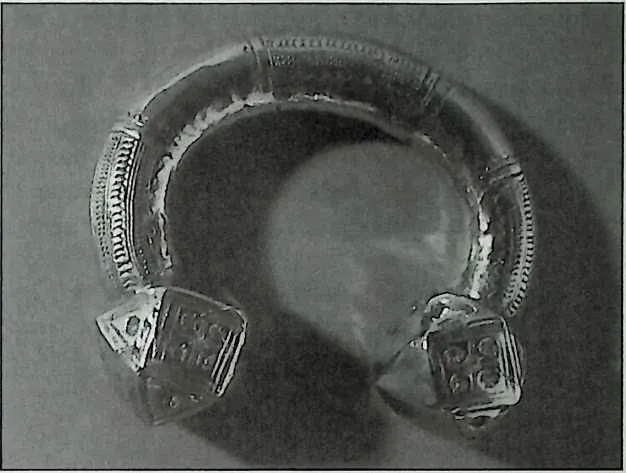
11Figure1.3 Old East African silver foot ring with ends shaped like a semi-regular polyhedron (cuboctahedron). (Source: Private collection. Photo: Gabriela Heim, Stuttgart.)
12 old can be found in the so-called polyhedral earrings and basket earrings produced in early medieval Europe. One pair of earrings, now in the German-isches Nationalmuseum Niirnberg, was probably found in a grave in Romagna, Italy. The material is silver wire with a tiny solid silver polyhedral knob attached to it.3 Another type of earring, an example of which is in the Landesmuseum in Stuttgart, was found near Basel in an Alamannic woman’s grave (end fifth century). One end of the so-called basket earring, made of either gold or silver, has an open cuboctahedron or similar form, in which a precious stone (e.g., garnet) is held. Although later on these polyhedral forms were copied by regional artists, their origin is thought to be Mediterranean, imported by trade or war.4
2.4 THE ANCIENT GREEKS ON POLYGONS
13In my hypothetical chronology, the ancient science of polygons and polyhedra began only after craftsmen had made simple polyhedral objects like the early cuboctahedra mentioned previously.
14 Pythagoras (ca. 570–510 B.C.) is attributed with developing a basic geometric theorem, the graphic demonstration of the algebraic formula a2 + b2 = c2. The square and the right-angle triangle play a major role in his proof.5–7To underline the importance of his work, we may recall here the story of how Pythagoras sacrificed a hundred fat oxen to the gods in gratitude for his having discovered the 90° angle.8
15 In Euclid’s Elements we find a discussion of the Pythagorean theorem. An illustration survived, dating from a time when European prints did not yet exist and can be found in an Arabic transcription of Nasr ad-Din at-Tusi (who died in 1247). If we consider the quality of the drawing, we see some interesting, progressive features: Letters permit cross reference to the text and the figure is drawn in red, whereas the lettering uses dark ink. Negative features also exist: The drawing is roughly executed with some lines shown double; the squares do not show true right angles; and the illustration is awkwardly squeezed between the accompanying text. The non-right angles are especially puzzling, as they concern the very essence of the geometric construction described. One may think that the illustration has no meaning on its own and can only be understood in relation to the mathematics in the text. We may call this a diagrammatic use of the drawn image.9
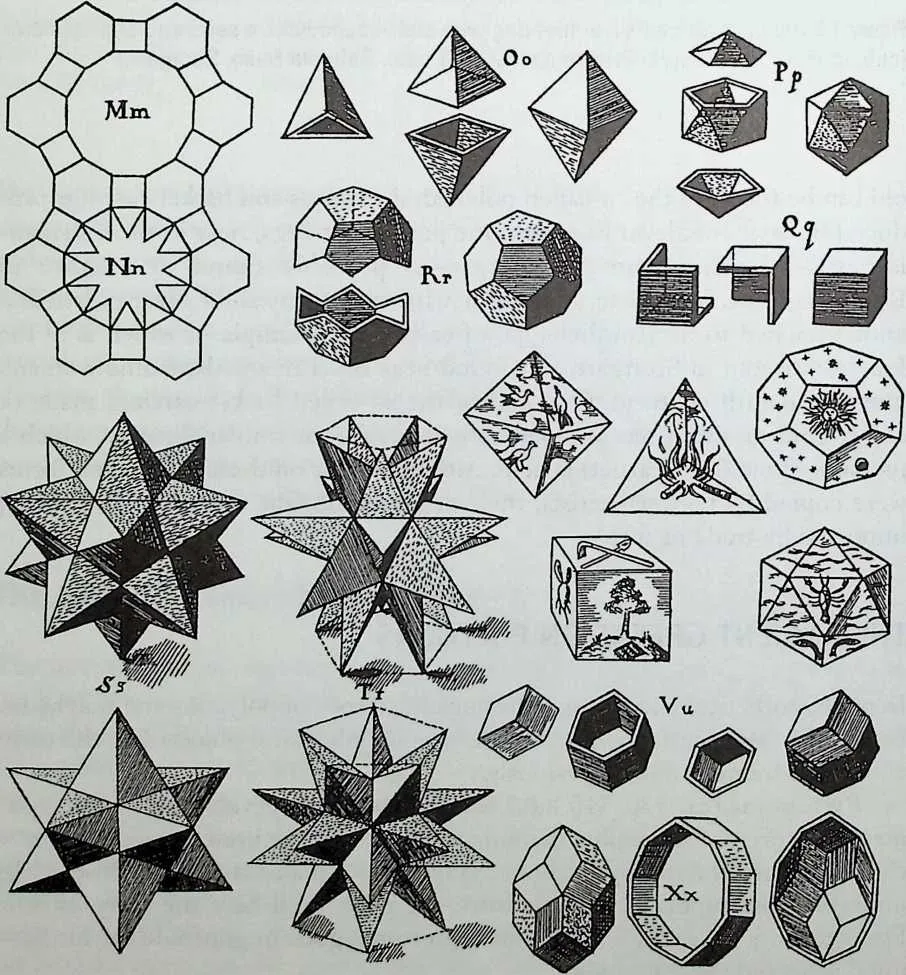
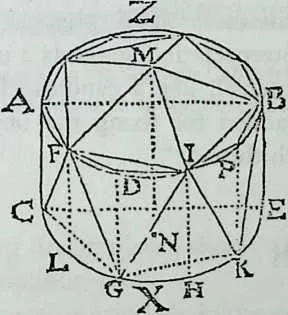
17Figure1.4 The five ‘‘Platonic’’ regular polyhedra and their symbolism—together with concave or stellated polyhedra—as depicted by Johannes Kepler in Harmonices Mundi (1619). (Source: J. Kepler, Die Weltharmonik, R. Oldenbourgh Verlag, Munich, 1990.)
2.5 THE ANCIENT GREEKS ON POLYHEDRA
18The Greeks started to theorize about the relationship between polygons and polyhedra and, in this way, entered into a hermetic realm of knowledge. The observation that only five regular and convex polyhedra can exist and the notion that these bodies were a symbol for all and everything were formulated as a doctrine by Timaeus of Lokri: Fire is represented by the tetrahedron, air by octahedra, ’water by icosahedra, earth by cubes and, since a fifth arrangement is possible, God has zised the dodecahedron to serve as a contozir of the zmiverse—cited from Timaeus by Plato (427–348/347 B.C.).5
19 Euclid (ca. 323–285 B.C.) described the basic geometric principles of these five polyhedra in his Elements.10,11 As we shall see, it was a long time before the visual image of polyhedra matched the mathematical rigor of Euclid. It is only from the 18th century onward that book illustrations can be regarded—more or less—as geometrically correct projections.10,12
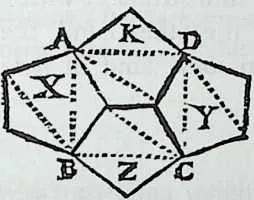
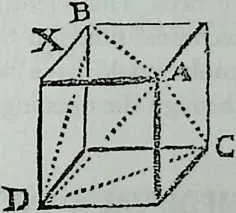
21Figure1.5 Polyhedra illustrations, showing poor standard of representation in 18th-century mathematical handbooks. (Source: B. Lamy, Les Elemens de Geometrie ou de la Mesure de I’etendue; qui comprennent les elemens d’Euclide;…, Paris, 1731.)
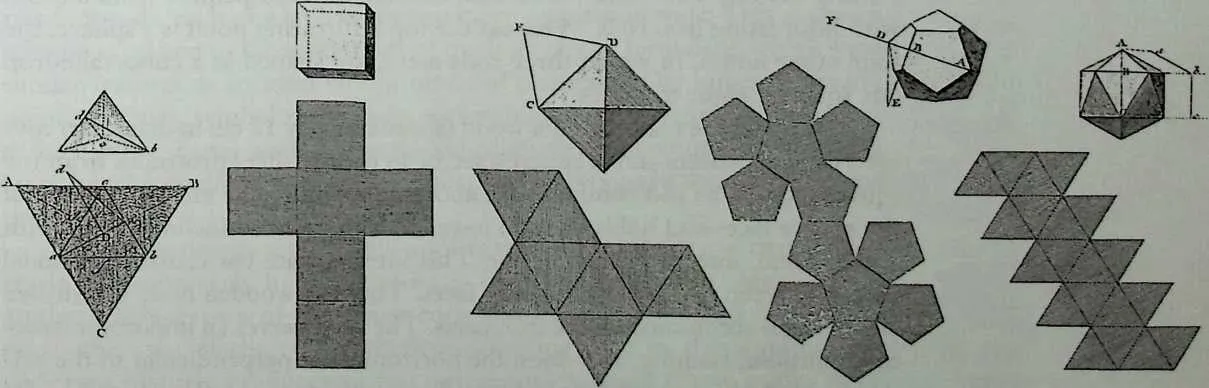
23Figure1.6 Polyhedra illustrations in a leading architectural handbook of the early 19th century. (Source: J. Rondelet, Traite theorique etpratique de I’artde batir, Paris, 1812–1817.)
24 Furthermore, note that it is in 320 A.D. that Pappus published the 13 semi-regular polyhedra described by the great physicist Archimedes (ca. 287–212 B.C.).6-7
2.6 ANCIENT POLYHEDRAL MODELS
25Let us return to the interesting question of polyhedra as three-dimensional objects. Referring to their autonomous beauty, Plato himself speaks in Phile-bos of the making of such objects ‘‘with a plane iron’’ and with the help of ‘‘guideline and triangle.’’13
26 In a recent contribution Malkevitch states that polyhedral objects were being made in late Roman times. He mentions icosahedra of steatite and faience with Greek letters incised on their faces.
27 Quite significant is a bronze dodecahedron found in Carmarthen, Wales (Society of Antiquaries of London). It is a hollow dodecahedron with 12 circular openings in the faces. The circular openings are of six different sizes and paired together on opposite faces. Solid spherical knobs are added on the 20 vertices. The scientific interpretation suggests a use as an instrument with a technical function or a utensil, like a candlestick. On the other hand, the knobs could have been added for fixing the object to some land of pole through the openings with thread.14
2.7 MEDIEVAL APPROACH
28Mature ingenuity is shown in the semi-regular polyhedra in the Barbarossa Chandelier in the Aachen Cathedral (ca. 1270). The Barbarossa Chandelier is one of the few remaining of this type in Germany, others being in Hildesheim and Gross-Comburg. These chandeliers symbolize the city of Jerusalem. Individual miniature towers are attached on a metal ring representing the city wall. The Barbarossa Chandelier is suspended from a chain with bifurcating iron rods. Whereas the top bifurcating point is a sphere, the four other nodes, in which three rods meet, are shaped as a cuboctahedron (six squares, eight triangles).
29 The nodes are made of solid wood (approximately 12 cm in diameter) covered by silver sheets and a sphere’s sector in copper sheet protrudes from the square faces. The rod coming from above enters the node element in one of the square faces and holds the two lower rods in a shared inclined plane with a horizontal, intermediate iron bar. This intermediate bar crosses the nodal object between two opposite square faces. Thus the wooden node was drilled crosswise to accommodate the iron parts. The node serves an important structural purpose, keeping, as it does, the horizontal bar perpendicular to the primary rod. As both secondary rods are fixed to the horizontal part with eyelet hinges, the structural solution for the chandelier and the even heavier chain,
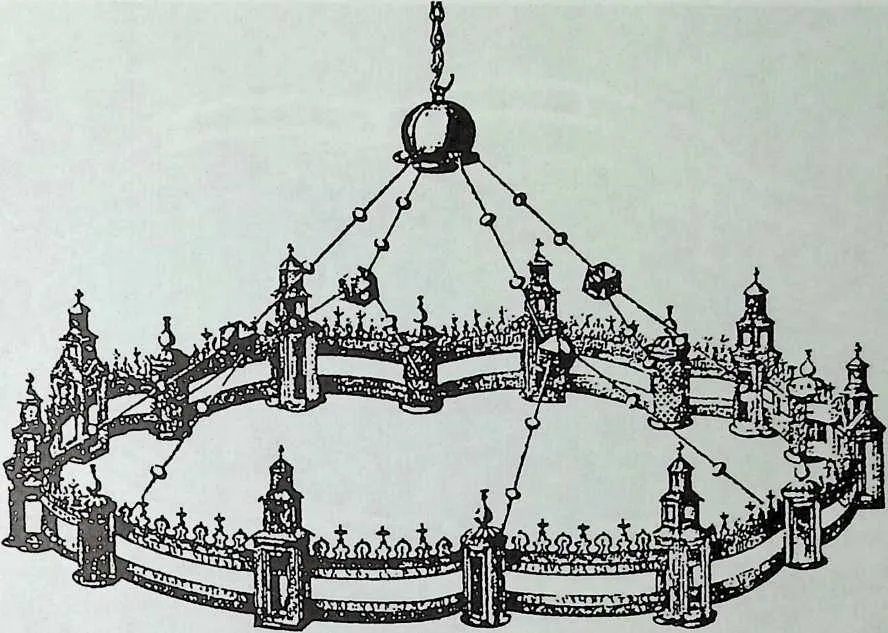
31Figure1.7 The Barbarossa Chandelier in the Aachen Cathedral (1170). (Source: Die Kunst-denkmaler dec Stadt Aachen, I. Das Munster zu Aachen, Dusseldorf, 1916.)
32 which together weigh 640 kg (incomplete), shows a maximum degree of freedom within a symmetrical equilibrium.15
33 Polygonal geometry is a major principle in the design, not only as applied to the node element but also in relation to the whole chandelier and even its position in the centralized space of the Aachen Cathedral, called the Octagon. The chandelier’s ring is divided into eight segments and carries eight three-story towers, alternating with smaller towers. Forty-eight lamps are regularly spaced around the wall. The bifurcation occurs in two stages: The chain carries four rods, each of which holds two more suspension rods. This geometric scheme is related to the symbolism of the holy city of Jerusalem, which shows similar features as an ideal city in terms of planning. The upper bifurcation point, a sphere, symbolizes the sun, as can be seen from texts on these chandeliers, and one may assume that the other smaller spheres and the semi-regular polyhedra could be interpreted as planets and moons in their ordered position in space.15,16
34 The inventive aspect of this application of polyhedra is that geometry is used correctly here as the basis for a spatial design. Although the angle of bifurcation of the lower rods was a free choice and is not related to the axes of the cuboctahedron, one may see in this application a very rare historic predecessor to contemporary space frame nodes developed from polyhedra.
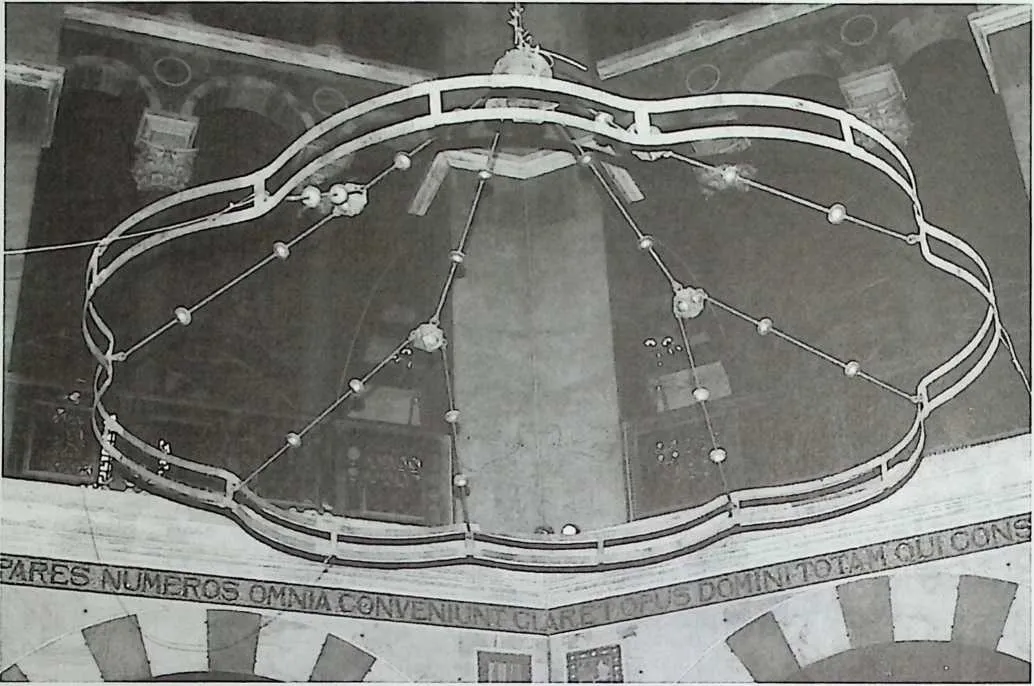
36Figure1.8 The structural parts of the Barbarossa Chandelier in the Aachen Cathedral (1170). (Source: Aachener Dom, Domkapitel. Photo: Herta Lepie, Aachen.)
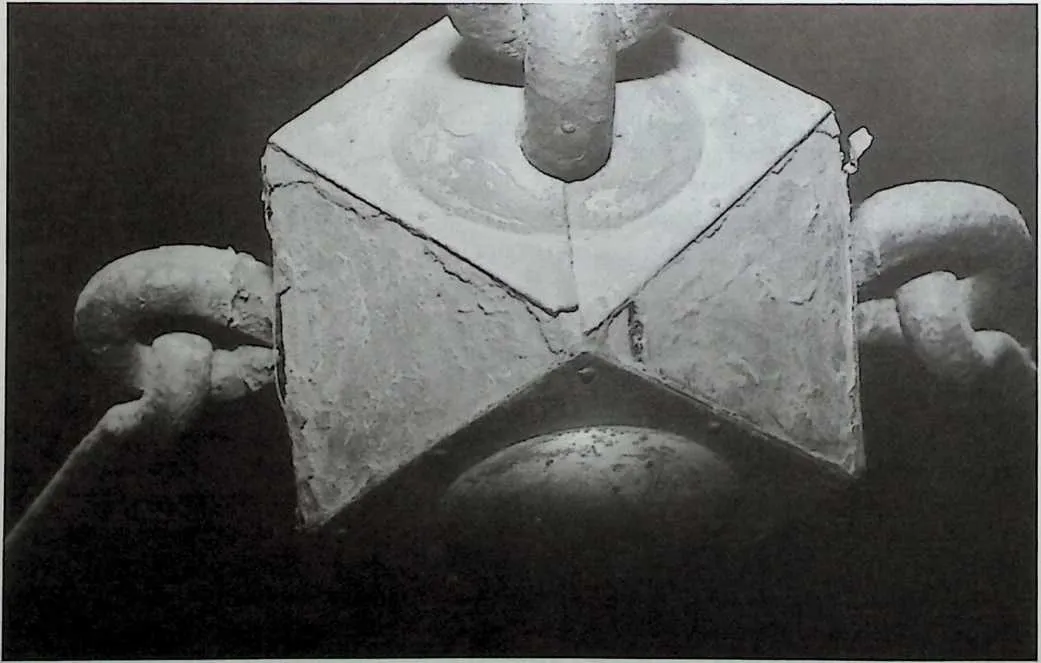
38Figure1.9 Semiregular shaped knot (snub cube) of the suspension of the Barbarossa Chandelier in the Aachen Cathedral (1170). (Source: Aachener Dom, Domkapitel. Photo: Herta Lepie, Aachen.)