0 Fuller---The Man and His Philosophy
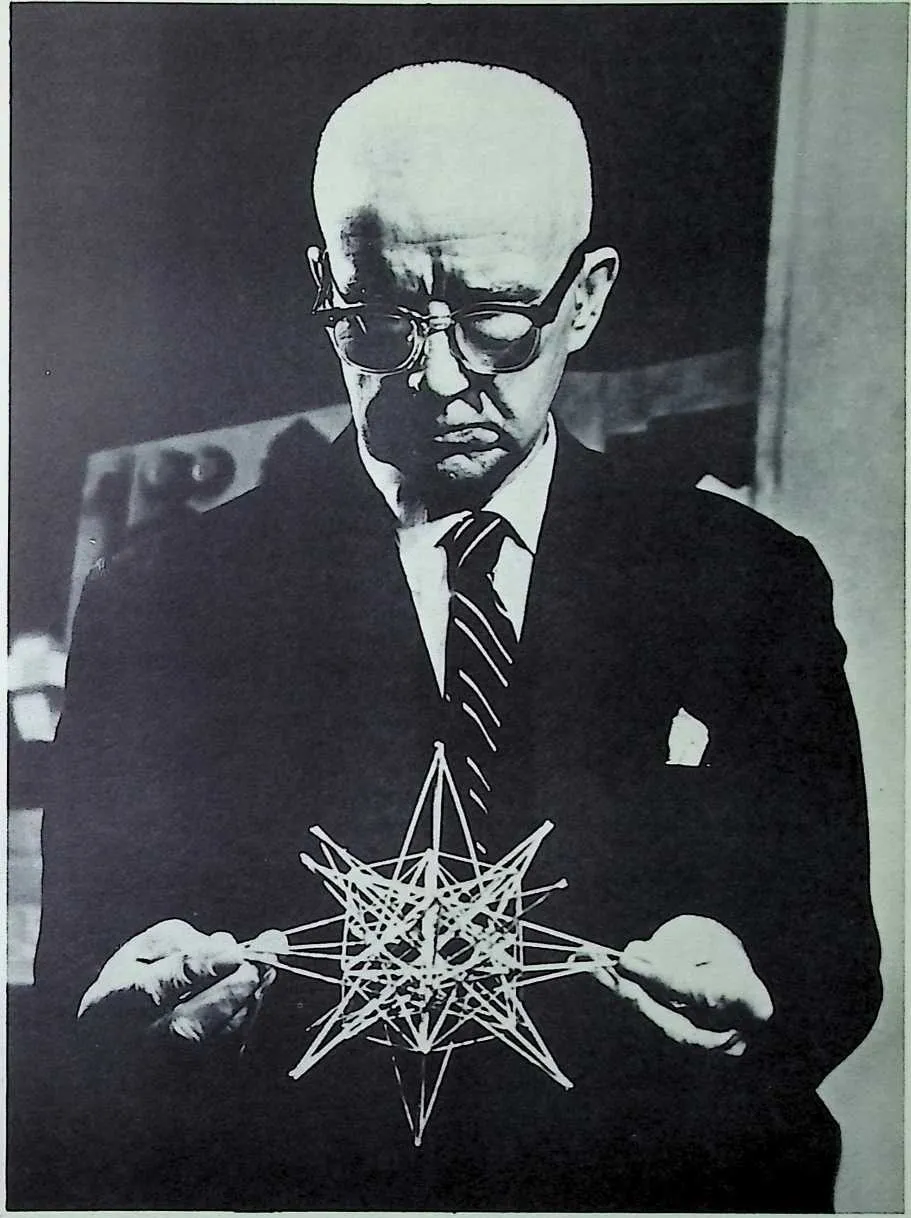
2 To people who are sensitive to the freshness of ideas and the pressure of mental designs, Buckminster Fuller is one of the most significant men of our time. To others he is alternately frightening and incomprehensible. To almost everyone he is puzzling.
3 Within a span of forty years Fuller has made front-page news as an architect, engineer, inventor-designer, cartographer, and mathematician. Yet he is none of these by profession. He is a maverick with a genius for seeing the world as something more than the sum of its isolated parts.
4 ‘‘I did not set out to design a house that hung from a pole,’’ he once said, ‘‘or to manufacture a new type of automobile, invent a new system of map projection, develop geodesic domes or Energetic Geometry. I started with the Universe—as an organization of regenerative principles frequently manifest as energy systems of which all our experiences, and possible experiences, are only local instances. I could have ended up with a pair of flying slippers.
5 This statement, a good example of Fuller’s verbal shorthand, requires interpretation. It is a credo. It is an assertion, in the tradition of Pythagoras and Newton, that the universe as a whole displays certain signs of orderliness—recognizable patterns of energy relationships. These patterns can be transformed into usable forms. ‘‘Valving’’ is Fuller’s special term for the transformation. ‘‘Valving, ’’ he holds, ‘‘embraces the concept of generalized design whose ultimate properties are determined only by frequency and angular modulations.’’
6 Another term which recurs with hydra-headed persistency in Fuller’s private linguistic world is ‘‘regenerative.’’ Tire dictionary meaning of this word, more or less, is having the ability to be born again, to reproduce, or to generate anew. In Fuller’s special argot, however, ‘‘regenerative’’ means ‘‘multi-orbital, cyclic, precessionally concentric’’—a definition which itself requires definition. By it he means the ability to display one form, then another, in a gamut of phases; each phase, however, like a tree ring, or a wave generated by a stone thrown into water, has its own orbit; and the various orbits progress outward or inward in concentric circles or shells. A seed is regenerative. A crystal is regenerative. Energy itself is an ever-generative patterning entity. Its forms are protean. It can appear as the breath of a hawk or coign of a cliff. It can cloak itself as radiation, as mass, as design, and as the wellspring of work. And since by fundamental law, energy can be neither created nor destroyed, its fate in the cosmic scheme is to meander through eternity in persistent, regenerative bliss.
7 To Fuller, what matters fundamentally with regard to both scientific method and social usefulness, is the total physico-economic picture, the Gestalt of nature—the patterns that are inherently comprehensive and universal, in contradistinction to what is local. Specific parts of a pattern, the local designs, can be derived from the general design, the comprehensive scheme. The reverse, however, is not true; in nature, society, and industrial complexes, wholes express more than the simple effect resulting from the sum of their respective parts. Fuller refers to the integrated behavior patterns as synergy, which he defines as ‘‘the behavior of a whole system unpredicted by the behavior of its components—or any subassembly of its components.’’
8 An illustration of the synergetic effect is the behavior of metallic alloys. The physical properties of several metals in combination is not implied by the properties they exhibit in isolation. A typical case is the tensile strength of chrome nickel steel. The tensile strength of chrome alone is approximately 70,000 pounds per square inch. Nickel has a tensile strength of some 80,000, iron of 60,000. The sum of their strengths is 210,000. But the actual strength of the three alloyed together is in the order of 300,000 pounds per square inch which is six times as strong as the alloy’s weakest link, four times the strength of its strongest link.
9 Yet from general formulations, particular instances can be derived. This explains, to some extent, Fuller’s approach to the existing geodesic domes. He regards no single dome of any generic importance; each is to him no more than a local application of a comprehensive system which he calls Energetic Geometry. This geometry is the separating out of individual cases from a comprehensive pattern. The geometry develops mathematical statements for what he calls, ‘‘the most economical relationships of points in universe and their transformation tendencies.’’ These statements determine the stress patterns of all geodesic domes.
10 A comparison can be made with the Einstein equation relating energy to mass. No specifications are given for the preparation of an atomic fission reaction; but from the equation a host of conclusions can be drawn—derived data which tell very simply how much usable energy can be extracted from substance of a given mass. The general statement, in short, covers all specific instances.
11 In times past, most pure scientists confined themselves to the physical world and its system of exact relations. Pythagoras, despite his wanderings in mysticism, was essentially a mathematician; Newton and Einstein were mathematicians; Copernicus was an astronomer; Max Planck, a physicist. Fuller departs from this tradition in that he is equally concerned with exact and social science. He is passionately concerned with a comprehensive view of nature—of the physical world as a patterning of patternings (his term is ‘‘macro-micro-oscillocosm’’) whose constituent functions are fields of force, each of which competes and influences other localized fields of force. But his concern is also social; it asks the persistent question: How can an expanding technology maximize the benefits to be derived from the knowledge and possible control of the energies in nature? How, in fact, can we as knowledgeable as well as social beings maximize our technological advantages?
12 This is the essence of Fuller’s world view. It is a concern that joins the several seemingly unrelated areas in which he has worked over the past four decades.
13 Another dimension of this Weltanschauung is expressed by the term Dymaxion, a label Fuller has used to qualify the implication of his various inventions, developments, and projected ideas. This distinctive Fuller trade-mark has a function which lies somewhere between Occam’s Razor—the principle which asserts that assumptions should not be multiplied unnecessarily—and de Maupertuis’ so-called principle of least effort. In its simplest form, Fuller’s Dymaxion concept is that rational action in a rational world, in every social and industrial operation, demands the most efficient over-all performance per units of input. A Dymaxion structure, thus, would be one whose performance yielded the greatest possible efficiency in terms of the available technology.
14 Yet there is another field in which Fuller follows a great tradition: the field of method. Tire spread of Fuller’s creative work is a direct consequence of his special method of thinking.
15 At a time of crisis in his life, Fuller set himself, like Descartes in his Dutch stove-heated compartment, to survey the whole of the human dilemma—all the obstacles that stood in the way of man’s survival and in the way of man’s potential development. His philosophical starting point was the totality of possible events—‘‘universe, ’’ as he called it, defining it in terms of the way it impinges on the human mind. ‘‘Universe, ’’ Fuller held, ‘‘is the aggregate of all men’s consciously apprehended and communicated experiences.’’ Tire communication can be directed inward as self-communication; it can be passed on to others as social wealth. But ‘‘universe’’ as a whole is a concept as difficult to handle as Hegel’s Absolute. Our minds can grasp what we regard as ‘‘things’’ and qualities of ‘‘thingness’’—what Fuller prefers to call ‘‘event constellations and pattern characteristics of constellations.’’ These are individual experiences. Their reality is guaranteed by the data of our senses. The universe as a whole escapes us. Yet it is a necessary conclusion that if a finite number of events or experiences exist individually, they also exist collectively.
16 Fuller regards wholeness as a collection of events. Tire universe, as ‘‘the aggregate of all men’s experience, ’’ is such a collection. It can be compared to an encyclopedia. We can accredit the collective integrity of an encyclopedia, although we are not able to consider all of its entries simultaneously. Tire universe, as Fuller envisions it, presents a spread of events that cannot be grasped simultaneously; nevertheless these events are integral parts of a functioning whole, and they were in existence prior to any of our individual acts of investigating, or sorting out, specific parts. Physical science has established that the physical universe is entirely energetic; and the first law of thermodynamics—the law of conservation of energy—attests that energy can neither be created nor lost. It follows that the totality of energy is finite.
17 External to this law, however, are experienced phenomena that are other than physico-energetic. These are the infinite spreads of metaphysical phenomena—the limbo of psychological events.
18 Fuller’s definition of ‘‘universe’’ is an attempt to treat all experience as finite. In his wording: ‘‘It brings the heretofore metaphysically bush-leagued scientific activity into full membership of inherently potential accountability as integral functions of the finite whole.’’
19 The latter statement requires interpretation. Fuller regards all human experiences as energy events finite in extent. All experiments performed, books written, thoughts expressed, and structures completed, are finite energy events. Together they form a totality, a cornucopia of patterned quanta. His approach makes experience as finite as any other energy phenomenon, and encompasses, he feels, both Eddington’s definition of science (‘‘the attempt to set in order the facts of experience’’), and Mach’s definition of physics (‘‘the attempt to arrange experience in the most economical order’’). Fuller views his definition as operationally justified, and refers to it, at times, as ‘‘the law of conservation of experience.’’
20 The scientific and philosophical explorations Fuller undertook, in terms of this definition, were what he calls, ‘‘a natural, logical search for orderly patterning processes of complex-complementary, self-transforming, inter-self-multiplication-and-division, inter-disassociations and associations, their minimum-maxi-mum degrees of inherent freedoms of actions, and the relative frequencies and over-all lags of such inherent event patterning.’’
21 In effect, he attempted the progressive subdivision of ‘‘universe’’ into a generalized mathematical schema, whose end product is a strategy of evolution radically opposed to Darwinism.
22 Fuller makes cumulative experience a pivotal factor in change. Experience is finite; it can be stored, studied, directed; it can be turned, with conscious effort, to human advantage. Darwinian evolution is assumed to be operative in ways independent of individual will and design. Darwinism posits chance adaptation to survival; Fuller’s approach pivots on the conscious, selective use of cumulative human experience.
23 The progressive expansion of this idea, augmented by his ‘‘finite accounting logic,’’ led Fuller to postulate a comprehensive, global economic strategy whose sole concerns are the advantages that can be directed toward man’s survival and growth. The energy and ‘‘universe’’ assumptions led Fuller to an ultimate philosophy of industrialization ‘‘which,’’ he maintains, ‘‘permits and implements man’s conscious, though limited, participation in his own evolutionary patterning transformation.’’
24 In this Fuller can be considered to have out-Marxed Marxism. Karl Marx proposed a way of bettering society as a consequence of political change. Fuller regards politics as an outmoded activity—a naive attempt to achieve through games of words what must ultimately be derived from technology. More lives can be saved by antibiotics than by acts of Congress; more shelter can be had from alloys and polymers than from social legislation. No matter how beneficent in spirit a legislative act may be, it is useless in fact unless it is underpinned by the technology adequate to its aim. The assumption which follows is that if you possess six fish, a way can be found to divide them among five people; the difficult thing is to provide dividends from no fish.
25 Fuller conceives of real wealth as the total organized capacity of society to deal with ‘‘forward event controlling,’’ that is, with future contingencies. His estimate of existing wealth, at any given moment, would consist of a specifically quantitative rating of the technological level of production and supply then in effect, the point of reference being the number of human beings who could continue to survive number of days without dependence on additional research or addition to the existing inventory of tools and facilities. He holds that when Adam and Eve sojourned in the Garden they owned no wealth whatever. Yet had they picked even ten ‘‘forward days’ ’’ supply of fruit, wealth would have accrued. It is what man adds to the ‘‘Garden’’ that determines his wealth. The transforming factors are work and ingenuity; both are functions of energy.
26 Real wealth to Fuller is thus nothing more than the extent to which man, at a given moment, has harnessed forms of universal energy and, in the process, has developed a re-employable experience. Since energy can be neither created nor destroyed, Fuller’s primary wealth constituent is non-depletable. The other constituent, re-employable experience, is augmented each time it is brought into play. Experience can only grow; like time, its quantity cannot be diminished. It follows that wealth, thus conceived, increases only and always with use. It is not derived from money; money is derived from wealth. Fuller observes, ironically, that although there is only some 40 billion-dollars’ worth of gold in the entire world, three trillion dollars of real wealth have been invested, during the last half century, in the development of the airplane alone. The harnessing factor—the activity which ‘‘valves’’ the mass-energy of the universe to human advantage—is inventive wisdom born of intuition and experience and put to use in a global industrial complex.
27 Wealth is now without practical limit; all its constituents are inexhaustible, and all are on inventory, available for development and exploitation. ‘‘Science has hooked up the everyday economic plumbing to the cosmic reservoir.’’ This was a philosophical point Fuller raised, in 1958, at a meeting with Nehru,-in India. Man’s survival is a technological, not a political problem. Abundance is a function of production, not protocol; and man’s chances of transforming a disease-ridden, famine-threatened society into a realm of orchestrated abundance depend on his ability to set in order the facts of his experience. Such an order requires a ‘‘comprehensive, anticipatory design science.’’
28 Perhaps dedication to this cardinal idea, a comprehensive, anticipatory design science, is the clue to Fuller’s anomalous position in the professional world. Established men tend to be suspicious of men without establishment. It is apparently a human urge to classify and label. The maverick is suspect. And Fuller, as was noted, fits no standard classification; he is identified by no familiar label. This may be partially explained by the fact that all his later years and thought have been a dedicated quest for all that is implied by the phrase, ‘‘a comprehensive, anticipatory design science.’’ And we have as yet in society no professional category that admits a quest so all-embracing.
29 To sidestep the difficulty, he sometimes refers to himself as a machinist (he is a card-carrying member of the International Association of Machinists), or as a sailor (he holds the ‘‘confirmed’’ rank of Lieutenant U.S.N. [Resigned], with life tenure in Class 1, Fleet Reserve). Both identifications are to his liking; both, he feels, are marks of craft and competence with reference to the essential human experiences: survival, fabrication with tools, and the turning of hazards into advantages.
30 For years functioning engineers and key-name industrialists looked at him with friendly but condescending eyes, often putting him down as an amiable lunatic whose ideas were always stimulating and frequently good for a laughable quote. Fortune, in 1946, lampooned him as ‘‘a chunky, powerful little man with a build like a milk bottle, a mind that functions like a cross between a roller-top desk and a jet engine, and with one simple aim in life: to remake the world.’’ Time, ten years earlier, spoke of him more charitably, as an industrial prophet noted for ‘‘arriving incoherently at logical conclusions.’’
31 Although in times past many automobile, aviation, and construction officials were proud to claim his friendship, and architects, including Frank Lloyd Wright, sometimes consulted him on technical problems, only off-beat mathematicians and mavericks sensed the seriousness and the scope of his ideas. Today Fuller holds four honorary doctorates and has lectured at most of the leading universities of the world; but in the late twenties he was heard only at off-campus college meetings and in the dim rooms where idea people develop abstractions about other abstractions. Yet even then he seldom failed to influence those who heard him; his ideas seemed always to generate conclusions which were fresh and unexpected, which had the ‘‘synergetic’’ quality—an intellectual singing in the sails that was more than the wind.
32 His economic and scientific ideas were served up as jig-saw picture fragments. Those who saw only the un-arranged pieces regarded Fuller as a man dabbling in philosophical Dada. But the pieces invariably fitted together. And when assembled, they made a clear picture, with implications few observers were in a position to grasp. A case in point is Fuller’s interpretation of the revolutionary world economic effects which would ultimately result from an application of Einstein’s relativity theory and the formula relating energy to mass. In a book, Nine Chains to the Moon, [Ful38] written in 1935 and published by J. B. Lippincott in 1938, he devoted three chapters to Einstein, the last of which was called ‘‘E = MC2 —Mrs. Murphy’s Horsepower.’’
33 Fuller argued that theory induces experiment and experiments pace science; science paces technology; technology paces industry; industry paces economics, and economics paces the everyday world. Consequently, the measurements of the speed of light and the new knowledge of energy —which together gave rise to Einstein’s new theories of the universe —must, in due course, ‘‘catalyze a chain reaction ultimately altering altogether the patterning of man’s everyday world.’’
34 ‘‘This stupendous fact seems apparent,’’ he wrote. ‘‘Newton’s static norm must be replaced by Einstein’s dynamic norm—always operative at the speed of light. No change, the norm of economic conservatives, must give way. The new turn of events will force the conservative—albeit unwillingly—to adopt constantly accelerating change as his economic norm.’’
35 When his publishers read the book in manuscript form, they were dismayed by Fuller’s presumption. To them, Einstein was Jovian and sacrosanct. His habitat was the upper reaches of rarified air—particularly that part of the atmosphere which hovered over Europe—and his work so esoteric that its significance was grasped only by twelve legendary, but qualified, European scientists. Who was Fuller to rush in and link the great man and Mrs. Murphy?
36 To his publishers’ assertion that he had overreached himself, Fuller had a simple answer: ‘‘Why not send the typescript to Dr. Einstein and see what he says?’’
37 The full book was posted to Princeton.
38 On a momentous day, three months later, Einstein came to New York from Princeton, the typescript under his arm, and arranged to see Fuller.
39 ‘‘I have read your interesting book,’’ Einstein said, without ceremony. ‘‘Regarding the three chapters treating with me, the first on my philosophy, the second on my energy equation formulation—these are satisfactory to me. But, young man, regarding myself and Mrs. Murphy, you amaze me. I cannot conceive of anything I have ever done as having the slightest practical application. I have propounded my theories only for the consideration of cosmogonists and astrophysicists in their broad accounting of an energy universe.’’
40 Three years after this, Otto Hahn and his co-workers at the Kaiser Wilhelm Institute in Berlin discovered the possibility of splitting the uranium atom. And within a few years it was Einstein himself who communicated to President Franklin D. Roosevelt the awesome potential of fission. What followed was the Manhattan Project, whose developments yielded the atomic bomb—violent physical proof of the objective reality of an abstract theory.
41 ‘‘Einstein’s out-of-this-world hypothesis,’’ according to Fuller, ‘‘became the most momentous application of abstract theory in all history. The hypothetical equation, E equals MC2, proved to be the generalized accounting of the local energies on inventory in the masses of all elements—everywhere.’’
42 He maintains that the pre-World-War-I conservatives who shuddered at a U.S. national debt of some two billion dollars ($1,191,000,000 in 1915), and considered this figure an indication of carelessness in avoiding uneconomic changes, forty-odd years later grudgingly rocketed the national debt to almost 300 billion ($276,343,000,000 in 1958). In the late 1950’s, the annual debt increased at the rate of 40–50 billion a year, a progressive increment forced by the ‘‘cold war’’—which, in turn, was the outcome of an acceleration in the revolutionary transformation of world technology. The question, ‘‘Who is loony now?’’ Fuller holds, used to mean, ‘‘Who is crazy?’’
43 In the new accounting, Fuller holds, the question, ‘‘Who is looney now?’’ means ‘‘Who are the sanest, strongest men to whom the multi-billion dollar moon-shoot contracts should be awarded?’’
44 Lecturing to a group of students at Massachusetts Institute of Technology, Fuller once outlined the scope of Energetic Geometry—showing how the basic energy patterns in nature could be expressed by families of geometric ‘‘solids’’ whose common metric is the tetrahedron (four-faced pyramid). On that occasion, John Ely Burchard, vice-president of M.I.T., introducing Fuller to the students, said with great solemnity, ‘‘I refrain from calling Mr. Fuller a genius because this is a term we usually reserve for foreigners.’’
45 When the lecture was repeated before a mathematics class at Columbia, Edward Kasner, who was then professor of mathematics at the university, made a single laconic comment. ‘‘My only regret about tonight,’’ he said, ‘‘is that Euclid and Pythagoras could not have been here.’’
46 In 1934, the novelist, Christopher Morley, who had become one of Fuller’s closest friends, published these words on the dedication page of his book, Streamlines: ‘‘For Buckminster Fuller, scientific idealist, whose innovations proceed not just from technical dexterity, but from an organic vision of life.’’ [Mor36]
47 In reviewing such appreciation, it is not easy to account for the length of time it took for Fuller’s essential ideas to gain even the semblance of public acceptance. Over a forty-year period most of his proposals, inventions, discoveries, and developments have been hailed and then shelved—so much so that almost each new creation, even those having immediate use-value, was greeted in the politer journals with a thunderous ave atque vale. Always there was simultaneous acclaim and dismissal. The industrial world, happy to pick up the phraseology of Madison Avenue, called him ‘‘failure prone.’’
48 Yet to Fuller there were no ‘‘failures.’’ He was not in business. A ‘‘failure,’’ to him, was a word invented for purposes of business accounting. Working theories, made in advance of experiment, may fail, but nature never fails. The principles of physics are integrities; they are observed regularities within a system. And all of his experiments had dealt with these regularities, these existing patternings of forces and stresses. All his models met the pragmatic test; they worked. His early Dymaxion house, his Dymaxion cars, his die-stamped bathroom, his Dymaxion map, his first Geodesic domes, were what he called ‘‘reductions to practice’’; they were experimentally proven and industrially reproducible prototypes of desirable and possible constructions.
49 But until 1955–1956—when industry and the Armed Services could no longer ignore the enormous technological advantages of Fuller’s structures—the straight ran of practical people continued to regard Fuller as a professional visionary and observed that nothing much ever seemed to have come from his prototypes. Why, they asked, did he never really exploit his successfully-demonstrated inventions and his pilot models? Why, instead of taking a solid job in industry, was he content to drag along on an income of $4,000 a year or less, and waste all his ‘‘technically accredited advantage’’—the phrase is Fuller’s—talking like Socrates in the market place?
50 But what few could realize was that Fuller’s energies and discipline were centered in a single drive: to promote the total use of total technology for total population ‘‘at the maximum feasible rate of acceleration.’’