0 Energetic-synergetic Geometry
THE DYMAXION MAP
1Oddly enough, the first news-making application of Fuller’s Energetic Geometry was the invention of a new type of map, the first in the history of cartography to show the whole surface of the earth in a single view with approximately imperceptible distortion of the relative shapes and sizes of the land and sea masses.
2 The Dymaxion map was not a shadow projection, as are other global maps, but a topological transfer of a high frequency form of Fuller’s totally-triangulated systems from the surface of a sphere to the equivalent triangular spaces on the faces of a polyhedron. Unpeeling this ‘‘solid,’’ and laying flat its unit skin, produced the continuous flat surface which is the map.
3 The standard map projection systems obtain true proportions in certain zones of the projection, paying for this sectional truthfulness of scale by exaggerated distortions elsewhere. Fuller’s topological transfer of the earth’s geographical data was accomplished with uniform distribution of the error throughout the entire planar surface. This uniform distribution reduces its magnitude at any one locality to a negligible amount.
4 The Dymaxion map was first published, March 22, 1943, in Life; as a cartographic innovation it was the first projection system to be granted a U. S. patent (No. 2,393,676; Jan. 29, 1946).
5 In his patent application, Fuller pointed out that all flat surface maps are compromises. The projection system of Mercator assumes that the flat surface on which the globe is to be projected comes in contact with the globe only at the equator; hence distortion increases progressively northward and southward, to the poles. If the projection system assumes the flat surface is in contact with the globe at either pole, distortion increases as the projection moves toward and beyond the equator. Other types of projection introduce compromises. A little distortion here is counter-balanced by a large distortion there; the consequence is an asymmetrical goulash of distortions.
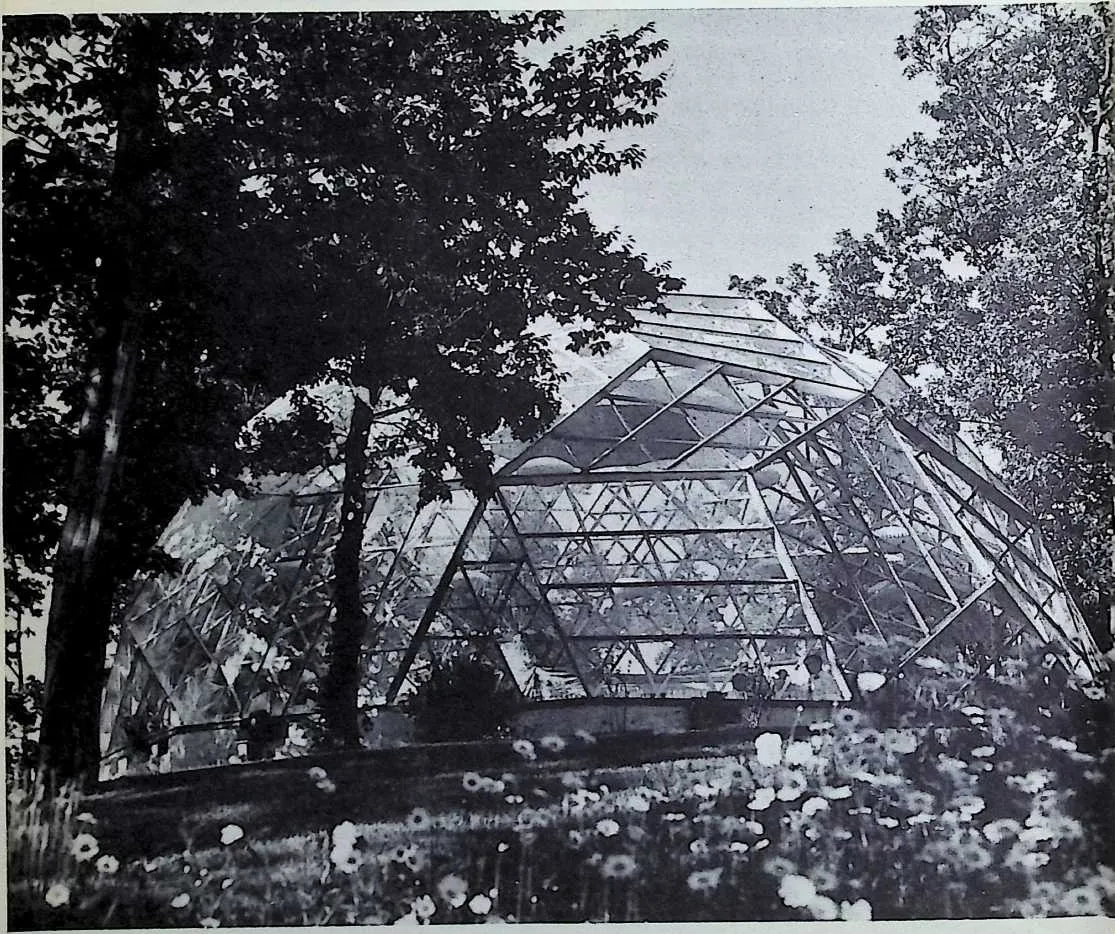
6 The geometric principles underlying the Dymaxion map are the same as those used to develop the basic pattern of Fuller’s domes.
7 The domes are based on the fact that a regular geometric ‘‘solid’’ (such as an icosahedron) can be projected outwardly on to the surface of a sphere (thus an ordinary icosahedron generates a spherical icosahedron).
8 To produce Fuller’s Dymaxion map, we reverse this process. We start with a sphere, on whose surface a spherical icosahedron has been drawn. Next, we sub-triangulate the icosahedron’s 20 triangular faces with symmetric, three-way, great circle grids of a chosen frequency. Then we transfer this figure’s configuration of points to the faces of an ordinary (non-spherical) icosahedron which has been symmetrically sub-triangulated in frequency of modular subdivision corresponding to the frequency of the spherical icosahedron’s subdivisions.
9 (The current version of the Dymaxion map consists of a transfer of points from a sphere to an icosahedron; the earlier version was a transfer to the Vector Equilibrium. The same principles apply in either case.)
10 The Dymaxion map has two significant virtues which distinguish it from all other maps. The first, as has been noted, is that it provides global information with negligible distortion of magnitudes. This fact may be of no importance to a man driving his car from New York City to Stamford, Conn. It is of extraordinary importance, however, to the navigational planning of global flights, and to strategists planning the course of an intercontinental ballistic missile.
11 The second is that it is the only flat-surface plot of the earth which presents all the true geographic scale areas in a single, comprehensive picture without any breaks in any of the continental contours, or any visible distortion of the relative shapes or sizes of these whole land masses. Thus, on the Dymaxion map, it is possible to view the whole earth’s surface comprehensively as one great continental archipelago lying within a one world ocean. Consequently many geographic facts, not usually observed, become dramatically apparent. An example of this is the visual emergence of what Fuller has called the ‘‘Dymaxion Equator’’ —a great circle running from Cape Canaveral, Florida, across the United States, through Cape Mendocino, California, then going completely around the world, passing over 21,000 miles of open water without traversing any continent other than North America. A guided missile fired from Cape Canaveral along this trajectory would not violate the air space of any alien power.
12 Another feature of this ‘‘equator’’ is that its north pole lies at fifty east longitude (from Greenwich) and fifty north latitude (from the equator). This ‘‘fifty fifty’’ point occurs at the foot of the Ural Mountains in Russia, where the Soviets maintain their missile launching station. This is the pole of a hemisphere which contains 93% of the world’s population. The ‘‘south’’ pole of the Dymaxion equator lies in the watery wastes where there is virtually no population.
13 Because automatically guided aircraft or missiles usually fly most profitably great circle courses, or shortest spherical distances, the plotting of such courses can be effected accurately on a global scale, Fuller argues, when the points of reference are fixed in a world-encircling, triangular great circle grid survey.
WORLD ENERGY MAP
14It is characteristic of Fuller to feed on his own creations, and to apply them to seemingly unrelated fields with surprising results.
15 Thus far we have seen how he moved conceptually from close-packed spheres to the Dymaxion, from the Dymaxion to the division of a super-sphere into equal-edged parts; and how this led to the notion of a topological projection of points on the surface of the globe (with a uniform boundary scale) to the faces of the Vector Equilibrium, and how the un-peeling of these faces produced the Dymaxion map. But Fuller did not stop at this point. He asked himself how he could use this map for an improved presentation of the air-ocean world town plan which he had developed in 1927 and whose reference data he had shown in an earlier map.
16 The 1927 map could portray only half the world at a time. But now he could show the whole of the earth’s surface in a single frame. Furthermore, the new map supplied a scale picture without any visible distortion so that a graphic display of vital statistics would be reliable in scale.
17 The primary question Fuller asked himself was: What is happening to the total population of the earth in terms of the technological advantages that might be made available? To answer this question it was necessary to reduce the idea of technological advantage to some measurable unit. Just as the French sociologist, Smile Durkheim, groped for a specific measure of human unhappiness and found it in the concrete statistics of suicide, Fuller reached for a measure of the social benefit available in advancing technical knowledge. He found his answer in the number of what he called ‘‘energy slaves’’ available per capita in a given section of the world.
18 This was the argument which led to his definition of the universal robot: One man can do approximately 150,000 foot-pounds of work in one 8-hour day, in addition to the energy spent from his metabolic income in ‘‘working’’ his own body. (This was a mean Fuller computed from U. S., German, and Swiss army data. A foot-pound of work equals the amount of energy required to lift one pound one foot vertically.) This additional work might be called his ‘‘net advantage’’ in dealing with the environment. The potential net advantage to be gained by each person each year, working 8 hours 250 days per year is 371 ⁄ 2 million foot-pounds.
19 In engineering, the term ‘‘efficiency’’ means the ratio of foot-pounds of work realized to the foot-pounds of energy consumed by a given mechanical system. This ratio is usually stated as a percentage. The highest possible efficiency to be realized from a 1959 automobile is 18%. The low efficiency is a result of the designed in frictions of such mechanisms as banjo gears and reciprocating engines. The most modem coal-burning, steam-generating, public utility electric power plants operate at a little better than 40% efficiency. Hydroelectric power generation sometimes tops 90%. Most automobiles, as used and abused, are less than 7% efficient. House heating systems are less than 2%.
20 Fuller calculated, in 1950, that, in the gamut of the ill-used, ill-designed mechanical gadgetry of our mechanical civilization, it would be unreasonable to expect man to have an over-all operating efficiency of more than 4% with respect to the total energy, from all sources, consumed by him. In the United States, at any one moment during a 24-hour period, there is an average of a million cars standing in front of red lights with their motors going. In the face of Americans’ love for hundreds of ‘‘horses,’’ this means that we are paying at all times for a national stable of 200 million ‘‘horses’’ who are putting all their might into an invisible tap dance performed without measurable usefulness under the shining hood.
21 Fuller estimated, with a probable error of less than 10%, the world consumption of energy from mineral fuels (coal, oil, gas) and water power for the year 1950 as totaling 80% quintillion foot-pounds (80,156,250,000,000,000,000 foot-pounds). Assuming that man’s efficiency in converting his gross energy consumption into work averages an over-all 4%, the net work obtained amounted to only 3% quintillion (3,206,205,000,000,000,000) foot-pounds.
22 Dividing this figure by 371 ⁄ 2 million foot-pounds (each man’s net annual energy output), the result is 851 ⁄ 2 billion man-year equivalents of work done for him by machines. These man-year equivalents Fuller called ‘‘energy slaves.’’
2381⁄ 2 billion energy slaves
24 214 billion world population (1950)
25 = 38 energy slaves per person
26 Although it is probable that some day the world’s energy slaves will be equally apportioned among all men, Fuller pointed to the current uneven geographic distribution. He catalogued ‘‘haves’’ and ‘‘have nots’’ among the various regions. Each inhabitant of North America, according to his computations, had some 347 energy slaves at his disposal in 1950; each Asiatic had two; each Central American had approximately none. The sociological unit, however, is frequently the family, not the individual. Despite the poor over-all efficiency of existing machinery, in 1950, every American family of five had exactly 1,735 effective energy slaves in constant attendance, not exclusively inside the house, but throughout the entire national industrial network.
27 Fuller then developed this information in detail and superimposed his findings on the land areas of the map, thus creating a chart sociologically as well as cartographically significant. This is the World Energy Map (first published in Fortune, in their 10th anniversary issue, February, 1940). The data indicated by coils of beads on the land areas of the map are expanded in the accompanying chart.
28 Energy slaves, Fuller maintains, are the natural ‘‘saviors’’ of society. Since the potential number of such mechanical batsmen available to humans is astronomical, man’s potential control over environment is approximately unlimited. Further, such hypothetical workers, although doing only the foot-pound equivalent work of humans, are enormously more effective as industrial workers; they can work under conditions intolerable to man, in extreme heat and extreme cold; they require no sleep; they can produce items accurate to within one-millionth of an inch (skilled men can do layout work no finer than one-hundredth of an inch); see at distance magnifications a million times that of man’s vision; and can voice their messages at a speed of 186,000 miles per second.
29 Energy slaves are the genii of industrialization. In 1810, there were a million families in America. And, sad to relate, there were then a million human slaves in this country, an average of one human slave to each family. Although many families were not the direct owners of human slaves, they lived in an economic network in which they were the indirect beneficiaries of the slaves’ labor. The difference between the America of 1810 and of i960 is not one whose democratic achievements can in any way be attributed to political democracy, Fuller holds. The difference is a consequence of the scientific design competence that made obsolete the 12-hour-of-work-per-day human slave who toiled for each family, and replaced him with a corps of 1,735 24-hour-of-work-per-day inanimate energy slaves.
30 Fuller asserts that the only difference between the Russia of 1917 and of i960 is the introduction of the same inanimate energy slaves. Without the inanimate energy slaves, Lenin’s socialism could only have arranged to have redistributed the grain crop of Imperial Russia so that instead of one man having a full bowl while five went hungry, everybody could have had a little in the bottom of his bowl once a day.
31 Fuller points out that the energy slaves have not ‘‘invaded,’’ first America, then Russia, like the rains and the sunlight without the contriving of man; nor were the energy slaves invited to America and Russia by the persuasions or commands of politicians or militarists. The energy slaves had to be discovered in the realistic dreams of individuals and be design-invented into being. They could only be communicated with and brought to task by those intellectually disciplined to speak in the terms of science and technology, a language not spoken or understood by any politician (a generalization, he holds, to which Benjamin Franklin is the proving exception). It is the coming energy slaves which will bring the world its peace, if this peace ever is to be brought.
32 The essential problem of society is to populate the yurts and igloos of the world with energy slaves; freedom from want and freedom from fear are functions of environment control. And environment control depends on the availability of usable energy. If these statements seem visionary or suggest a mystique of mechanism, the reader may be re-introduced to a broader social perspective by a statistical fact. During January, 1949, when Fuller was collating his data, 5,000 people were reported to have died from exposure in a single city: Shanghai.
33 ‘‘As of 1959,’’ said Fuller, ‘‘the problems of world peoples have been entirely entrusted to its political masters. Tire political masters ever and anon meet and get pushed by their respective sides into the word-punching ring called ‘summit,’ only to discover that they can not resolve anything by political statements simply because the world’s problems are not political. Tire real problem is how to get three times as many energy slaves working as are now working, and to get them working for all the families of the world. This is a problem which can only be solved by competent scientific design ingenuity; and design ingenuity is a function unique to individual men. The nearest the politicos can come is to say: ‘Let’s not throw the energy at one another. Let’s turn it into industrial power.’ Ask them how, and they will have to call on experts. But even experts cannot be hired to invent. True invention has never been purchasable.’’
34 Tire net result of the farce of political premiership in the solution of world problems is that both sides descend from the summit suffused with negative apprehensions and state to their respective peoples that they must now undertake unprecedentedly greater precaution in dealing with the enemy’s duplicity. They each authorize 40 billions of dollars annually to underwrite the scientific and technical inventiveness in their respective camps. The 40 billions is distributed through their respective military’s to their respective industrial establishments, with the demand that 40-billion-dollars’ worth of invention be produced and ‘‘made operative.’’
35 Tire major industrial establishments then demand of their universities and subcontractors that they create the required inventions. Thirty billion dollars are spent in committee meetings and assistant researcher recombines of yesterday’s scientific literature, patent files, and, above all, in magnificent building programs. Finally the authorities on each side find a dozen or so free-lance poet-inventors and pick their brains—thus harvesting their respective advances.
36 What is made operative is what the secret intelligence of each side thinks is worth copying in the other fellow’s seemingly improved models.
37 There is an entirely inadvertent byproduct to all this nonsense. In order to produce the two dozen inventors each year, both sides are finding more and more to-and-froing and more and more employment, strictly on the bird-flying basis that the more people employed the more the possibility that for every million employed, there might be one inventor. The inventor is about as scarce as heavy water. Millions of gallons of ordinary water have to be processed, to obtain an ounce of the desired product.
38 The rate at which all men will finally get on the payroll will probably match the rate at which the power-plumbing is being put on the cosmos, and the primary tools for the articulation of the energy slaves is created. And the foregoing rates will probably accelerate in inverse ratio to the brilliance displayed by the world’s political leadership.
39 ‘‘You can’t leave this problem entirely to the negatives,’’ Fuller concludes. ‘‘Therefore the rate of acceleration of the coming of the day of total participation by all men in the total resource enjoyment at satisfaction levels higher than any as-yet-even-dreamed-of will be in direct proportion to the initiative taken by individual Joes in the competent disciplining of their scientific design intuitions. That is the invisible, realistic story’.’’