0 Geodesic Structures
1In his Milton, Massachusetts, schooldays, Fuller had been a critical but enthusiastic geometer. Yet it occurred to him, even then, that fallacies were introduced into the demonstrations when the teachers, following traditions more or less general in schools, assumed that points, lines, planes, and solids could be thought of as existing, when actually their existence was as fanciful as the hoof prints of unicorns. Fuller has always embraced abstract principles with ardor; but his principles have abstractions or general statements of operations that can be verified through experience. He has been an excessively practical Pythagorean.
2 To pretend that non-existents existed, and then to memorize the rules governing their non-existing existence, seemed to Fuller, in time, to be an endless game of blind man’s bluff; all the players were flushed with transcendental joy at the prospect of not knowing where they were.
3 Yet there was a translation of geometric principles that could satisfy the demands of the most rugged empiricist. Force existed; its pull was a line; its effect could be plotted and measured. Forces (as energy vectors) displayed themselves in patterns; there were regularities to their behavior. The lengths of the vectors were proportionate to the product of their masses and their velocities. The derivations of vectors were measurable angles. And because these vectors always embodied velocity, they must also, by the principles of thermodynamics, embody time and heat.
4 Also, it seemed to Fuller that men had invented mathematical coordinate systems and several independent theories concerning nature, such as chemistry, physics, and biology. And with these arbitrary coordinate systems and independent theories they set about to trap and measure Nature. When the measurements appeared to be irrational in respect to these arbitrary coordinate systems, then men rationalized that Nature was perverse, diffuse, and indiscreet, and was characterized by irrational constants such as pi (3.14159 π)
5 Fuller reasoned that a good possibility existed that Nature herself had a comprehensive, incisive, coordinate mensuration system which might even be entirely rational. He noted that chemical elements combined in rational increments only; for example, hydrogen and oxygen as H2O, but never HTO. He thought it possible that Nature had no separate departments of chemistry and physics. He felt that by adequate observation of nature, without recourse to any particular modular frames, and without any elementary theory, nature’s whole complexes could be charted and appraised, and that such charting, or orderly inventorying, might yield generalized behavior patterns governing all nature’s transformations and accommodations. Beginning in 1917, Fuller attempted to organize into a logical system, the energy patterns he observed or discovered. The consequence has been an extensive series of propositions and demonstrations which, as a collection, he calls Energetic-Synergetic Geometry.
6 What follows is startling. Fuller saw clearly that men do not make structures out of ‘‘materials’’; they make large structures out of small structures—visible module associations out of non-visible module associations. The limits of the visible spectrum did not represent the threshold of change between man-devised structures and nature-devised structures. There was, in fact, no threshold. Fuller became alert to the fact that there was a regularity of patterning linking the behavior of man-devised structures, such as bridges, buildings, frames, trusses, and the behavior of the minute or invisible structures, such as crystals, molecules, atoms. It seemed apparent to him that the patternings of force in a macrocosm were not essentially different from those in a microcosm; forces interacted in the same way, moving most economically toward equilibrium in all the forms of the universe.
7 If this assumption were correct, Fuller reasoned, he could isolate in one coherent mathematical system the significant rules which govern all physical structures. Energy plays no favorites. What you could or could not ‘‘see’’ was irrelevant.
8 One phase of Fuller’s exploration for a geometry of energy resulted in the discovery of what he named closest-packing of spheres, each sphere being conceived as an idealized model of a field of energy in which all forces are in equilibrium, and whose vectors, consequently, are identical in length and in angular relationships.
9 Fuller learned much later that Sir William Bragg, the Nobel physicist, had—around 1924—independently discovered the same geometrical arrangement in atomic agglomerations, and had logically given the same name, closest-packing, to this apparently fundamental energy phenomenon.
10 However, when spheres are packed together in concentric layers and as closely as possible around a center sphere, certain regularities of design appear. These regularities can be described by a comprehensive vectorial, quantum geometry. To Fuller this patterning appears to be the fundamental geometry of the universe, since it apparently accounts for the forms which interacting fields of force generate, whether in the interior of an atom, the shell of an egg, or a man-made dome. If the principles of this geometry are applied to industrial construction, the greatest possible ratios of strength to weight can be obtained.
11 Here are some of the peculiarities of these patterns:
12 If one sphere is completely surrounded by other spheres equal in size and packed as closely together as possible, exactly 12 spheres, no more, no less, make up the surrounding layer.
13 If a second layer, or shell, be formed around the first, 42 spheres will be required to complete the shell.
14 To form a third layer, or shell, 92 spheres are required. This structure, according to Fuller, suggests analogies with the 92 unique regenerative atomic systems which make up the total number of chemical elements found in nature, and with the nuclear energy pattern of uranium, the 92nd element in the atomic table. He found that if we add together the 12, 42, and 92, the numbers of spheres in the first three layers, we get the sum, 146, the number of neutrons in uranium.
15 Fuller assumed that every layer of a finite system has both an ‘‘interior, concave, associability potential,’’ and an ‘‘exterior, convex, associability potential.’’ And he observed that the outer layer of an atom system always has an additional, full number, ‘‘unemployed associability’’ count. It follows that an additional 92 is to be added to the 146—the sum of numbers of spheres in the first three shells. The total is 238, the number of nucleons in uranium—whose atomic weight is 238.
16 Additional sphere-packed layers (shells) around one central sphere can be added ad infinitum. Each layer, however, is a complete and symmetrical enclosure of tangentially-packed spheres.
17 The total number of spheres in any layer (shell) can be found by multiplying the second power (square) of the number of layers by 10, and adding the number 2. (Thus the number of spheres in the third layer, 92, is 10 x 32 plus 2.)
18 Because the number of spheres in any layer is factored by the second power (square) of the modular subdivisions of the radius of the system formed about the nuclear sphere. Fuller saw that there existed here, in nature’s closest-packed symmetric agglomerations, an’agreement with the second power factor fundamental to both Einstein’s energy equations and Newton’s gravitational equations; in both of these the second power of the numbers of modular subdivisions of the respective radii of the systems considered govern the relative behaviors and values of the systems.
19 The additional two spheres of every layer—over and above the second power factoring—function as polar terminals, one at each diametric pole in each layer. These ‘‘polar’’ spheres provide a neutral axis of spin for every’ atomic system. ‘‘They are,’’ says Fuller, ‘‘separately accountable from the second power shell potentials as convex or concave associabilities and disassociabilities, i.e., gravitation and radiation behaviors.’’ The multiplication by 10, he discovered, was related to the number of triangular symmetries in each hemisphere of the atom. To account for the triangular symmetries in both hemispheres, this number is doubled.
THE ‘‘DYMAXION’’ OR ‘‘vector equilibrium’’
20Spheres packed together as closely as possible around a center sphere do not form a super-sphere, as would be expected. They form a polyhedron bounded by 14 faces. Six of these faces are squares, eight are triangles.
21 Fuller’s name for this 14-faced geometric ‘‘solid,’’ which is always formed when spheres are closest-packed around a center sphere, is the Vector Equilibrium, because the value of its radial vectors is exactly the same as that of its circumferential vectors. In terms of dynamics, the outward radial thrust, in this figure, is exactly balanced by the restraining, chordal force, hence the figure is an equilibrium of vectors.
22 Words that are technically meaningful often have no pictorial virtues and convey no image. It may be useful to restate the properties of the Vector Equilibrium: All the sides of this figure are of equal length, and this length is the same as the distance of any of its vertexes to the center of the figure. For this reason the Vector Equilibrium represents an equilibrium of the lines of force radiating from its center, and those binding inward around its periphery—barrel-hooping. Since directional lines of force are indicated as ‘‘vectors,’’ it follows that the Vector Equilibrium represents precisely what its terms indicate—an omnidirectional equilibrium of forces. The magnitude of its explosive-potentials is exactly matched by the strength of its external, cohering bonds. If its forces are reversed, the magnitude of its contractive shrinkage is exactly matched by its external compressive archwork’s refusal to shrink.
23 Fuller once called this equilibrium pattern figure the ‘‘Dymaxion.’’ He later concluded that it was a gesture of conceit to apply ‘‘Dymaxion,’’ a term that had become for him a kind of personal brand name, to a recognized figure in non-vectorial geometry and sometimes listed in crystallographic geometry as the ‘‘cubo-octahedron.’’ He then substituted the descriptive term, based on the figure’s force properties.
24 However, another point of fact is to be noted. The Vector Equilibrium is the figure formed by closest packing of spheres around a central sphere. It is a model representing equilibrium of forces under such given conditions. But what happens if there is no center sphere?
25 Fuller discovered this significant point: If spheres are close packed, and the center sphere is removed or compressed, the remaining spheres close in to form a 20-sided ‘‘solid,’’ the icosahedron.
26 From this it follows that a Vector Equilibrium can be translated into an icosahedron and vice versa. They are close relatives. Each has twelve vertexes, and the same number of surface-defining spheres. And each is a model of symmetrical regularities. Each, in fact, has a place in a family of relationships which is capable of cycling through a sequence of phases, hence is what Fuller calls ‘‘regenerative.’’ Fuller demonstrated this family of relationships of regular (equal-sided) geometric figures with a construction he called a jitterbug. The jitterbug was simply a Vector Equilibrium constructed with flexible joints. When supported, it was a perfect Vector Equilibrium consisting of eight triangles and six squares. When released, however, it contracted symmetrically, going through a series of phases. It became, first, an icosahedron, then an octahedron. Ultimately it became a tetrahedron.
27 Thus it follows that the Vector Equilibrium, icosahedron, octahedron, and tetrahedron are simply different phases of the same configuration of forces.
28 But whereas, at the Vector Equilibrium stage, the tendencies of the system to ‘‘cohere’’ or to ‘‘explode’’ were in exact balance, at* the icosahedronal, octahedronal, and tetrahedronal stages, the ‘‘cohering’’ circumferential vectors developed a progressively higher structural stability advantage over the interiorly shunted ‘‘explosive’’ radial vectors. Conversely, expansive transformations of the Vector Equilibrium developed configurations of structural instability in which the ‘‘explosive’’ radial vectors were greater than the circumferential, finite, cohering vectors.
29 It was no surprise to Fuller when the trans-uranium elements were developed, some time later, and it was found that these elements disintegrated within split seconds. Fuller describes the trans-uraniums as trans-Vector-Equilibrium configurations—that is, atomic arrangements in which the radial vectors (the ‘‘explosive’’ force lines) exceed the circumferential restraints.
30 The steps in Fuller’s logic that led from closest-packing of spheres to Vector Equilibrium, and from Vector Equilibrium to Geodesic domes, are not easy to follow. Nevertheless they represent a brilliant demonstration of deductive reasoning, rich in unexpected observations and conclusions. It is not possible to oversimplify the reasoning without sacrificing the precision and neatness of the derivations.
31 This is the sequence of arguments:
32 The closest-packing of spheres generates the figure of the Vector Equilibrium. When the Vector Equilibrium is partially contracted, it rotates sectionally, to form an icosahedron (a figure with 20 faces, all equilateral triangles).
33 Each vertex of the icosahedron is surrounded by five equilateral triangles. The icosahedron has 12 such vertexes, and each vertex is assumed to represent a sphere, that is, a spherical field of force.
34 If the process of contraction, or compression, is continued, the icosahedron is transformed into another geometric pattern. Each of the six pairs of the 12 external spheres will be so compressed that one sphere of each pair will swallow the other. There will then be only six spheres left, all arranged in symmetrical triangular faces. The comprehensive pattern which is thus formed is the octahedron (a figure with eight faces and six vertexes).
35 There are four equilateral triangles around each vertex of the octahedron.
36 If the contraction is continued further, the same surface rotations occur, and two of the pairs of external spheres accommodate the contracting force by the geometric cannibalism we have already witnessed: one sphere in each of these pairs ‘‘swallows’’ the other. What remains are the four spheres (vertexes) of the tetrahedron (a figure with four faces and four vertexes) in their closest-packing arrangement.
37 Three equilateral triangles surround each vertex of the tetrahedron system.
38 We come now to the conception of a system. Fuller defines a system as a patterning of force that returns upon itself in all directions—that is, a closed configuration of vectors. Insofar as a system loops back on itself, its dimensions are limited; hence the system is finite. It has an inside and an outside, what Fuller calls ‘‘withinness’’ and ‘‘withoutness.’’ Every system consequently divides the universe into two parts: that which is within the system, that which is external. A plane (as defined by Euclid) can not constitute a system, because a plane is conceived to be a surface without limit. It extends on and on, to infinity, never returning on itself, never developing inwardness or outwardness.
39 It is characteristic of a system, as Fuller conceives it, that the angles around its vertexes must be concave or convex with respect to the position from which they are viewed—concave if looked at from the interior space, convex when viewed from outside.
40 It is significant, however, that the angles surrounding a vertex can not add up to exactly 360°. For it is a condition of a system that it be finite, which is to say that it should curve back on itself from all directions. If the angles around any vertex added up to 360°, they would initiate an infinite plane. And since a plane has infinite extension, and does not close back on itself, this condition violates the requirement of finiteness—the essential property of a system.
41 The triangle is the geometric plane figure which has maximum rigidity, accomplished with least effort because, as Fuller shows, the vector (line) opposite any angle of any triangle is always operating at and between the ends of the levers which are the sides of the angle, thus providing maximum advantage over its own angular stability with minimum effort. Fuller therefore concluded that omni-triangulated, omni-symmetric systems require the least energy effort to effect and regenerate their own structural stability.
42 Fuller holds, further, that in any network, high energy charges refuse to take the long way round to their opposite pole. They tend to push though the separating space, striving to ‘‘short.’’ Thus energy will automatically triangulate via a diagonal of a square, or via the triangulating diagonals of any other polygon to which the force is applied. Triangular systems represent the shortest, most economical energy networks. Fuller, consequently, took the triangle as the basic unit of energy configurations, whether occurring as free energy’ or as structure, and concerned himself with the derivative or cumulative systems that were, in essence, vectorial networks of equilateral triangles, or symmetrically-balanced sub-triangulations of these triangles.
43 The icosahedron (20 sides), octahedron (8 sides), and tetrahedron (4 sides) are the only omni-triangulated, symmetric systems. And all three, as we have seen, are ‘‘phases’’ of the Vector Equilibrium. Yet each is ‘‘locked up’’—that is, it is stable; it does not of itself collapse further, or expand further, to become one of the other phases.
44 Each of the triangles in any of these systems can be subdivided into smaller triangles.
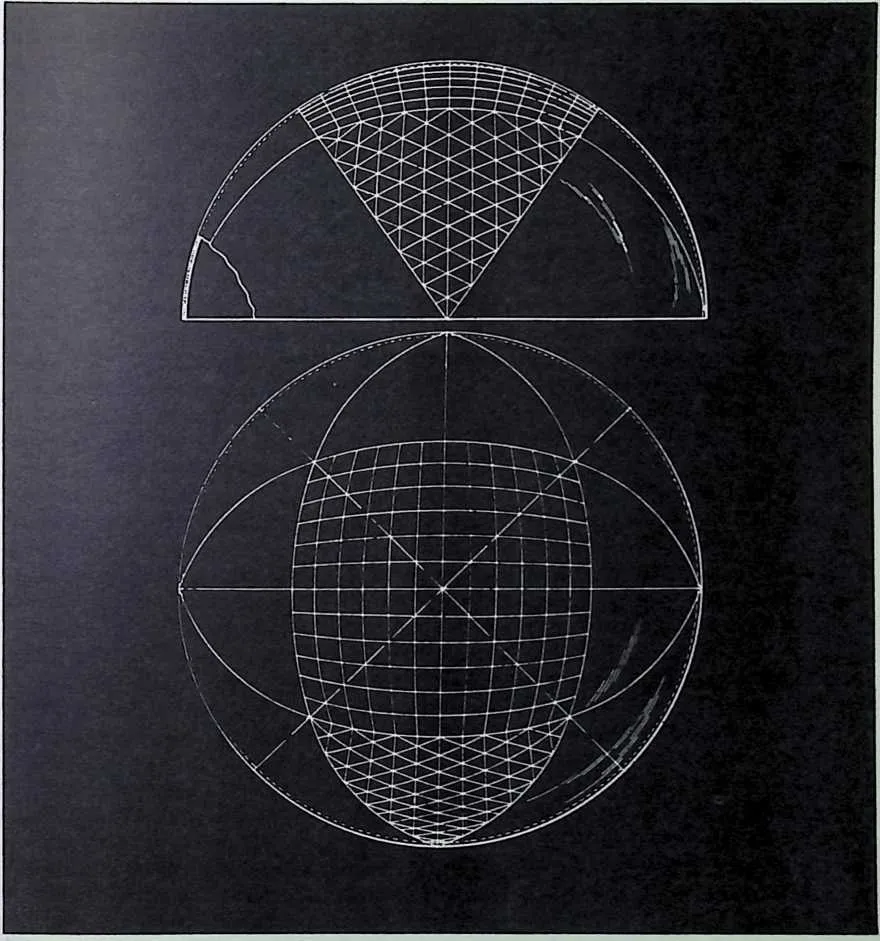
45 Symmetrical triangular systems provide the most economical energy flow, or structural, systems. Yet symmetrical triangular systems may be subdivided into sub-sets—asymmetrical triangles, each oriented to one of the three major symmetrical axes. The three sets of similar asymmetricals repeat themselves in orderly sequence around each major triangle’s center of gravity. The sum total of these asymmetricals constitute synergetic symmetry of subdivision of the major symmetrical triangles. Fuller discovered a hierarchy of ‘‘most economic’’ networks with respect to symmetrical and asymmetrical energetic omni-triangulation of systems.
46 The three equilateral triangular systems, icosahedron, octahedron, and tetrahedron, and the subdivisions of their respective triangles, can be projected outwardly upon a spherical surface. The consequence is a spherical system—a spherical icosahedron, octahedron, or tetrahedron.
47 The great circle chords, rather than the great circle arcs, between the vertexes of these spherical systems generate a structural system of maximum economy because chords are shorter than arcs. These three-chorded, symmetric, omni-triangulated systems, subdivided to any desired extent of synergetically symmetric frequency of sub-triangulation, comprise the limit set of systems of least effort providing maximum resistance to external or internal forces, both concentrated and distributed.
48 These systems, when developed, are Fuller’s Geodesic structures. In modern geometry, an arc of a great circle is called a ‘‘geodesic.’’ In physics and mathematics, more is implied. Fuller speaks of geodesics as a physico-mathematical concept of ‘‘macro-macro energy cosmos structuring.’’ The concept, sometimes attributed to Heinrich Hertz, was redefined by Riemann, and again redefined by Einstein. Its axioms are non-Euclidean. Fuller’s own definition is this: ‘‘Geodesics are the most economical momentary relationships between separate events.’’ To shoot a flying duck, a man does not aim at the duck, but where the duck is going to be. If the bullet hit the duck, its trajectory was a geodesic.
49 In geodesic systems, the higher the frequency of the triangular subdivisions, the less vulnerable is a whole system to destruction. In systems constructed with many modular subdivisions, impinging forces are swiftly distributed in the region of the impingement, and are inhibited by the succession of rings which tense around any point of pressure in the symmetrically and totally triangulated network.
50 (In June, 1959, Dr. A. Klug and Dr. J. T. Finck, of Birbeck College, London, wrote to Fuller enclosing published reports of their discovery of the icosa-geodesic structuring of the polio virus. In conversations with Fuller in London, in July, that year, they intimated that it is probable that all spherical viruses comprise geodesic arrangements of proteins in systems similar to Fuller’s frequency modulated geodesic structures.)
51 Since the Vector Equilibrium, or any other finite system, could be broken down into a basic number of tetrahedra, Fuller considered the tetrahedron to be the lowest common structural denominator of nature. His hypothesis was reinforced when Linus Pauling’s Nobel laureate treatise documented the discovery of the basic omni-tetrahedronal constellations characterizing not only all of organic chemistry, but also all of the combining patterns of metallic atoms as disclosed, thus far, by x-ray diffraction analysis.
52 An interesting confirmation of some of Fuller’s assumptions of the relation of Energetic Geometry to atomic structures was given, in 1958, by John J. Grebe, Director of Nuclear and Basic Research, Dow Chemical Company, in a paper, ‘‘A Periodic Table for Fundamental Particles,’’ delivered before the New York Academy of Sciences.
53 The mass of the various grouped subatomic particles, Grebe stated, ‘‘is highly reminiscent of a relation pointed out some years ago by R. B. Fuller in a report explaining the problem of building into a structure the maximum strength and rigidity with the minimum material. Fuller’s solution involves the equivalent of tripods or balloons placed in closely packed cubic pattern. …These models could represent the structure of the so-called elemental particles mathematically, although not necessarily physically—too little is known to say that. However, it does seem as if these successive layers are significant in the properties—particularly the slow neutron cross sections—of isotopes, from the smallest nuclear masses to those of the twenty-sixth shell, and including both lead and bismuth.’’ (Annals of the New York Academy of Sciences, Vol. 76, Sept. 15, 1958, pp. 5–6. [Cas+])
THE MATHEMATICAL BREAKTHROUGH
54One of Fuller’s most interesting mathematical breakthroughs was the discovery that in an isotropic vector matrix (a network in which all points are equidistant from each other, hence all vectors are the same length) the existing points (which are also the centers of gravity of closest-packed spheres of identical size) are connected in such a manner as to produce a symmetrical transforming series of concentric geometrical enclosures or shells around either one central point or one central void. These enclosures can be visualized as spheres within spheres, much as the universe is envisaged in Dante’s Divine Comedy.
55 Each layer discloses a pattern of points so arranged that when the points are interconnected by shortest lines, the area of the shell will be subdivided into ‘‘lots,’’ each of which is a triangle.
56 The positions of the points in the layers (shells) are entirely congruent with all the centers of gravity of all the spheres of a uniform unit size which can be closest-packed around either a common center sphere or a common symmetric void.
57 Fuller discovered that in such symmetrical vector systems, the number of points in every layer, minus 2 (the two points that, for every layer, function as the diametric poles of the layer—‘‘North’’ and ‘‘South’’) is the number of edge modules of the outer layer (shells) of the system raised to the second power, multiplied by one of the first four prime numbers (1, 2, 3, or 5), and again multiplied by 2:
58 (No. pts.—2 polar pts.)
59 = (No. outer layer edge modules)2 X (1,2, 3, 015) x 2
60 or
61 No. pts. = 2–4-[2 X (i> 2, 3, or 5) X (No. outer layer edge modules)2]
62 Fuller sometimes compares the frequency number of a system to the number of blades in a propeller. A given quantity of bronze can be patterned as one propeller with two large blades, or one propeller with 1,000 small blades.
63 Frequency, in short, is the measure of extreme modular subdivision development of a finite system.
64 When the term ‘‘frequency’’ is used in physics, its meaning is taken in just such a sense. Since energy can be neither created nor destroyed, every local event in the universe involves a local energy investment articulated at some specific frequency. The frequency number is the relative number of repeat oscillations which occur until the unit energy assigned to that event patterning is exhausted.
65 This, according to Fuller, is the schematic logic of quantum wave mechanics.
66 We have seen earlier how the closest-packing of spheres (around a center sphere) generates the contours of the figure Fuller calls the Vector Equilibrium, and how the Vector Equilibrium, when collapsed, goes through phases which form the contours of other symmetrical figures.
67 There are other ‘‘solids,’’ i.e., external symmetric patterns other than the Vector Equilibrium, which are also comprised of the same pattern of closest-packed sphere layers as is the Vector Equilibrium. However, these other superficially different systems all represent symmetric contractions or truncations of the Vector Equilibrium, or additions to the Vector Equilibrium. But only ‘‘four primary systems,’’ or ‘‘contours of symmetry,’’ can be developed by closest-packing of spheres in concentric layers.
68 The exterior contours of these are the equi-edged:
- 1.
- Tetrahedron
- 2.
- Octahedron
- 3.
- Cube
- 4.
- Vector Equilibrium
69 In each case, the number of modular subdivisions of the outer layer’s edge is regarded as the frequency of the system. (The icosahedron is excluded from this list because a concentric system of icosahedron layers cannot be formed by closest packing. All central coring must be removed or shrunken before an external icosahedron shell can be formed.)
- 1.
- Tetrahedron
70 If the superficial (external) pattern of the closest-packed spheres is the tetrahedron (4 sides), the number of exterior spheres (or points) will be:
71 2 + (2 x 1) x
72(No. outer layer edge modules)2
- 2.
- Octahedron
73 If the superficial pattern of the closest-packed spheres (points) is octahedronal (8 sides), the number of spheres in the outer layer will be:
74 2 + (2 X 2) X
75 (No. outer layer edge modules)2
- 3.
- Cube
76 If the superficial pattern is a cube (6 sides), the outer layer spheres will number: 2 + (2 X 3) X
77 (No. outer layer edge modules)2
- 4.
- Vector Equilibrium
78 If the superficial pattern is a Vector Equilibrium (14 sides), the number of spheres in the outer layer will be:
792 + (2 X 5) X
80 (No. outer layer edge modules)2
81 In all four of the above ‘‘primary systems’’ the 2 + 2 X v2 is constant and the only variables are the multiplication of the second 2 by one of the first four prime numbers 1, 2, 3, 5.
THE GENERAL STATEMENT OF POINT SYSTEM RELATIONSHIPS
82The number of spheres (or points) in any other symmetric arrangement of closest-packed spheres will always be one of the four first prime number formulas, as listed above. The only independent variable is the system frequency. All of the many symmetric forms, such as the dodecahedron (12 sides) and the tricontahedron (30 sides), will always prove to be one of the above formulas multiplied x-number of times by one of the original four primes. No new prime numbers are introduced.
83 This is to say that all omni-triangulated symmetric point systems are explicable in terms of the first four primes. This is a mathematical discovery that is significantly and uniquely Fuller’s.
84 The general statement, in algebraic notation is:
8586l-5
87 P = 2+(2XN)X(F)2
88 or, in words, ‘‘the number of points in the outer layer (shell) of any symmetrical system is 2 plus 2 times a given prime number from 1 to 5 multiplied by the system’s edge frequency to the second power.’’
89 Engineers are accustomed to think in terms of areas. Stresses on buildings are discussed in terms of the area of the surface which is involved. And surface area is computed in terms of the second power of some metric such as the radius of a sphere.
90 Fuller, however, observed that the function of area, or ‘‘surface,’’ of a system is accounted for by his formula for points. He then reasoned that inasmuch as this is the equation for the number of points in the outer layer of any symmetric energy system, the phenomenon of ‘‘second powering’’ of the exterior of the symmetric system is to be uniquely identified with the number of existing points, not with the superficial area. Tire strength of a structural shell is determinable only by the energy relationships existing between the points which configure the shell, not by the imaginary entity called ‘‘surface.’’ A surface is in essence nothing more than the exterior set of a swarm of points.
91 Fuller also observed that ‘‘solidity,’’ the cumulative sum of all the points in all of a system’s layers, is a third power of the layer frequency, corrected for the same four prime number constants.
92 (The corrections consist of the addition of polar points, multiplication by 2, and multiplication again by the constant for the collection: 1, if the collection is tetrahedronal in its overall confirmation; 2, if the collection is octahedronal; 3, if cubical; 5, if a Vector Equilibrium.)
93 Since every symmetric system contains a neutral axis, with polar points, it follows that Fuller identifies ‘‘third powering’’ specifically with a symmetric swarm of points around and in addition to a neutral axial line of points. Yet another factor is involved. To find the total number of points collectively in all a system’s layers, it is necessary to multiply the third power of the frequency by one of the first four prime numbers (times 2). Consequently, these collections disclose a fourth power characteristic of the number of points in the symmetric swarm—four dimensionality of total point population with reference to the frequency of the system.
94 A number of additional and fundamental mathematical discoveries resulted from Fuller’s special energy accounting system. He found, for example, that the number of triangular faces (facets) which occur in any omni-triangulated system is always twice the number of non-polar points, that is, of the total number of all the points, except two. It follows from this that the number of triangular faces of such systems is always even.
95 He found that the number of circumferential lines, or ‘‘surface’’ edges, of these omni-triangulated symmetric systems is always three times the number of non-polar points (all points minus 2). These constant relations of triangular facets and edges with respect to non-polar points was unknown to topology until Fuller discovered the peculiar fact that the additive twoness of systems was to be identified with the system’s poles, and had introduced into the concept of symmetrical systems the energy economy requirement of omni-triangulation.
96 Another significant discovery of Fuller’s was that although with respect to every ’1’ non-polar point in such systems there are three lines, or edges, networking the surface, there are also always three lines (which can be regarded either as tetragonal edges, or vectors) connecting the point by omni-triangulation either to the next inwardly or outwardly concentric omni-triangulated point layer.
97 It follows from this that every non-polar point in the energy universe monopolizes an inherent inventory of six energy lines.
98 Of even more significance is the fact that each of these six energy lines, impinging on every non-polarized point (‘‘focal event’’) in the universe, has a unique and symmetrical continuation beyond that point. The continuation of the lines can be regarded as negative vectors. The six positive and six negative vectors are symmetrically arrayed around the point. Consequently every point in the universe is inherently the center of a local and unique Vector Equilibrium domain, containing its 12 vertexes as the corresponding centers of 12 closest-packed spheres around a nuclear sphere.
99 Again, Fuller found that the geometrical voids between the symmetrically swarming closest-packed points take on well-known geometric configurations when the points are interconnected by lines representing the most economical relationships between the points. Because the points are omni-equidistant from one another, and because the lines represent the most economical relationships, there results an omni-directional omni-triangulation, by ‘‘omni-equi-length’’ lines. This interlacing of the points discloses hierarchies of tetrahedra, octahedra, cubes, and Vector Equilibriums. At certain layer frequency levels the many polyhedra discovered by the Greeks and later geometers occur. It is to be noted, however, that all the complex polyhedra are derivatives of the first four prime number polyhedra: tetrahedron, octahedron, cube, and.Vector Equilibrium.
100 The volumes of all polyhedra can be accounted for in terms of tetrahedra. Fuller chose the tetrahedron as a basic volumetric unit, pointing out that the identity of unit with tetrahedron permits volumetric accounting in Nature’s most economical manner. The omni-angular accommodation around one point, for example, can nest only eight cubes. In this omni-angular accommodation around one point, however, it is possible to nest the exact equivalent of 20 tetrahedra.
101 Further, the tetrahedron is contained in the other first prime number polyhedra as multiples of simple whole numbers. Thus, by Fuller’s tetrahedral metric, the volumes of the first four prime polyhedra are as follows:
102 tetrahedron 1
103 cube 3
104 octahedron 4
105 Vector Equilibrium 20
106 Because these metric values are rational (values that can be expressed as a ratio of a whole number), all the derivative, complex, symmetrical polyhedra geometries in Fuller’s system—when expressed ‘‘tetrahedronally’’ rather than ‘‘cubically’’—are rational. Nowhere in Fuller’s geometry is it necessary to introduce irrational numbers, such as or (3.14159 .-+).
107 Because the tetrahedron uses only one-third as much basic energy quanta as do cubes to account for all energy transformations, Fuller asserts, tetrahedrons are three times more economical than cubes. In structural systems, the tetrahedron uniquely articulates the prime number i, and is therefore logically to be identified as the most economic quantation unit in universal energy accounting.
108 Because all energy event experimentation has shown systematic and most-economic behavior patterning, and because all most-economic pattern systems, asymmetric as well as symmetric, are resolvable into symmetric components, Fuller believes that his comprehensive point system relationship discovery provides a rational accounting of all energy patterning of ‘‘universe.’’