
11 The Dymaxion Car
1As early as 1917, when he was at Hampton Roads, Bucky had begun to think about an aerial vehicle driven and maintained in flight by jet propulsion; he had never forgotten those white jellyfish in Penobscot Bay, which moved so smoothly and effortlessly through the water. Many evenings were spent with Pat Bellinger discussing the idea. Bellinger’s venturesome mind, far from rejecting it, had encouraged it. There was no question that it would be far more efficient than propellers, which wasted a large percentage of power through slippage. No one had even thought of a jet engine at that point. Bucky’s engine was to be fueled by liquid oxygen which when heated would expand with enormous thrust.
2 Then, in 1929, after Bucky had designed the Dymaxion house, he realized that, if its owners were to be able to live the self-contained existence in uninhabited regions which he envisioned, they would need an equally unique form of transport. So he developed his idea of the omnimedium jet-propelled streamlined, transport with inflatable-collapsible wings to permit it to travel by road, sea, or air. Explaining it to two-year-old Allegra he called it a “zoommobile.” He placed a porpoise-shaped object in the parking space under the model of the Dymaxion house to represent it.
3 In 1932 Bucky’s mind returned to the zoommobile. Since alloys that could withstand the intense heat of expanding gases in a jet motor had not yet been developed, Bucky decided to experiment with a land vehicle powered by a conventional motor.
4 Because the greatest stresses to which any aircraft is subjected occur when it makes contact with ground, his experimental model would enable him to make preliminary investigations of its ground taxiing capabilities such as its behavior in crosswinds, its stability, the effectiveness of its streamlining, and such. He made engineering drawings of this vehicle, and published them in the final issue of Shelter into which he “dumped everything.”
5 Philip Pearson of Philadelphia apparently read that copy of Shelter and was fascinated by the idea. Pearson has been described as “a very interesting, very square sort of guy who made his living sitting in a boardroom buying and selling stocks; and every day coming home a little bit richer.” Unlike most of his fellow plungers, he had judged the stock market correctly and made a fortune selling short. Sensing the precarious situation of the banks in late 1932, he converted a large sum of money into cash and stashed it in various safe-deposit boxes. There it sat, safe but neither earning interest nor growing.
6 In January, 1933, Pearson and his tweedy wife, Temple Pearson, who was a niece of Isadora Duncan, came to Bucky to discuss financing the building of a prototype Dymaxion car.
7 Like everyone else on whom Bucky turns the full force of his intellect and enthusiasm, Pearson was completely enthralled. An especially telling point Bucky made concerned the wind resistance of the conventional automobile of the era. At thirty miles an hour wind resistance made little difference, but since this effect increased at the rate of the second power progression, at sixty miles an hour the resistance to the square-shaped automobile body then in vogue was four times as great as at thirty, and continued to multiply by the square of each unit of increase in speed. As a result, at speeds over sixty, the engine was using most of its power simply to overcome the tremendous resistance and drag created by its horse-and-buggy contours. Bucky believed that his streamlining of the Dymaxion car would greatly decrease this effect with huge savings in energy and fuel—more with less.
8 Pearson was completely convinced by Bucky’s brilliant exposition of the advantages of the Dymaxion design. He immediately offered to finance the building of a prototype. However, Bucky remembered his painful experiences with the stockholders of Stockade and he was even then having trouble with the people who had helped to finance the Dymaxion house, who, despite all the publicity, had received no return on their money. He explained to Pearson that he must be completely free to work out his own ideas. “I won’t take your money,” he said, “unless there is a clause in the contract stating that if I want to spend it all buying ice cream sodas, that will be that, and there will be no questions asked.”
9 Pearson, that hard-headed businessman, was so bedazzled by Bucky that he even agreed to this strange proposition. Perhaps he thought: “This is just an inventor’s eccentricity. He doesn’t really mean it, or if he does I will find a way to exert the power of money.”
10 The seeds of later trouble lay in their different conceptions of the purpose of the prototype. Pearson thought of it as a new type of automobile, which might make him a fortune. Bucky envisioned it as the tadpole from which his omnimedium, jet-propelled 4D transport would develop.
11 Immediately the deal was concluded, Pearson gave Bucky the entire amount he figured he needed in cash. Bucky promptly formed the Dymaxion Corporation with R. Buckminster Fuller as director and chief engineer, and set out to find a place to build the prototype. In the very nadir of industrial activity that was not difficult. For a modest amount he was able to rent the big Dynometer Building of the Locomobile Company (which had recently expired), in Bridgeport, Connecticut. For his consulting engineer he persuaded Starling Burgess to join him at a comparatively small salary—“though it was pretty big for those days,” Bucky says. “He took the job because he had nothing to do at that time, and found it very exciting.”
12 Burgess bore a famous name as an aeronautical engineer and naval architect. He was an authentic genius. At the time of World War I he had designed the Burgess-Dunn airplane, which, though not used in the war, had many unusual features including the delta wing. Like Bucky, he was ahead of his time, for the delta wing did not come into its own until supersonic speeds made it necessary. Burgess’s genius was finally recognized by the presentation of the Collier Trophy, the most prestigious award in aviation.
13 In 1933, he was far better known for his superb sailing yachts. He designed the Rainbow, which defended the America’s Cup in 1930, and later designed the cup defenders Enterprise and Ranger. The latter was the last of the huge J boats to defend the cup, and without question was the fastest sloop ever built. He also designed the beautiful schooner yacht Iralita, and the popular Atlantic class yachts. He also conceived the layout of the twelve-, ten-, and eight-meter yachts.
14 The relationship that developed between these two geniuses of the Dymaxion Company was exceedingly strange. They were so much alike and so unalike. Burgess, a slight, wiry man with an unfashionably long, wax-tipped moustache, knew every millionaire yachtsman on the East Coast. He understood and profited by that deluxe racket where the shipyards were in league with the captains of the great yachts for kickbacks. It was assumed that anyone who could afford a yacht was fair game, but the owners themselves were tough characters, who knew they were being cheated, but took their revenge in arrogance. Burgess was out to make money. But, as Bucky says: “He was such a capable designer; he had an extraordinary relationship with the yachtsmen. He loved to tell fantastic stories about them, people like the Du Ponts and Vanderbilts and Astors, a few of which may have been true.”
15 Burgess loved high society and extravagant parties. He was as eccentric as Bucky but without his depth and inner stability. He was married five times, perhaps because he never found his Anne.
16 Cynical though he was, Burgess had a vision of the future. He and Bucky had great empathy, tempered by a powerful mutual distrust. Bucky learned a great deal from Starling Burgess.
17 However, the principles of the omnimedium transport, Bucky says, were entirely his own. At first Burgess told Bucky that his idea for a jet engine powerful enough to fly an aircraft without wings could not possibly work. He said, “It might work for a little over water, but you’re going to want to go over land, and it won’t work over land.” Later he changed his mind.
18 But Burgess did contribute a great deal to the technical engineering of the Dymaxion car. Bucky says: “I had a great deal of experience before meeting Starling in building prototypes, getting things going, but I had not tackled anything on quite such a high level, or going out on the highway with something dynamic that meant taking people’s lives in our hands. I had to be very sure it was safe. So I found Starling’s experience to be very, very important.
19 “Philosophically we talked a great deal about the intuitive dynamic sense. Starling was one of the first in the engineering world, I think he was the first, to go along with me on the terribly important part intuition plays in design. Everything in me, my subconscious experience, said that if you got a revelation of that sort you just grabbed it. The intuitive dynamic sense has to do with things like pole vaulting or the way a man throws a baseball. When you design something you coordinate instinctively as an athlete does. You get a personal feeling as to how, if it’s a boat, it will behave in the water.”
20 Starling agreed with Bucky about this. He told about John Hereshof, the blind brother of Nathaniel Hereshof, the great yacht designer. John Hereshof went around a hull with his fingers, feeling it all the time, and he would move his own hand through the water and thereby get an absolute sense of how this hull was going to move through the water. In this way John was able to design half-models and testing models which, when proved in the tank, were within 5 percent of perfect.
21 Burgess was also better trained as a mathematician, at that time, than Bucky; he was very good at calculus. “He would figure exactly what we would have to have in the way of forging this part or the tensile strength of that piece so that these things were not going to fail. And he would give me alternatives,” Bucky said. “We went through a great many testing models, tracking models, testing behaviors of all sorts, wind drag, crosswind effect, stability on turns, braking, and so forth, before we built the first full-sized prototype. Sometimes he would propose things I thought were extravagant, but he could persuade me they were not.
22 “In other words Starling understood what I was trying to do with my principles, and always just by his disciplines, he carried them on. That was exactly the way I wanted it.”
23 Bucky actually started building the Dymaxion car on Saturday, March 4, 1933, the day the United States went broke. That morning President Franklin D. Roosevelt ordered all the banks in the country closed and a moratorium on the payment of all obligations. Had he not, the banks would have been forced to close anyhow because of the money panic sweeping the country.
24 Bucky says: “Nobody in the country had any money, and I, having gone from the poorest guy in the world, had all this cash given me to do anything I liked with—the ice cream soda deal. And I could have anything I wanted.”
25 What Bucky wanted was the best mechanics in the world and he got them. Rolls-Royce had started an American factory in Hartford, which they had just closed down because of the depression. They had sent over their best mechanics to man it, and these men were out of a job. Bucky’s advertisement for skilled mechanics produced over a thousand applicants for twenty-seven jobs. He tried to select those most in need. If two applicants were equally good, he chose the one with a wife and children to support. Later he decided this had been a mistake. The heads of his body shop were two men Rolls-Royce had sent over to make certain the American bodies were up to their high standards. Bucky also was able to purchase secondhand machinery at bottom prices.
27 The car was built in a secret room they made in the factory, boarded off and guarded. One of the things Burgess taught Bucky, which became a guiding principle with him, was, in Burgess’s words: “Never show people botch work. Don’t ever demonstrate a principle in inadequate materials. If you get up an old beer can that has your principle embodied in it but is hammered out of tin, people will call it a jalopy.”
28 Burgess was so insistent on this principle that every day as a piece of work was completed it was polished or painted so that it would look like the finished product, and the room was kept as immaculate as a showroom of General Motors. Bucky says: “Those Rolls-Royce bodymakers were wonderful. I don’t think anybody ever turned out more elegant work.
29 “In this way Starling made people really respect his work, the people who were building it, and the owners and everyone who was allowed to see it. This procedure in the plant was very expensive, but it made it so exciting for everybody that they felt everything must be done in the best way man knew how to do it. You were working in the championship beat and on the championship device. Starling said, ‘If you don’t do it right, you have no right to do it at all.’ ”
30 Not everything went as smoothly between the geniuses as this may sound. There were many flare-ups of temperament and clashes of ego. One thing that irritated Bucky was that on the sign in front of the plant Starling had his name painted beside Bucky’s in equally large letters as though they were equal partners. “He was really my employee,” Bucky says. “It shows his very great ego, but I did not make an issue of it.”
31 To some extent this statement shows Bucky’s sensitive ego. Though in future years his name will be remembered when Burgess’s is a small-type footnote, at that time Burgess was far better known than he.
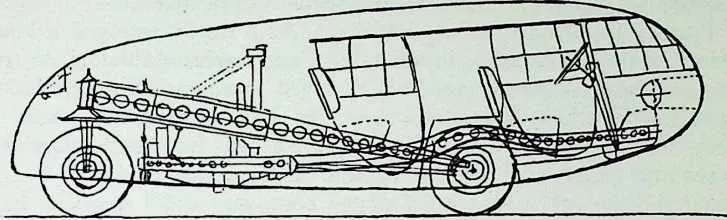
32 Rapidly the Dymaxion car took shape. As it finally emerged it was, indeed, a notable advance in automotive engineering. Mounted on triangular chrome-molybdenum frames hinged to each other, the aluminum, teardrop body was aerodynamically sound even to its fish-form belly which enclosed all the running gear, usually exposed, except the lower half of the three wheels. By this means mudguards were eliminated and the entire road width of the body was useful space. It had front-wheel drive with a single wheel in back by which it steered. There were “air nostrils” in front by which the car was air-cooled by the current of air flowing over dry ice. Headlights were recessed. Its multihinged multisprung frame made it ride smoothly even over a rough field.
33 Powered by a Ford V-8 90 hp engine mounted in the rear, driving the differentially-coupled front wheels, it attained a speed of 120 miles per hour, which in the conventional 1933 sedan would have required a 300 hp engine. Some of these innovations were not introduced in American automobiles for twenty years. Many of them never have been.
34 If there was a criticism of the car, it could be directed at the rearwheel steering. Bucky was enthusiastic about it, because boats and airplanes are steered by a rear rudder; but rudders work against pressure whereas the single wheel had only contact with the road, which was less effective. But it had great advantages. In parking you had only to put the nose of the car against the curb, turn the wheel hard left and reverse, and the tail came right in. The Dymaxion car could park in a space four feet shorter than that required by a conventional car of the same length. It could also make a 360-degree turn in its own length. To this day Bucky valiantly defends rear steering. However, in a car he designed much later for Henry Kaiser, he combined the advantages of both systems. The Kaiser car steered with the front wheels. The rear wheel was locked, but could be unlocked and used for parking and other maneuvers.
35 When the Dymaxion car was shown to the public on July 12, 1933, it created a tremendous sensation. Bucky’s name was in all the headlines. Crowds gathered wherever it went, causing such horrible traffic jams that Bucky was politely, even tearfully, requested not to use it at rush hours. Riding in it was a delightful sensation. No matter how rough the road it seemed to float effortlessly over the ground at tremendous speed. Seated in the rounded front with shatterproof glass all around, one had unimpeded vision. There were periscopes for excellent rear vision.
36 Bucky had enormous fun with the Dymaxion. Once, when he was showing it off to a group of New Yorker and Fortune editors, a traffic officer at 57th Street and Fifth Avenue stopped all traffic and said, “What the hell is that?”
37 While Bucky explained it through an open window, he rotated the car in a tight circle around the bemused cop. The officer at 56th Street saw the show and, when Bucky reached him, he insisted on a repeat performance. This happened all the way down Fifth Avenue to 34th Street. It took an hour to go that long mile. All of which may have been the inspiration for the New Yorker cartoon of two men in a very streamlined car stuck in traffic with the caption, “Anyhow, we’ve got wind resistance licked.”
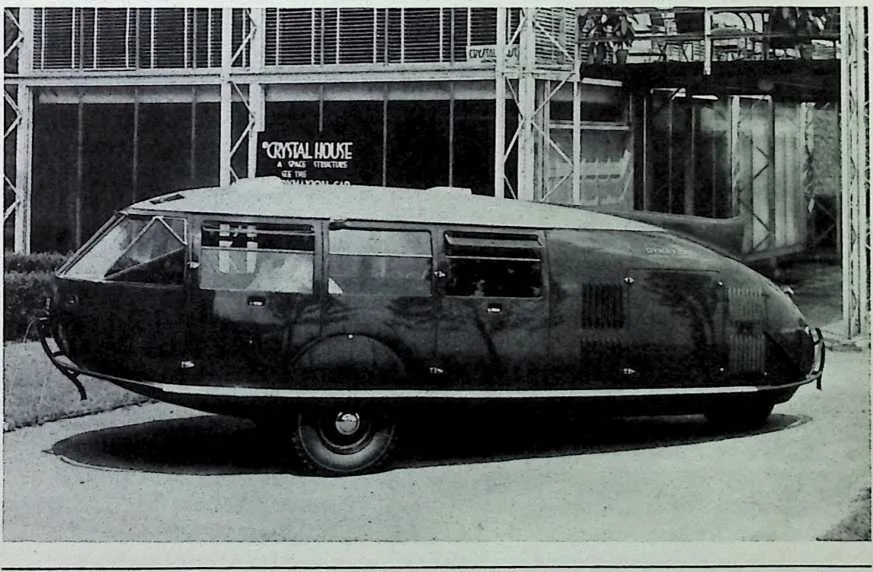
39 Bucky was invited to exhibit the Dymaxion car at the 1934 Automobile Show in the Grand Central Palace. Then the Chrysler Corporation, which was about to come out with a half-breed, extremely ugly car called the “air flow” model, forced the officials to withdraw the invitation, fearing a really streamlined car would make theirs look silly. Bucky, not to be rejected lightly, drove his car slowly around and around and around that block, while crowds watched him. Finally, sympathetic Police Commissioner General Ryan gave Bucky permission to park in front of the Grand Central Palace. So, in spite of Chrysler, he stole the show.
40 Bucky had intended to build only one prototype. However, pressures built up on him. Neither Burgess nor the Pearsons were happy about stopping production. But the strongest pressure came from the skilled mechanics. They came to Bucky, some of them actually weeping, and begged him not to close down and throw them out of work. They also instituted a slowdown. “So in order to get my first car finished,” Bucky says, “I had to start a second one. And in order to get that one done, I started a third.”
41 The truth is that Bucky was too softhearted to close down. Secure in the “ice cream clause,” he would have defied Burgess and the Pearsons, and later did; but he could not stand against the pleas of those men who depended on him for a livelihood.
42 While the second car was being built, another enterprise took shape in the Dymaxion plant. Burgess had drawn up the plans for a small, ocean-racing sloop about forty feet long, which he hoped might become the prototype of a “Bermuda Class.” He was desperately anxious to build her. There was plenty of spare room in the big Dymaxion factory, but no money. Bucky talked Pearson into financing it, and work was begun.
43 When completed she was a beautiful little boat with sleek, racing lines, a towering mast, and superbly cut sails; the craftsmanship of her hull was “exquisite.” Though she belonged to Pearson and was designed by Burgess, she temporarily became Bucky’s boat by the same process of osmosis by which he had acquired the Lathrop engine from Mr. Lamb of Camden. He named her the Little Dipper. At precisely the same time his sister Rosey on Bear Island was calling a new boat Jim Hardie had built for her the Little Dipper. Bucky’s system of telepathy was communicating with remarkable precision.
44 Bucky loved the Little Dipper more than any boat he ever had until he acquired the Morgan-built sloop Intuition in 1967. He proposed to race her in the first long race of the season, the Overnight Race in Long Island Sound. Typically, he manned her with an almost all-Hewlett crew consisting of Carmen Hewlett, Arthur Hewlett, Roger Hewlett, and their close friend, Gilbert Stearns. The Hewlett boys were all good small boat sailors, but had no experience in larger craft. Gee Stearns was a first-class sailor in any size boat; but none of them, including Bucky, had had a chance to learn the special characteristics of this brand-new boat.
45 The race was sailed in a twenty-knot wind. As Bucky has often said, anything he does he does thoroughly. In this case, thoroughly meant taking the Little Dipper over the starting line flying every stitch of canvas she owned. Since she was, if anything, oversparred, it was a slightly terrifying experience for his crew. When the sun went down, the wind, instead of dropping, increased. Little Dipper labored through the darkness continually knocked down, “scuppers under,” by the half gale. Not from fear, but from common sense, the crew protested that she would make more speed if Bucky shortened sail. But that was not his all-or-nothing way of sailing a race. Let the mast go if it must, the new sails be torn to ribbons, Bucky would drive her like a China clipper running her easting down.
46 Finally, Carmen Hewlett protested in language Bucky felt no skipper should permit. In the authentic tones of Captain Bligh, he said to his brother-in-law, “Carmen, go below and consider yourself in irons for the rest of the voyage.”
47 All the yachting world was watching the performance of Starling Burgess’s new boat. Unfortunately, it was not distinguished. A brand-new boat and an unfamiliar crew weighted the odds too heavily even for a hard-driving old salt like Bucky. Little Dipper finished back in the ruck. This did nothing to endear Bucky to Pearson and Burgess, who had hoped to profit financially by a brilliant coup.
48 However, Bucky had other finer voyages on Little Dipper. In 1936, she was sold to Elihu Root.
49 The first Dymaxion car was purchased by Captain Alford F. (Al) Williams, holder of the world speed record for planes. An English syndicate was interested in buying Dymaxion Number 2, which was still being built. In 1933, they sent Colonel William Forbes-Sempill, an English aeronautical authority, over to report on the performance of the Dymaxion car.
50 The dashing colonel arrived on the Graf Zeppelin, which on that voyage went to the Chicago World’s Fair. Al Williams put his Dymaxion at Forbes-Sempill’s disposal and Turner, a race driver, drove it from Detroit to Chicago. Later Bucky drove Dymaxion 3 over the same route, breaking the record between those two cities.
51 Then came one of the strokes of incredibly bad luck which Bucky seemed to attract in those early years. Forbes-Sempill was being driven to the airport in the Dymaxion by Turner, when a car belonging to a South Chicago parks commissioner came alongside and apparently challenged it to race. Off they went at seventy miles an hour, dodging traffic through the crowded streets. The inevitable happened. The commissioner’s car hit the tail of the Dymaxion, sending it rolling over. The driver was killed and Forbes-Sempill badly injured.
52 This was bad enough from a public relations point of view, but worse followed. By the time reporters and police arrived on the scene the commissioner’s car had been spirited away. The reporters saw only the bloodied hulk of the Dymaxion. As a result the headlines read: “dymaxion car kills driver”.
53 The New York Times report stated: “The machine skidded, turned turtle and rolled over several times. Police say it apparently struck a ‘wave’ in the road.”
54 The coroner’s inquest, held thirty days later when Forbes-Sempill was sufficiently recovered to testify, brought out the truth, but by that time nobody was interested; it was back-page news. The public continued to believe that the Dymaxion car was dangerous.
55 Bucky and Al Williams conducted their own careful investigation which confirmed their opinion that there were no design or mechanical failures involved. The car was rebuilt and Williams continued to drive it until he sold it to the director of the Automotive Division of the United States Bureau of Standards.
56 The English syndicate wanted no more to do with Dymaxion cars, so Bucky eventually sold Dymaxion Number 2, which was finished in January, 1934, to a group of his mechanics. Dymaxion Number 3 was purchased by Johnson and Johnson heiress Evangeline Johnson Stokowski, wife of conductor Leopold Stokowski. It was exhibited at the Chicago World’s Fair in 1934, and after passing through many hands turned up in Wichita, Kansas, in 1946, when Bucky was there building his second Dymaxion house for Beech Aircraft.
57 Despite the temporary burst of bad publicity, Bucky could have gone on producing Dymaxion cars and selling them indefinitely. But as usual, when he had proved a principle, he had no interest in making money. For years people infuriated him by saying, “Too bad the Dymaxion car was a failure,” to which he irately replied, “It was not a failure. It was a resounding success in proving my principles and teaching me what I wanted to learn from it.” He had no interest in becoming a minor Henry Ford.
58 When Bucky tried to close down the factory he ran into difficulties. Some of his workers took it hard, and windows in the factory were smashed at night. In addition, money was slow in coming in. Pearson’s original stake had been used up, and Bucky had been financing it himself. His mother died in 1934. At least she had lived to see the Dymaxion car and to hear her son acclaimed a genius. Bucky was using his inheritance from her to finance car Number 3. But he had difficulty getting the trustees, Woolly and the bank, to sell shares of stock and turn the money over to him. He blamed them, thinking they were slow for their own convenience or that the bank wanted “to manipulate the market.” In all probability they were trying to protect him from himself.
59 In any event, though Bucky was solvent, some bills were overdue. One day the sheriff came to his office to see him about a bill from a lumber company. Bucky explained the whole situation to him, and his anxiety to close down.
60 The sheriff was most understanding. He said: “I see what’s going on. You’ll never be able to close up while you are here. The only way you can get it done is if you would be willing to go away and leave it in my hands. I’ll sell your machinery, pay your bills, and close it up for you, and this way you will not go bust.”
61 Bucky accepted his offer and left. He says: “I made up my mind that never again would I be responsible for the lives of men who were working on prototypes, because I saw their fear of losing their jobs. When this fear entered the equation it wrecked your capabilities. That sheriff saved me.”
62 But there was an awful row with Burgess and the Pearsons. They believed in the car, believed that it could be a moneymaking thing, and blamed Bucky bitterly for closing down. It was the same sort of bitterness that had been engendered by Bucky’s idealistic indifference to making money in his other companies; and would happen again. He never understood it, never will; for he did things solely for the sake of the doing and even naively expected his backers to share his point of view. He would tell them his position frankly, but they would not believe him; they were incapable of believing that a man could turn his back on a fortune and walk away.
63 Eventually, when Bucky got his full inheritance from Mrs. Fuller, he used it to pay back all the investors in his company. But even that did little to assuage their bitterness. They thought angrily of the profits that might have been.
64 As for Bucky, he was back just where he had always been. Virtually his entire inheritance had been used up. He was, as usual, flat broke.