
18 Grand Strategy
1The fact that Bucky, advocate extraordinary of industrialization, is also fervent for ecology superficially seems to be another of his paradoxes. It is not. For his kind of industrialization is based on ephemeralization and recycling. By doing more with less he would conserve the resources of Spaceship Earth and virtually eliminate pollution.
2 Bucky defines industrialization as “the extra-corporeal, organic metabolic regeneration of humanity.” It consists of tools, specifically tools which are too complex to be made by a single individual, and which give man additional advantages in nature. These include words, tools which obviously require two or more people. “Industrialization is inherently comprehensive and omni-related to all humanity and all of humanity’s ecological environment.” 1
3 The second law of thermodynamics states that all systems are radiating energy; they are entropic. But, since energy can neither be created nor destroyed, a balance must be struck somewhere in a finite though ever-expanding universe. The opposite of entropy is syntropy,1 a gathering in, ordering, and consolidation of energy. Fortunately, our dark planet is strong on syntropy. Earth’s own particular radiant energy star, the sun, is its prime source of energy. In addition billions of stars are giving off energy and a not inconsiderable portion of this reaches earth. Finally, earth picks up about 100,000 tons of stardust a year, and stardust is the intraverted concentrate of cosmic radiation because, according to Einstein, radiation and matter are behavioral states of the same phenomenon and have eternally regenerative terminal intransformabilities. Ergo, energy is powering into Spaceship Earth, if we only use it properly. As Bucky said at Black Mountain, “Man has now completed all the plumbing and installed all the valves to turn on the infinite cosmic wealth.”
- 1.
- “Letter to Doxiadis.” Buckminster Fuller, Main Currents in Modern Thought,. March—April 1969.
4 In the course of Bucky’s researches he has come up with some curious and startling statistics concerning our wasteful misuse of earth’s resources. Take petroleum. By careful calculation he found that the amount of energy required to make one gallon of petroleum figured at the current price per kilowatt hour of electricity would cost roughly $1,000,000. At that rate one shudders to think of the cost of running one automobile for one day.
5 In order to dramatize our wastefulness Bucky sometimes cheats a little. A favorite saying of his is that at any given hour of the day in the United States 2,000,000 automobiles are stopped at red lights with their one hundred horsepower engines running, and, he adds, “This is the equivalent of 200,000,000 horses jumping up and down going nowhere.”
6 The fallacy lies in the fact that the idling engines are only putting out about one horsepower, so it is 2,000,000 horses jumping up and down, not 200,000,000. That is still a lot of horses.
7 Other discoveries of Bucky’s are that the amount of sulfur belched out of industrial chimneys in a year to pollute the atmosphere almost exactly equals the amount of sulfur taken from the ground for industrial purposes; that the amount of tin lying around above-ground in the United States is greater than all the tin left in all the known tin mines of the world; that the Bell Telephone system has enough copper in its obsolescent equipment to enable it, with its current excellent policy of ephemeralization, to supply all its ever-increasing system for the foreseeable future. The point is that his kind of industrialization would mean infinitely less pollution and waste. A balance could be struck with nature that could keep Spaceship Earth going full blast virtually forever.
8 Another telling point Bucky makes—and proves with statistics—is that in fully industrialized countries the birthrate automatically drops to about zero population growth. Therefore, he argues, if all the underdeveloped countries were fully industrialized, as they could be by intelligent use of the world’s resources without taking anything away from the “have countries,” the problem of overpopulation would simply disappear. Margaret Mead does not like his saying this; it undercuts her.
9 These are but a few of the reasons for Bucky’s optimism about the ultimate success of humanity as a function of Universe; that function, as before noted, being syntropic, i.e., to produce order in an entropic system in accordance with the generalized principles which can be discovered by exercising God-given metaphysical intellects. Where he fails most dismally is in his plan for implementing these resplendent possibilities, in other words, the political system by which they can be brought to fruition.
10 Bucky would snort furiously at that; he considers politics a dirty word. For he does not realize that running any system, be it a government, an industry, or only a large farm, involves politics, if you accept the definition of politics as being the art or science of government. One of his favorite sayings is that if all the technicians and the machinery they operate were suddenly to be lost to the world at least two billion people would starve to death within six months. Whereas if all the politicians were shipped out in a very slow rocket to Jupiter, six months later the inhabitants of the world would probably be eating better than they do now. The catch is that the technicians would have had to metamorphose into politicians.
11 Bucky’s plans for bringing about the happy circumstances he envisions are far less well thought out than his coordinates of the Universe. In one article he proposes that all the young architects of the world get together in an association to see to it that obsolescent methods of building are replaced by modem ephemeralization techniques. The il-logic of this is evident when it is noted that Bucky has been fighting the architectural establishment all his life. Seeing their attitude toward his new approach, one boggles at the idea of a world run by a bureaucracy of architects.
12 At other times he states that when the peoples of the world are educated enough to realize that there would be plenty for all in a properly managed economy, they will force the politicians to turn matters over to the technicians who can do it. This still leaves the question of which technicians are going to make the decisions. Since they will indubitably differ violently among themselves, there has to be a person or committee to decide what is best to be done. And that is politics.
13 Another Bucky proposal—in the World Game—is to let computers make all the decisions, thus doing away with personal politics. But who is empowered to program the computers, which also can be made to speak with forked tongue?
14 Bucky’s grand final solution is a form of instant democracy that would make the great protagonist of power to the people, Thomas Jefferson, revolve so violently in his grave as to produce an earthquake effect of 8.5 on the Richter scale and knock the University of Virginia flat. Instead of national citizenship, there would be world citizenship. Very good; with luck we may come to that. But he then proposes to hook every world citizen up to a giant computer by means of television. All great questions of world concern would be referred to the entire world electorate whose votes would instantly be recorded and tabulated. Bucky’s faith in the innate wisdom and goodwill of humankind is so great that he believes they would make the right decision every time if they were properly informed without being misled by politicians.
15 That is the rub. Even though all the necessary information were fully available to every man—and woman—in Bucky’s electronic utopia, how could he induce them to study, ponder, and vote upon it? Human nature being what it is, and people being as intellectually lazy as they are—even in the comparatively well-educated United States only about 65% of the electorate will stir their stumps to vote in a national election —why would the well-fed, well-cared for, lack-nothing people of his 99.95% perfect world bother even to push the right button?
16 It is Bucky’s sublime faith in people that makes him so naive in this area. In his moments of humility—and he has them in spite of what has been called his “delightfully unselfconscious egotism”—he says: “I am not a genius. I am a very average human being. What I have done any ordinary person can do. It is just because I am so average that I am a good example, a sort of norm of the potential in every newborn child.”
17 Freed from fear of scarcity, with their longings assuaged by the rich opportunities that could be theirs, Bucky believes that people would develop all the sensitivities, the compassion, the wisdom and, yes, the love, which are his unique qualities. “Reform the environment,” he says, “and human nature will do the rest.”
18 One is reminded of Jean-Jacques Rousseau’s Natural Man, and of truly idealistic Marxist doctrine that after the triumph of the proletariat was assured, the state would wither away. And one wonders…
19 Though Bucky was so vigorously disseminating his philosophy with such a truly horrific schedule of toing and froing as would make the average man (as he thinks he is) collapse from sheer fatigue after no more than a week of it, he continued to pour out inventions for improving the environment and carrying out the design of Universe as revealed by his prescient intuitions.
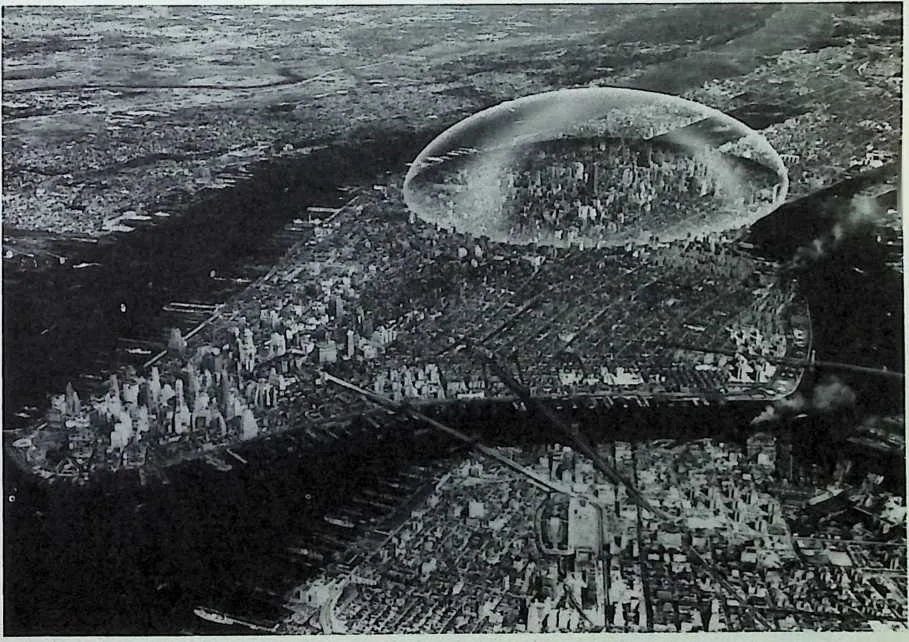
20 One thing that he proposed and designed was a dome to go over an entire city, specifically the midtown part of New York from 64th Street to 22nd Street and from the Hudson to the East River. This was not as wild a flight of science-fiction as might be supposed. Bucky calculates that such a dome would reduce the energy loss of Manhattan approximately fifty-fold. This is because a sphere encloses so much more volume for each square foot of its surface than any other structure. The towers and other buildings of Manhattan are like the fins on an air-cooled engine, radiating heat, whereas the exposed heat-radiating surface of the dome would be only 1/85 of that. Conversely, in hot weather the dome would have much less heat absorption. Heating the surface of the great dome in winter would melt the snow. Melted snow and rain would run into huge gutters around it and be piped to reservoirs in Westchester instead of being wasted. Bucky calculates that the savings to the city in snow removal costs alone would pay for the dome in ten years.
21 He envisages a dome two miles in diameter and one mile high at its apex. Its skin would consist of wire-reinforced, one-way-vision, shatterproof glass, mist-plated with aluminum to cut sun glare while admitting light. From the outside it would look like a great glittering hemispheric mirror, while from the inside its structural elements would be as invisible as the wires of a screened porch, and it would “appear as a translucent film through which the sky, clouds and stars would appear.”2
22 The circular lower rim of the dome would be mounted just below the tops of New York’s tallest towers. In such a large dome the weight of the enclosed atmosphere would be almost equal to the weight of the structure with a differential of only 1/1,000. If the interior atmosphere were heated only one degree warmer than the outside air, the thing would actually float against its restraining cables like a hot air balloon. It would be far less costly to air-condition the entire city than it is to heat or cool individual buildings.
23 Bucky becomes poetic as he describes life in such a city. “Those who are familiar with the delights of covered city streets, in which outdoor restaurants and exhibits are practical (as in the great arcades of Milan), can envision the effect of a domed-over city, where windows may be open the year ‘round and gardens bloom in the dust-free atmosphere.”3
24 It was seriously proposed to put a similar dome over the New York World’s Fair of 1964. Pity it fell through! The perfect weather inside might have made the fair a success instead of the dismal failure it was. And the effect would have been great.
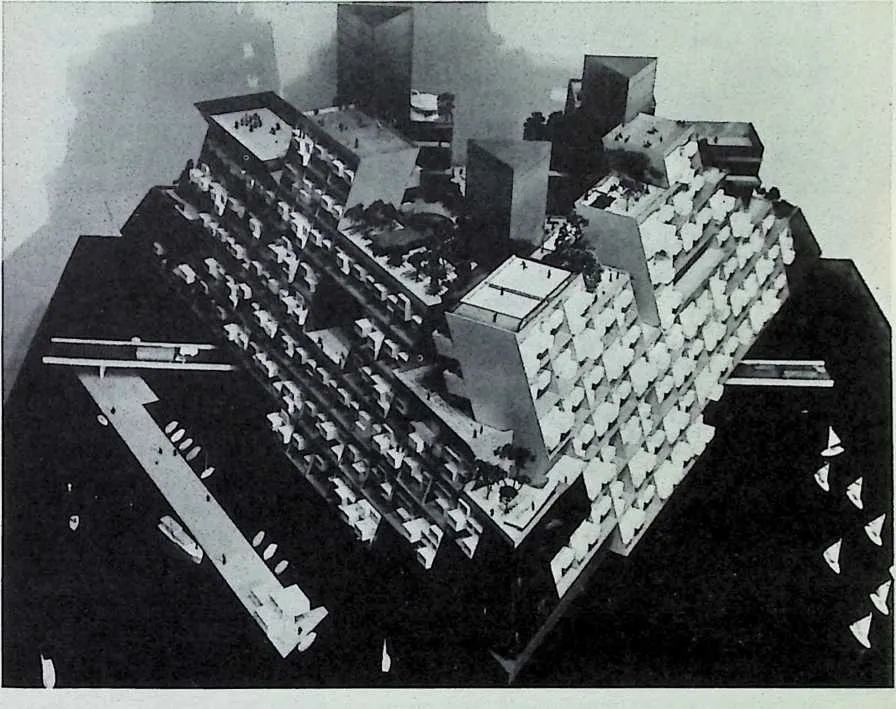
25 Another Bucky design for the almost perfect city is a huge, hollow tetrahedronal building like a latticed pyramid two hundred stories high capable of housing 1,000,000 people or 300,000 families, each of which would have a 2,000 square foot terraced apartment, with an additional 1,000 square feet for a garden. It would be, in effect, an open-truss-framework structured mountain whose sides would be covered with parked mobile homes. The interior would contain all the necessary machinery as well as vertical and horizontal transportation systems.
27 Because Bucky considers the ownership of land a feudal relic, stultifying to the owner because it ties him down when he should be completely mobile, and unfair to the vast majority of landless people, his almost perfect city would float on the ownerless sea. Its pyramidal apex would be 8,500 feet high and its three base edges would be two miles long. Because of its tetrahedronal structure it would be so relatively light that its hollow, box-sectioned, reinforced concrete foundations would float it easily. The city could be moored in triangularly patterned canals or anchored in the ocean at any point. It would be earthquake-proof and, because the hundred-foot depth of the foundations would be far below the turbulence level of the waves, “it would be a floating atoll with a harbor that is always calm and protected.” 45 required. Such cities would permit new habitation possibilities on the watery three-quarters of the earth’s surface.
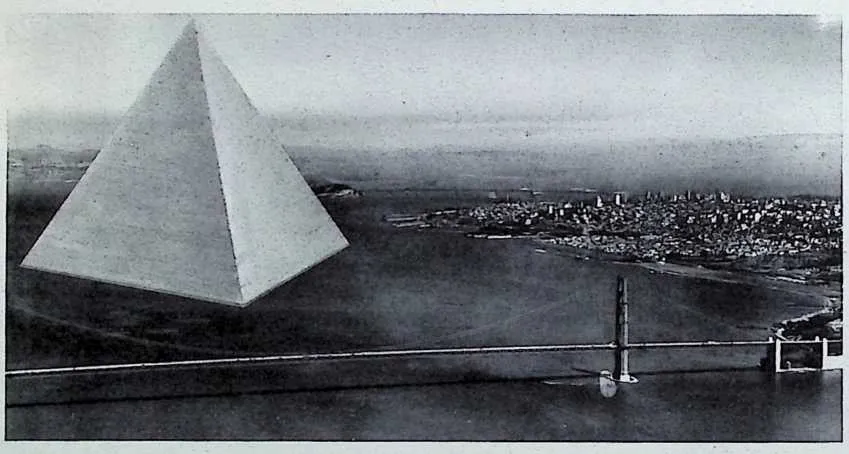
30 In 1967, Bucky became president of the Triton Foundation and chief architect for the production of the Tetrahedronal Floating City for the U.S. Department of Housing and Urban Development. However, changes in government policy aborted the project.
32 Some of Bucky’s most inspiring experiences during the 1960s were the annual Doxiadis cruises. They were sponsored by that remarkable Greek ekisticist—planner of cities—Constantine Doxiadis, as floating symposia for men and women of international fame and highly intelligent, farsighted people of goodwill. They included representatives of many disciplines and vocations: philosophers, writers, teachers, planners, industrialists, scientists, and even politicians. They all boarded a ship at Piraeus, the port of Athens, and sailed around the Aegean Sea visiting one or more of the historic Grecian islands every day. Aboard the ship there would be morning and evening lectures by different eminent men and women, followed by group discussions of how this or that world problem could best be solved or, at least, mitigated. It was Doxiadis’s idea that the ambient atmosphere of glorious ancient Greece would inspire creative thought and intellectual harmony. And it did.
33 Bucky was at his best giving and hearing the lectures, but not so good in the round table discussions. His inability to take part in the rapid give-and-take of group discussions has often been written of as an example of his supreme egocentricity. The difficulty has a physical explanation—he can’t hear them.
34 Even as a young man, Bucky was somewhat deaf; as he grew older this malfunction became ever greater. Fortunately for him, as his deafness increased, so did the power of hearing aids which are now, with the use of transistors, exquisite examples of ephemeralization. With them he can hear any single voice—a man lecturing or someone conversing alone with him. However, the babble of many voices makes the tiny machines in his ears screech in a way that is pure torture. Ergo, his blank or pained expression during a general conversation.
35 Anne went with Bucky on several of the Doxiadis cruises, including the last one, called the Delos Symposium, in July, 1972. The theme of this symposium was “Action for Human Development”—a topic exactly suited to bring out Bucky’s most stimulating ideas.
36 Norman Cousins gave a very amusing, highly typical description of Bucky on another trip, which he had from his close friend James Perkins.* On a certain day, Bucky gave an afternoon presentation. Cousins says: “Then they adjourned for dinner, but Bucky kept right on talking, not eating himself, and resumed in the saloon after dinner. Then he walked with the individual participants to their cabins. Finally he ended up with Doxiadis and Jim Perkins in the former’s cabin long after midnight.
37 “As it was described to me, Perkins and Doxiadis, totally exhausted, looked at this man, who by now had been on this talking marathon for nine hours. You can picture it—Doxiadis getting undressed, Jim * President of Cornell University.
38 Perkins slumped down in a chair, and Bucky sounding off his thoughts, exhilarated, fresh, energetic. And there was no doubt in either Doxi-adis’s or Perkins’s minds that he could have kept on through the entire night, and he would still be fresh.
39 “What Bucky demonstrates to me in all this,” Cousins said, “is that the key to longevity is creativity; the notion of degeneration of brain cells beyond a certain age is true only in the absence of creativity. Bucky, at seventy-seven, is proof of the theory that there is a limitless reservoir of potential intellectual activity that we carry around with us and most people in the course of a lifetime put only five or ten percent of it to work.
40 “Bucky still has a reservoir full and he’s still using it. And this may be the most important discovery of all those he has made.
41 “It seems to me that there is a direct connection between creative thought and involvement in life and the production of epinephrine by the adrenal gland. When the challenge stops, the supply is turned off; the will to live atrophies and the body chemistry no longer functions…Doctors are important merely as pain killers. Disease is combated by will. The proper prescriptions are written by the body itself, but only in the condition of balance and a state of grace. I’ve never known Bucky not to be in the state of grace.”6
42 An earlier cruise had inspired Bucky to write a letter to Doxiadis in which he set forth what he calls his basic concepts of making man function as Universe intends. Woodrow Wilson had his Fourteen Points; Bucky has fourteen concepts. They are:
43 Concept one: Universe
44 Bucky always starts with Universe. This is his definition of it: “Universe is the aggregate of all humanity’s all time consciously apprehended and communicated experiences.”
45 Concept two: Humanity
46 The human is not an accidental onlooker “who happened in on the ‘Play of Life,’ but an essential syntropic function of Universe.”
47 Concept three: Children
48 “Focus on new life. Since children are the hope of the future and 98% of the environment’s positive or negative effects upon new life are wrought by age thirteen, it is obvious that effective work in advantaging life through environment can mainly be realized within the first thirteen years.”
49 Concept four: Teleology
50 Teleology by Bucky’s definition means “the intuitive conversion by brain and mind of special case, subjective experiences into generalized principles…which permit the individual to reform the environment …so as to provide ultimately higher advantages for men,” and to inspire others to do likewise.
51 Concept five: Reform the Environment, Not Man
52 Bucky’s philosophy and strategy confine design initiative to reforming only the environment and never to emulate the almost universal attempts of humans to reform and restrain other humans by political actions, laws, and codes.
53 Concept six: General Systems Theory
54 Using the generalized principles he has discovered, Bucky says, “I always start all problem-solving with Universe, and thereafter subdivide progressively to identify a special local problem within the total of problems.” He thus attacks it comprehensively and anticipatorily.
55 Concept seven: Industrialization
56 “Industrialization consists of tools.” It involves “all experiences of all men everywhere in history.” Bucky sees it as inherently comprehensive and omni-interrelated in respect to all humanity. And he believes that, though subsystems of it are run shortsightedly by selfishly motivated people, the whole works inadvertently toward ultimately providing all men with higher standards of living…Because energy plus know-how is wealth, “the integrating world industrial networks mean ultimate access of all humanity to the total operative commonwealth of Earth.”
57 Concept eight: Design Science
58 Design Science is concerned “with the scheduling of the complex interaction of the general systems events of industrialization.” The rapid advance of technology in one field—air transportation, for example—must be “comprehensively integrated with all other vastly accelerating environment relationship transformations.”
59 Concept nine: The Service Industry
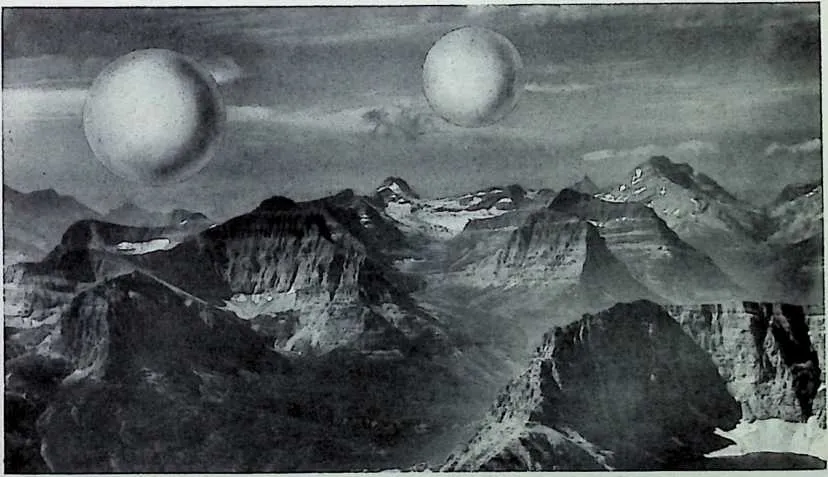
60 “Humanity is gradually trending toward becoming Worldians.” Therefore, the static appurtenances of life—houses, automobiles, even typewriters—will all be rented like telephones because of man’s increasing mobility. Amplifying this thought in another article, Bucky foresees man’s ability to deploy at will all over the earth and the solar system by means of autonomous structures made livable by our astronauts’ life-support ‘black box.’ ” And he adds, “Quite clearly, man, free to enjoy all of his planets…will also be swiftly outward bound to occupy ever greater ranges of the universe.” 8
61 Concept ten: Ephemeralization
62 “The acceleration of doing more with less…will complete the task of providing enough for all humanity within another thirty-four years…despite political systems that deliberately divide society and set one group against another.” Bucky believes that without the interference of political systems it could be done in twenty years.
63 Concept eleven: Prime Design Initiative
64 Bucky believes that it is essential for the individual, invention-developing pioneer to maintain his economic initiative and not get tied up with the massive capital-cum-bureaucracy of large corporations, despite the leverage of their wealth.
65 Concept twelve: Self-Discipline
66 Instead of the obligation to make a living, Bucky substitutes the higher obligation of the individual’s syntropic responsibility in Universe.
- 6.
- Playboy, February, 1968.
68 Concept thirteen: Comprehensive Coordination
69 Comprehensivity instead of specialization is Bucky’s key to successful design competence. His foremost self-discipline is never to try to sell one of his ideas to others. He will just design and test it, and wait for others, who need it, to come to him. He only goes where he is asked to speak because, if you force your ideas on people they listen unwillingly, but if they ask you to speak to them—especially if they pay a high fee—“they are very receptive.”
70 Bucky incessantly engages in trying to make all his previous inventions obsolete by designing better ones.
71 Concept fourteen: World Community and Its Subcommunities
72 Bucky divides the ecological history of the human race into two chapters. The first chapter of a million years or so saw the scattering of humanity from its point of origin—Indonesia, he thinks—all over the earth into tribal units that became differentiated by various climatic conditions as regards pigmentation of skin, general appearance, etc. The second chapter—the last ten thousand years—saw these different tribes migrating toward each other and gradually eliminating the differences by crossbreeding. Thus we are now becoming genetically integrated—one race in one world. He believes that chapter three is just beginning, in which world man will realize his potential for success as a function of Universe through his accelerating mastery of “vast, inanimate, inexhaustible energy sources combined with doing more with less.”
73 Bucky thinks that the United States, as “the theater of crossbred world man,” best discloses the patterns coming upon all men; the patterns of total mobility. “The swift evolutionary changes taking place invisibly are about to uproot [man]. …All concepts of urbanization will become obsolete; only the Earth and the solar system will be his temporary home.”
74 The “world shuttling” citizenship will converge for metaphysical exchange—for the brain and mind activities. They will deploy for physical activities such as field sports, work in factories, and for physical research in ecology, geology, archeology, and so forth.
75 Urbanism, according to Bucky, is “a world-embracing, entropic, volcanic physical explosion, countered at increasingly high frequency with the world-embracing, metaphysically contracting and informationconcentrating system, which regenerates by broadcasting and publishing its progressively generalized concepts for regeneration of man’s antientropic functioning—that fulfill his universe functioning.”
76 This letter, condensed, rephrased, and summarized by the author, represents the distillation of Buckminster Fuller’s “grand strategy” for humanity. He ended it on a characteristically humorous note:
77 “Believe it or not, this is the longest letter I have ever written.
78 “Faithfully yours. Finis