
21 The Cresting Wave
1It is a very extraordinary thing, as Bucky says, how happily the Fullers have fitted into the life of Philadelphia. He remembers the first time he ever came to the city in the autumn of 1917 when he was taking the Inca from Boston to Hampton Roads. The day before, he had sailed down the East River under Brooklyn Heights and, in answer to his ship’s whistle, Anne had run out and waved to him from the lawn of her father’s house. At Philadelphia, he had docked at the Navy Yard, not far from where he now lives, and walked up Market Street toward the center of the city. It was a holiday and everyone seemed to be out in the streets. “It was like Mardi Gras in New Orleans,” Bucky says. “Perhaps because of my uniform, girls were grabbing me and kissing me all the way up Market Street. I was not too excited by it as I had just been married to Anne.”
2 In October 1972, with the help of Doctor Meyerson, Bucky found a lovely home for Anne and himself; an apartment on the thirtieth floor of one of the tall new buildings which have been built on Locust Street down by the Delaware River, where the old junky warehouses and hovels had been cleared away by the urban renewal program. The many-windowed drawing room seemed to float high above the renascent city like a balloon—you could almost feel its buoyancy. The shipping on the Delaware gave Bucky the feeling of being in touch with all the oceans of the world. To the north he could look over the whole city with Independence Hall in the foreground, surrounded by trees and green lawns and fountains playing, and the rosy brick of the refurbished eighteenth-century houses glimpsed through the leaves.
3 Do not think that because Bucky is such a futurist he has no feeling for historic places and antiquities. He loves beautiful old things, like Margaret Fuller’s ladderback chair and Monroe Hewlett’s cobalt blue porcelain Fu dogs, which fit into that modern room as well as they did in the Carbondale dome-house. And he has such a romantic attachment for historic places and such a strong belief in their educational value that, in his Utopian tomorrow of world-around mobility, he plans certain oases of antiquity, where people will be living just as they did long ago. Oxford might be one of these, or a French village clustering around a chateau-fortress on the Loire, or perhaps, a Roman villa on the Tyrrhenian Sea, complete with its farm buildings and yoked oxen pulling the kind of plowshare Cincinnatus beat his sword into, and iron-tired chariots for transportation.
5 These special places would be kept free of anachronisms so that young people—and old for that matter—could come and look, or even live for a while, and learn at first hand what life had been like in other times; and perhaps gain a sense of serenity and continuity.
6 So his view of Independence Hall means a great deal to Bucky; even as did the flat prairies of Illinois, where he says: “You got that Abe Lincoln feeling. That was a great experience, too.”
7 Of Philadelphia Bucky says: “This is a center of intellectual life, like Boston. And like Bostonians, the people here are ready to move toward new design. If you build a better boat or design a better sail they will get it. If a thing works, they want it.”
8 Anne also loves Philadelphia, which has many of the things she missed so greatly in Carbondale.
10 Bucky has as many strikingly original ideas about the future of education as he has on all the other strategies for achieving success in Universe. Indeed, when he was first at Carbondale, he gave a long discourse to the planners of the new campus at Edwardsville that was published as a paperback book called Education Automation: Freeing the Scholar to Return to His Studies.1 Now, in the congenial and inspiring atmosphere of Science Center, he has enlarged and refined the ideas expressed in that discourse.
11 Bucky says: “The essence of what the people here are saying to me is that they realize that an education revolution is really coming. This is an old educational complex—it could not be more so—where scholars have been thinking very cogently about the great changes that are taking place, in contradistinction to the relatively new educational institutions where they have not had long enough to sense the changes that are really imminent. So, realizing that the educational revolution is coming, the trustees, the presidents, faculty, students et al.—the community—is really saying, in so many words, ‘We would like you to lead us in our accommodation to the great educational revolution. What should we really do?’ ”
12 Bucky believes that universities as now organized will become obsolete in ten years. Those that are still operating then will be “very great studios.” “You will not find on the campus professors who are just there to earn a living while they do research. Those people will have been given fellowships to go elsewhere and do their studies.
13 “But the people who are really interested in education will be there; and they will be producing really extraordinary documentaries.”
14 Bucky points out that under the present system the student who wants to get any kind of special information on a particular subject often finds it necessary to spend two years qualifying himself to ask the professor, who is the authority on that subject, the questions he wants answered. And he is just not willing to wait that long anymore.
15 “Quite clearly, with electronic call-up and so forth it is perfectly possible to have every single subject expounded by the greatest minds in that particular field. There will be these great documentary studios where the experts in a given subject, professors, graduate students, and technicians are participating in the making of these very, very good videos with sound tracks in two or three major languages. If the leading authority does not happen to have very good diction, some other man may read what he has written, supplemented by an enormous number of pictures.
16 “It could possibly take a year or two years to make a particularly good video on any given subject. When completed it will be put in cassettes and will be call-upable by computers all around the world by means of the interlinking ability of those computers. With a communication satellite relay system anyone anywhere is going to be able to call up any program visually from any place on the planet within ten years. The documentaries will be there, and just as the student goes to an encyclopedia today and feels his way into finding what he wants, the students of tomorrow will be able to feel their way through the call-ups until they get right on to the subject they do want, and then hear it and see it explained by the greatest living authorities.
17 “This is the way the educational system is going to go.”
18 Bucky believes that even for young schoolchildren—especially for young children—the living pictures of television are a far more effective means of communication than books and blackboards and teachers explaining things that even they may not properly understand. In Education Automation he wrote:
19 “I have taken photographs of my grandchildren looking at television. Without consideration of the ‘value,’ the actual concentration of a child on the message is fabulous. They really ‘latch on.’ Given the chance to get accurate, logical, and lucid information at a time when they want and need to get it, they will go after it …in the most effective manner.”2
20 Bucky believes that even with the present idiotic programming, television has made it much harder for parents to indoctrinate their children with outworn, bigoted mores and ideologies, and has vastly improved the spoken language of all classes.
21 There can be little doubt about his major thesis: that undergraduate and graduate students would profit enormously if, instead of listening to some hack professor mumbling through a lecture he has given a hundred times before, they were presented with a brilliant exposition by experts, graphically illustrated with technologically perfect pictures or diagrams. Of course, it would be frightfully expensive with all those satellites, computers, and intraplanetary linkages and call-up systems; but in Bucky’s world of plenty, by wide use and savings in unit costs we could easily afford it.
22 Naturally, the heads of the consortium sponsoring Bucky would like him to stay in Philadelphia much more than his program allows. He has explained to them that most of his current itinerary was worked out long before they invited him to be associated with them, but he pointed out that the way he carries on his work, living as he does on the cresting wave of knowledge, and operating, as he feels he must, without submitting to the manacles of patronage, working always on his own initiative, he is bound by the obligation to undertake the tasks that need to be done. He is still committed to the concept that nature ecologically does have intersupport. “The tree,” he says, “is quite unaware of exchanging gases with the mammals; and the honey bee is quite unaware of his tail cross-pollenizing the vegetation, which can’t procreate otherwise. We have then this beautiful design of nature where the individual participants are usually working on local drives quite unaware of the comprehensive integration of the effect of their efforts. I, too, must work in that blind way. My 1927 commitment was very much predicated in the idea that nature does have a synergetic or a precessional ninety degrees resultant to work, and that if I did commit myself to work that needed to be done for the evolutionary support of humanity and to the advantage of humanity, and assuming that the universe had some very important purpose in designing human beings and inaugurating the extraordinary design of the ecology of life on board of our planet led by the human beings that have minds, I said, ‘It all seems very purposeful.’ I would say that if I really committed myself to participating as competently as I know how I would not have to worry about how to get support, because if I was really making the right contributions, I would be supported completely indirectly.”
23 So it has happened. Bucky pointed this out to Martin Meyerson and Harris Wolford and the others, and explained that the magnitude of his operations had now reached the point where he was required to earn about $200,000 a year to support them, and this could only be done by his world-around lectures. “Furthermore,” he said, “these lectures are part of what I am trying to do. Talking to audiences of fifteen hundred or two thousand people at a time in different parts of the world enables me to communicate my ideas and give them coinage. I find it very appropriate. It is all a part of the developing work. I have no agencies to promote me. It all has to come from the spontaneous invitation of somebody or some group of people.
24 “So I said to the Philadelphians, ‘I can’t possibly unhook this from the responsibility I have for being able to pay my bills, but also to be able to accommodate this demand for the communication of ideas.’ ”
25 However, Bucky does see another way. In line with his Education Revolution he told the Philadelphians, “I would be interested in doing more of these documentaries on my own, and to help you toward doing the right ones. I have made many tapes and some videos, and the World Game is the very essence of the way I do my own. If you can arrange to get support for the development of this kind of programming—the video cassettes—if you can get enough funds to pay for my time, I would be glad to be here more.”
26 Meyerson said to him, “I realize that this is a very risky thing for you to do, but I am going to ask you please to stop making any engagements for 1974, or to cut them down to a minimum. You know me, and I’m going to use all my capabilities to try to make it possible for you to stay.”
27 There it rested.
28 In June 1972, a group of Bucky’s friends and admirers organized the Design Science Institute, a tax-exempt foundation whose purpose is to “encourage, stimulate and advance the philosophy and works of R. Buckminster Fuller on a worldwide scale.” It is headed by Doctor Glenn A. Olds, former United States Ambassador to the United Nations who became president of Kent State University after “the troubles” there. Among Doctor Olds’s eminent cofounders of the Institute are Norman Cousins, Martin Meyerson, Mrs. Walter Kaiser, John Rendel-man; M. W. Whitlow, president of the East Dubuque Savings Bank, who ever since he met Bucky in Wichita days has helped to manage his erratic finances, William M. Wolf, president of Wolf Computer Co., and Frederick J. Close, Chairman of the Board of Alcoa. The institute’s World Advisory Council consists of Arthur C. Clarke of Columbo, Ceylon, originator of communication satellites; Constantino Doxiadis, Margaret Mead, Doctor Jonas E. Salk, and President Jerome Wiesner of MIT.
29 Herman Wolf, who long since made up with Bucky—though not with Anne and Allegra—and unselfishly devotes his time to helping him, is the institute’s secretary. Bucky is, of course, its chief consultant.
30 The basic objective of the institute, as he defines it, is to promote reform through design revolution: “Political revolution, per se, commonly takes from one to advantage another. Yet total success for humanity could eliminate war.” This can be accomplished only by “shunting the high priority air-space electronics industry from preoccupation with killingry to preoccupation with livingry.” 3
31 Bucky gave the back of his mind to both great contending political ideologies long ago in a single trenchant paragraph. He says that they both operate under the false Malthusian doctrine of inevitable scarcity. The free enterprise system solves the problem by “ruthless, but often polite decimation of the unsupportable fractions [of humanity], or leaving the unsupportable fractions to their unhappy fate.” On the other hand he calls socialism, “the theory of austerity for all and sharing of the inadequacy with slow mutual approach to certain, untimely demise.” 4
32 “Livingry,” then, is Bucky’s purpose for the institute and not hopes for any self-glorification or spurious immortality. The other founders hope that it will serve that purpose and also preserve his ideals and creative thought for posterity.
33 Financing the institute has been something of a problem because of Bucky’s integrity which forbids him to become beholden to any great “patron” such as the Ford or Rockefeller foundations. With his charming belief in the essential goodness and common sense of “Earthians,” Bucky apparently expected millions of dollars to be contributed in small amounts by ordinary people all over the world. Thousands of dollars have been donated in small, unsolicited contributions, but Bucky’s expectations were too high. The hope of the trustees is for large, no-strings-attached donations at which he cannot cavil.
34 Meanwhile, the institute serves as a bona fide foundation into which Bucky can pour his own large contributions to the service of mankind to which he pledged himself so long ago.
35 Though the institute, per se, has not generated wide public support, Bucky’s personality and inspiring message have never been so universally acclaimed. He said, “In terms of public response and enthusiasm for my philosophy and the general principles I have discovered, the last three years have equaled all the twenty-five years preceding them.”
36 And he added somberly, “When people accept your leadership and trust you it is a great responsibility. I have found that in order to fulfill the commitments I feel toward them, I have had to work perhaps beyond my capacity. Often after my evening lectures, I have had to work until five or six o’clock in the morning answering letters or trying to solve some mathematical problem that I felt could not wait.”
37 In November, 1972, Bucky’s horrendous schedule finally caught up with him. He suffered a physical collapse in California and was taken to a hospital with a suspected heart attack. It was nothing but sheer exhaustion.
38 Bucky says: “I just had to sleep. I slept while they were poking things into me and making tests. I even fell asleep under the X-ray machines. For all my willpower I could not stay awake. When I had slept enough I was perfectly all right and started off again.”
39 Try as they might, the doctors could find nothing organically wrong with him. There was a sporadic action of his heart which troubled them a little. But Bucky said to them: “All my life I have experienced this thing of my heart dancing. It means nothing.” And they were forced to believe him.
40 Another physical eccentricity is that sometimes a nerve in his neck is pinched and the supply of blood to his head is impeded. Bucky says: “That, too, I have had forever. When I start feeling a bit queer, I just shake my head hard, and I feel the blood rushing back, and in a moment, I am back to normal.”
41 The collapse in California has made Bucky slightly more cautious, but very slightly. He says: “The trust of people inspires me so greatly that I must go on. And I Can.”
42 The enormous adulation Bucky receives from the young is another thing he knows he must be cautious about. Long ago in Romany Marie’s he found people trying to make him a guru, and now he sometimes faces the same situation. The weak and the neurotic see him as a father figure and seek his psychic support. “It would be easy,” he says, “to build an organization of weaklings, but that I will not do. People must believe in my principles and my ideals—not in me. For I am a very ordinary person.”
43 Though much emphasis is put on the fervor of Bucky’s youthful admirers, he has exercised an almost equal influence on mature people in high places. Scientists, architects, engineers, industrialists, philosophers, anthropologists, astrophysicists, monarchs, professional pundits of press and television, poets, and even despised politicians have not only been inspired by his unorthodox creative thought but have given him their warm personal affection. It is not so surprising that they should be stimulated, even a little awed, by the coruscation of ideas that pour like the gleaming particles of a comet’s tail from his radioactive intellect. But mental brilliance is seldom an endearing quality; there must be something more. And there is.
44 It is Bucky’s need to be loved, and his eagerness to return such love in lavish, overflowing abundance. For he believes in love as the most important principle of Universe, more important even than intuition. His heart is so full of love that he pours it out, mixed with loyalty, on all who are related to him, and on anyone who has been in any way kind to him, or even on comparative strangers who have only been a little appreciative of something he has done for them; and, of course, on anyone in trouble.
45 His brother-in-law, Roger Hewlett, best expressed this endearing quality of his when he said: “Bucky will do anything, including inventing geodesic domes, to make you love him. I think that is why he charms the great and the famous and the powerful, like Indira Gandhi.
46 “They hear about this man of great genius, and they meet this man of utter simplicity—not to mention his fascinating talk. And they are completely beguiled by him, because his wish to be loved shines out all over him.”5
47 All sorts of people all over the world are constantly writing about Bucky, usually about his inventions, more often now about his philosophy, which pleases him far more. But they little know of Bucky who have not seen him oil Bear Island, where he becomes again the supersensitive little boy who found his greatest youthful happiness there.
48 In the summer of 1972, Bucky was late getting to Bear Island. He likes to arrive by the first of August, but he had been delayed by the last Doxiadis cruise, and then a month spent in India’s torrid summer, working with frustratingly evasive people on the airport buildings. He was close to exhaustion when he arrived.
49 Physically the island had changed very little with the passing years. The Big House stood, gray and gentle, half hidden by the trees planted when Bucky was a boy. Low, lichen-covered stone walls marked off the different fields. Deliciously pure cold water was still drawn in buckets from the wells; and soft rainwater from cisterns fed by pipes from gutters along the gabled roof was dipped out for washing. The only comparatively modern additions were a rusty jeep, which required very skillful driving because it had no brakes, and a small propane gas stove and refrigerator that stood in the kitchen of the Eating House facing the old iron, wood-burning stove, circa 1906. A small token dome was anchored on the abandoned tennis court.
50 But Bucky’s fame had inevitably altered the island’s ambience. Eminent men and women, whom he had met and drawn there by his optimistic viewpoint and unorthodox thinking, were anxious to see him about this or that great enterprise. Teen-age children, who had won his easily given affection, wanted only to sit near his feet and listen to his wisdom. Bucky’s uncontrollable hospitality was extended to them all. Of course, Allegra and his beloved grandchildren, and nieces and nephews, and children of old friends, and all Hewletts were always welcome. It made quite a crowd.
51 To Rosey, whose idea of Eden is that bitter, lonely winter on the island, it had become too much. She had married lawyer Alphonse Kennison and now had grown children of her own, who also loved Bear Island. So she had retired as Bucky’s official hostess and built a charming, shingled cottage for her family a few hundred yards from the Big House. She often came for the cocktail hour, but no one went to Rosey’s cottage unless they were specifically invited.
52 Her place as hostess of Bear Island had been taken by Bucky’s niece, Leslie Larned,6 who had married Richard Dana Gibson, a fine artist and typical New Englander, even though his ancestry was New York State. Leslie has that rare Massachusetts combination of intellectuality and sturdy competence. Clad in a cotton dress, sensible shoes, and an old straw hat, she looks like a pretty, eighteenth-century Puritan housewife as she hauls water from the well.
53 Leslie keeps the Big House shining, sweeping the floors, making the beds, seeing to it that the Victorian pitcher-basin-and-slop-jar sets in the bedrooms are always clean and fresh; conversing with the guests in whatever rarefied realms of thought they care to soar to; and never, never, never letting their numbers discombobulate her. Bucky calls her “My right-hand niece.”
54 In the safe little harbor floats the Fuller fleet—Intuition, the flagship, all dark blue elegance with shining brightwork; Leslie’s and Rosey’s smaller sloops; the fast cabin cruiser Alice for meeting guests; Lichen, the twenty-foot utility “stink-pot,” as Bucky calls motor-driven workboats; the sixteen-foot fiber-glass sloop Sandrasan for the grandchildren’s delight, and four dinghies to service them.
55 Bucky’s late arrival that summer of ‘72 caused unusual congestion. Everyone had to be there for the last two weeks of the summer holidays
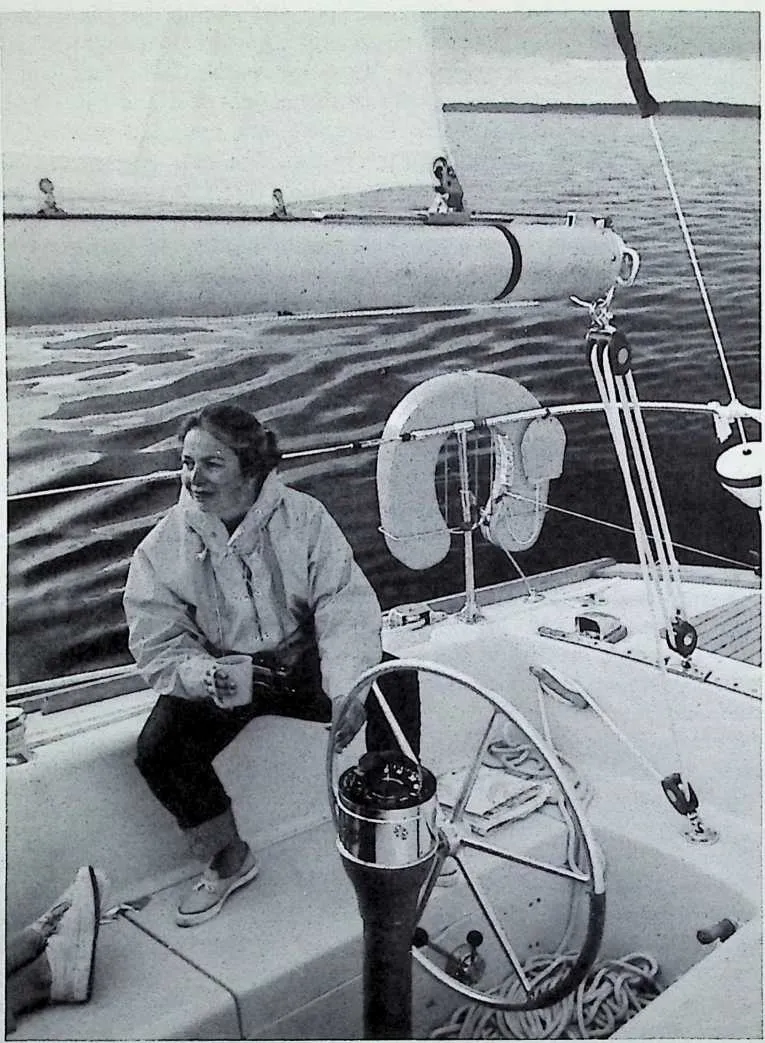
57 —Anne, Allegra, Bucky’s grandchildren—Alexandra, just entering her sophomore year in college and Jaime, about to start as a freshman—Leslie and Richard Gibson and their fourteen-year-old son George, who was in Bucky’s old quarters in the attic of the Big House, now partitioned into rooms. Rosey, Alphonse, and their son Oliver were in the cottage, and there was a heavy turnover of distinguished visitors and eager students.
58 There were, of course, no servants, but two college girls had volunteered to cook for the company. They were Claire Fahnestock and Lucy de Chatenard, both from well-to-do families who worked, not for the wages Bucky paid them, but for the privilege of listening to him expound the secrets of Universe. Remarkable girls they were, completely refuting any theory of the younger generation going soft. Working with the small propane stove, pumping water for dishwashing with a hand pump connected by a hose to the cistern, sleeping, if at all, in unheated cabins, they turned out two good meals a day—breakfast and dinner at night—for up to twenty-eight people, all for love of Bucky.
59 Usually, Bucky’s month on Bear Island was a time of complete relaxation surrounded by the people he loved most; his spirit healed by the omnipresence of his chosen element, the sea. Not that he stopped thinking out loud—for he could never do that. But his thinking there was serenely happy, a syntropic ordering of thoughts he had been too pressured to pursue to their ultimate conclusions.
60 Not that year. For he is a man whose time has come in the worldwide recognition of his philosophy, as shown in his Chronofile by the mounting tide of news items, articles, and books about him, and by the ever-increasing calls for him to lecture and to teach his doctrine of success for mankind in Universe from people all around the planet. He is like a surfer riding just ahead of the crest of this enormous wave of popular acceptance. Bucky knew this, and at seventy-seven, he knew that there was a limited time in which to complete his great design.
61 So that summer of 1972, the pressures followed him even to Bear Island. He had no time for the innocent frivolities of ordinary summers, for young laughter, swimming in the icy bay; good, hard, mind-easing manual work; or even sailing through a dusty nor’wester with all canvas set and the kids soaked with flying spindrift and whooping with joy —he only took Intuition out once in the first four weeks.
62 There was a huge accumulation of mail to be dealt with; there was his masterwork, the compendium of all his mathematical theories—Synergetic Geometry—to be thought about, refined, edited, and amplified; and a new type of dome to be invented. He had arrived exhausted and he never let up. No wonder his skin looked pale and skull-tight, his eyes wearily distant; no wonder he was unusually short-tempered and intolerant of foolishness. He was not even able to get his short, restorative hours of deep sleep. He said, “Often when I lie in bed, the numbers pour through my brain, multiplying, dividing, square roots and fourth powers, making fantastic patterns that go just to the edge of realizing some unique discovery. I cannot turn them off.”
63 And Bucky said, “Bear Island used to be very remote. Now it’s suddenly invadable because there are so many powerboats. People can charter boats, and they are suddenly beginning to come out here.
64 “I really love human beings, but I do need time to do some thinking, and do some forward work. I live on the frontier of science and design; and you’ve got to put in, in order to put out.
65 “So Bear Island is where I try to put in. There are stacks of things waiting that I have not been able to find time to read, let alone getting the new work done. It is a life of great thoughtfulness …or should be. You might think I’ve found nothing while I’ve been here. But by and large a lot comes in.”
66 The people on the island who love Bucky worried but said nothing —the worst possible thing to do was to imply that he was ailing; it would only have increased the pressure. The less knowing ones did increase the pressure with questions and demands on his precious time. The outside world refused to keep its distance, but brought its problems to the island.
67 Early in September Don Moore arrived. Bucky had met him in Moscow the summer of the Khrushchev-Nixon debate in the modern kitchen Don designed for Whirpool. He is a tall, unflappably energetic man with a vigorous mind and the dexterous hands of a watchmaker. He has studied and worked in the great scientific schools—the laboratories of Princeton, general systems theories at Pennsylvania, communications at MIT, business administration at Notre Dame.
68 When Don got back from Moscow he found that his assistant, a former pupil of Bucky’s, had taken over at Whirlpool, and pushed him out of a job. Bucky, feeling a secondary obligation because his pupil had behaved badly, took Don on as his assistant; and never regretted it. After a few years Don went on to found a successful business of his own as a science consultant.
69 “But,” says Bucky, “he takes the trouble to come here summers, giving up his vacation to help me. If anything goes wrong on the island —things that I used to fix—Don comes along and takes care of it, because I am physically unable to any more. That in addition to his marvelous help building models and working on designs.
70 “You ought to know why Don is here. Just pure love for me…”
71 Bucky had continued through all these years to experiment with the tensegrity structures he believes will render the classic geodesic domes obsolete. When Don Moore arrived, he and Bucky began designing a new type of tensegrity sphere, which obviated some of the architectural difficulties of previous designs by introducing rectangular sections suitable for doors and windows without destroying the basic triangularity that ensured the fantastic strength of the structure.
72 The author happened to be present when, after days and nights of intricate calculations and skillful arranging of short hollow rods (compression members) and clothesline (the tensional element), Don Moore began the final assembly of the 4-foot-diameter model in a field beside the Eating House. Bucky, totally drained by having worked through at least one twenty-eight-hour day without even one of his catnaps, appeared so completely a thing of spirit that he seemed to have ephemeralized himself. As he looked at the jumble of rods and ropes lying in the rough grass, he was unusually pessimistic. “It won’t work that way,” he said. And began a long scientific discourse on why it was impossible. Don Moore paid no attention; just silently kept on threading ropes through rods and tying knots. Everyone on the island, kinfolk, students, and visitors, stood in the chill wind watching in expectant anxiety.
73 As Don tied the last knots, made the final connections, and tensed the clotheslines, the tangled heap gradually assumed a spherical shape and stood gloriously erect. Bucky poked it tentatively, then brought real pressure to bear. Instead of collapsing, the sphere contracted visibly and the tensional components distributed the load throughout the structure.
74 Then everybody got into the act, treating it very roughly, pushing it, throwing it into the air, dropping it on the rough ground, where it bounced like a football—for basically the same reasons. This was no delicate toy but an amazingly rugged structure almost impossible to damage. It worked!
75 Bucky was beaming. His eyes behind the glittering goggles were flashing signals of triumph. Lines of age and care disappeared miraculously from his face, which was suddenly ruddy with health. In five minutes he had lost five years. “This is very wonderful,” he said. “It is pure synergy. It is a new development that will mean something great for mankind, and it is eminently patentable. All of you remember this date—September 10, 1972.
76 “And it’s all due to the stubbornness of dear Don Moore. We’ll call it the ‘Moore Tensegrity’ ”
77 After that things were fine on Bear Island. Bucky bloomed, becoming stronger, ruddier, healthier every day. The old bounce and gaiety came back to him; he began to have fun again. There was even one more glorious sail on Intuition, with the fifteen-knot wind driving her, lee scuppers awash, and the clean, cold spray lashing over her bow. They stayed out so long that black night fell before they reached harbor. One or two aboard wondered how Bucky would find his way home.
78 But he did, getting his bearings from the familiar lights flashing on the horizon—the twins, Minots’ Light and Thatcher’s Island Light, and Owl’s Head Light low in the southwest, threading his way among islands and reefs with the skill and percipience of a Maine-raised boy who, unseeing those hazards in the darkness, feels their presence and avoids them—by intuition.
79 So Bucky brought his beautiful sloop foaming through the narrow harbor entrance under the dim lights of Pearl Hardie’s cottage; swung her sharply into the wind with canvas slatting, and nosed her gently up to her home buoy in the bravura style of the old salt he likes best to be.
80 Later that night, he stood, square-built and sturdy, on the cliff-prow of his island ship, feeling the earth turn under him in its designed motion in an ever-moving cosmos. The sky, swept clear by the steady northeast wind, was brilliant with all the northern constellations—the two dippers; Orion, Canis, with Sirius dancing like a puppy; the Great Bear and his cub, and Polaris, “the earth’s mooring buoy,” pointing the true north. He was fulfilled and happy.
81 For Bucky has an intimate relationship with the planets and the stars.
82(continued from front flap)
83 The author has compiled much fascinating information never before revealed about Fuller: his unfortunate career as a student at Harvard, his near suicide, his years of meditation, his generally unsuccessful business enterprises, his love for and marriage to Anne Hewlett, and the resistance to his far-reaching ideas by people of limited vision.
84Buckminster Fuller: At Home in the Universe is an immensely important biography of a man of ideas whose time is arriving, a man whose enormous impact on the world has only begun to be felt. It is a book that will compel both young and old to explore the mind of a man whose mystical, almost transcendental view of the universe has led us closer and closer to that which he prizes above all qualities: Truth.
85 Jacket Design: Michael Perpich
86Front cover: Buckminster Fuller in front of the Expo ‘67 Dome
87Crown Publishers, Inc.
88419 Park Avenue South, New York, N.Y. 10016
89 Designed by John Kelly, it was a gossamer net arching over the society’s buildings, gardens, and pools. Kelly regarded this structure as “a realization of Fuller’s concept of advancing technology’s overall trend to invisibility.” 2
90 The biggest dome built in the 1950s was constructed by Bucky’s own company, Synergetics, Inc., for the Union Tank Car Company at Baton Rouge, Louisiana, in 1958. The company needed a plant big enough to run a whole train of cars into for rebuilding and reconditioning with a huge span of clear space for shunting and turntables.
912The Dymaxion World of Buckminster Fuller by Robert W. Marx, Southern Illinois University Press, 1960.