
15 Geodesic Intuition
1When Bucky had left Washington for Wichita, Anne had gone to stay with Arthur and Natalie Hewlett in Woodmere, Long Island, leaving Allegra to finish her last year as a boarder at Miss Madeira’s School. After the Arthur Hewletts joined Bucky in Wichita, Anne rented an apartment at 6 Burns Street in Forest Hills, Long Island. It was a pleasant though small apartment in a far from fashionable suburb, but it was conveniently located midway between New York and Lawrence. “I liked it,” Anne says, “but Allegra thought it wasn’t classy enough.” Bucky never cared where he lived. The Fullers lived there longer than anywhere else in their married lives—over fifteen years until the apartment was finally burned out.
2 Allegra had grown up to be a very pretty girl with cobalt blue eyes under long dark lashes, good features, and a golden creamy skin. She was quite small, having inherited Bucky’s stocky figure. “She is all Fuller,” the Hewletts say.
3 When she graduated from Miss Madeira’s School, she spent that summer of 1946 studying ballet with Balanchine in New York. This was not a girlish whim but a long-term interest in the dance in all its aspects. Every summer she had studied different techniques with a variety of teachers. Sometime during the summer of 1946 Bucky came east for a talk with his daughter about her future.
4 Bucky says: “I thought Allegra was going to be an engineer, because she used to enjoy mathematics so much; and she enjoyed talking to me about my search for the coordinate system of nature. She was an extremely good critic of my mathematical thinking. For that reason I had entered her for MIT. I was very thrilled when they agreed to take her, because at that time there were only six girls in MIT.”
5 When he talked to Allegra, Bucky sensed her lack of interest in becoming an engineer and her genuine love of the dance. So, hiding his disappointment, he told her: “I can see that I am really pushing you to be an engineer. You don’t want that, you want to be a dancer.”
6 Allegra nodded, and Bucky said, “Why don’t you give up the idea of going to school altogether and concentrate on what you really want to do?”
7 Allegra did that, working with Balanchine at the New York School of Ballet for two years. But just dancing was not enough for her. Because she had lived in an atmosphere of intense intellectual excitement all her life, she found her fellow students rather dull. There was a great deal of sitting around waiting to go on, and all the girls seemed able to talk about was the best place to buy their stuffed-toe ballet slippers or the technique of ironing a tutu.
8 She thought of her father’s great long charts of the upward progress of man; and she thought of doing something of that sort about the history of the dance. So, without giving up Balanchine and the School of Ballet, she began spending more and more time in libraries getting data about the dance. At about that time Lincoln Kirstein and Edward M. M. Warburg, who were helping to finance Balanchine, gave their great collections of terpsichorean memorabilia to the Museum of Modern Art. Knowing of Allegra’s intellectual interest in the history of the dance, the curator in charge of these collections asked her to help organize and catalogue them. So, for the last part of her time with Balanchine, Allegra was also putting in a full day’s work at the museum. And learning a great deal.
9 In an unexpected way Bucky profited by his daughter’s enthusiasm for the dance and her evolving theory of it as a means of communication. During the years from 1932 to 1943, Bucky had not given any important lectures; he had dropped out of sight in that field. In 1943, he had been asked to explain his theories to a gathering of scientists who were guests of the Board of Economic Warfare at the Cosmos Club in Washington. From that time on, partly due to the publicity about the Dwelling Machine, the demand for him grew. Naturally, Allegra went to hear him on several occasions.
10 She loved her father very much and understood even his recondite phrasing, but she noted that other people often did not. So one day she gave him an illuminating piece of advice.
11 “Father,” she said, “you were brought up as a New England gentleman, and they are taught that it’s not good form to make flamboyant gestures. So when you lecture you stand there stiffly with your hands at your sides, just talking; and sometimes people don’t get it. But when you talk to me alone you use your hands most expressively. Now, from what I have learned about the dance I know that arms and legs and body movements can be a marvelous and fundamental method of communication; and I believe that you could communicate with your audiences better if you would only let yourself go.”
12 Bucky said, “Allegra, you’re absolutely right.”
13 That was the beginning of Bucky’s frenetic—and endearing—style of platform expression. He starts quietly enough with simple words and phrases, but as he warms up and becomes more esoteric, he begins moving. His stubby hands form triangles and circles, his arms rotate or come together to make tetrahedra and octahedra. As he becomes more deeply involved, his legs take up the rhythm so that sometimes he is dancing all around the platform, his whole body expressing the principles of very energetic-synergetic geometry, or whatever he may be talking about. As Allegra foretold, and Norman Cousins observed when he spoke of people understanding Bucky “by osmosis,” he does communicate his thoughts far more clearly by illustrating his speech with body language.
14 The scrapping of the Wichita project inevitably brought Bucky down in people’s thinking; Fortune unkindly observed, “Fuller is down the flush.” Of course they were quite wrong. For Wichita had been to him merely a wartime detour, though a vitally interesting one, from the mainstream of his thinking, which more and more concentrated on the mathematics of his synergetic geometry and how he could apply the general principles he had discovered to specific matters. For, as he often says, “Philosophy gains validity by the practical application of its general principles.”
15 He was already conceiving a spherical structure based on the three-way great circle grid. He had intuitively realized that it could be done; but since it must be done with absolutely scientific accuracy, his previous empirical methods would not suffice. He says: “Between my jobs at Fortune and the BEW, I had managed not to be quite as impecunious as I had been. Though I had spent most of the money, I had a few things I could sell and we had an apartment at the very low rent of seventy dollars a month. So I said, ‘I am just going to buy the time—I don’t know how long it will take—but I am going to buy the time to fully comprehend spherical trigonometry. Because if you are going to build a dome based on geodesics and triangles you are going to have to be absolutely accurate, near enough would not be good enough.’ So I invested the time—two years—1947–1948, and just really worked on my mathematics. And I got it!”
16 In a way this resembled Bucky’s great decision of 1927 to concentrate on thinking. But he did not carry it to such lengths. For one thing, he did not feel silence was necessary. He was not now clearing rubbish from his mind, but merely studying a new discipline. He knew “what sounds he wanted to make,” so he kept right on talking to anyone who would listen. More and more people were anxious to hear him. In 1947 he lectured at the American Institute of Architects in Cleveland, Dartmouth College, the Municipal Housing Show at Portland, Maine, and the Institute of Design in Chicago, besides many lesser places.
17 Thus he came from Wichita to the little apartment in Forest Hills to turn it inside out, but not upside down, since he regards the words up and down as purely fallacious when referring to the spherical system known as Planet Earth, where there is logically no up or down but only in and out. In fact, he later wasted a powerful amount of thought trying to find accurate substitutes for sunrise and sunset, such as “sunclipse” and “sun sighting,” though these expressions failed to satisfy his poetic sensibilities.
18 In any event, the apartment became a combination study, workshop, and classroom and therefore a shambles. Anne made no complaint. Her serene faith in Bucky could not be shaken by any apparent failure, and her belief that her particular function in Universe was to help him in his life’s work had survived worse confusion and would be triumphantly vindicated sooner than she expected.
19 As might have been surmised, Bucky rapidly mastered the principles of trigonometry, making some improvements on conventional doctrine as he went along. He did not wait, however, to complete the course before beginning to build models of the vision he had when he first scratched out the coordinates of that three-way great circle grid on the copper sphere that Butler had made for him.
20 He was to call his supreme invention the geodesic dome, because parts of great circles are technically known as geodesics and the dome was half a sphere based on great circles crisscrossing to form triangles or tetrahedra evolving into octahedra and icosahedra.
21 In his thinking about a dome as a dwelling, Bucky developed the historical theory that man’s first habitations were domes—the natural domes of caves and the vaulted branches of trees. These visible geometric natural structures were but “manifestations of the invisible, because of the infra-sensorial structuring of nature’s universal dynamic mathematical cellular agglomerates.” Thinking about the narrow limits of man’s sensorial apprehension compared to the enormous range of the macro-and micro-modules of Universe, Bucky came intuitively to one of his basic conclusions: “The physical and metaphysical are altogether one reality.”
22 As he reconstructed the history of housing Bucky put it in two categories. The first was the natural dome which man later imitated by building conical huts or igloos, or up-ending the inverted dome bottom of his primitive basket-boats or dugout canoes over his head to keep off the rain. This evolved into the stone domes made of wedge-shaped blocks of the early seafaring peoples of the eastern Mediterranean, the domed tombs of Greece, and the Roman domes like that of the Pantheon.
23 In the second category were buildings based on the cube, which, according to Bucky, were inferior because horizontal crossbeams are comparatively weak. As he points out, the walls and columns of ancient buildings remain standing long after the roofs have fallen in. But the Grecian tombs, the dome of the Parthenon, and the ancient domed buildings of Istanbul, the Near East, and India remain intact. In modern times the only building to survive at ground zero in Hiroshima was a domed structure.
24 With his love for wordplay Bucky makes an argument for man’s innate feeling that the D-om-e is H-om-e, by citing words with the root syllable om-domus (God) domicile and the fact that man travels through life from the W-om-b to the T-om-b. However, he merely points it out and is willing to accept “negative reactions.”
25 As has been noted, before Bucky ever went to Washington or Wichita, his dome had been gestating in his mind. He even conducted some crude experiments while he was working with Beech. In his two years of study in Forest Hills, the idea became all-consuming. It was not only an intellectual development from the general principles of synergetic-energetic geometry, but an intuitive insight as well, a transcendental glimpse into the Great Intelligence.
26 As he explained it: “When I had worked out my three-way great circle grid of perfect triangles for the map, I realized that it would be possible to make a spherical structure or dome, which is a half sphere, formed by thirty-one great circles around a sphere, crisscrossing each other to form perfect triangles of varying sizes. The surface triangles of a sphere are the outer parts of a tetrahedron. So I had all these tetrahedra and they all go to the center of the sphere; they cannot come apart. Now supposing I cut off the points leaving only the triangles; and I have tension bands on the outside; they still can’t fall in or get out, they are like triangular corks. Cylinders have parallel lines, which do not help each other; they let infinity in, and with my map I had learned that you never do anything with infinity. The triangles are a closed stable system so this distortion, this infinity thing, cannot get in.
27 “Nothing could be more fundamental to my feeling that it would be possible to develop a three-way great circle grid, and if I did so it would have structural strength without any precedent in history.
28 “The reason for this is that whereas parallel structures do not help each other, my grid of triangles with great circle tension bands would transfer a load to all parts of the structure. The bigger it was and the more triangular or octet trusses were involved, the more the load would become diffused and therefore more easily taken care of. In other words, a load upon any particular part of the structure would be absorbed by the strength of the entire structure through the tension bands. Therefore any section could be made infinitely lighter than it would have to be if it stood alone, as do parallel columns and beams.”
29 The scientific wording of this is: “As the number of trussed faces of symmetric polyhedra are increased through the hierarchy of great circle arc…and chord-trussed solids, the number of vertexes and edges increase, providing more dispersed structural interactions for resisting concentrated loads and also more and shorter chords, thus providing increasingly favorable slenderness ratios for the compression columns…
30 “Therefore, theoretically (and as far as it has been tried—practically) the size of a clear span structure is limited only by the relative alloyed coherences of the metallic atoms,” Bucky wrote in 1967. “We may therefore consider clear-span geodesic, tensegrity spheres in the magnitude of two miles diameter as now realizable…1
31 In Forest Hills Bucky began to build small domes using various materials and different variations of the basic geodesic structure, and they generally worked. Then, in 1948, he was invited to go to Black Mountain College for the Summer Institute where he had delivered a lecture the previous year.
32 Black Mountain had been a remarkable innovation in education when it was founded by John Andrew Rice and a small group of idealistic artists and scholars in 1933. Located in the hills of North Carolina near Asheville, it was a sort of educational commune, an experiment in community education based on pure democracy and freedom from formal academic structure. Its atmosphere in some ways resembled those of the communal experiments of Brook Farm and New Harmony in New England, without their religious connotations. Many of its rustic buildings had been built by the faculty and students themselves to plans supervised by the great Walter Gropius of the Bauhaus in Berlin. In its time it had attracted some great teachers of art, music, and literature, and sent forth graduates who made names for themselves in their various disciplines.
33 By 1948, it was suffering the disintegration due to the clash of ideals and personalities that had also afflicted those other communal experiments. However, the summer institutes still attracted brilliant, uninhibited intellectuals, and the 1948 one was especially scintillating.
34 Bucky knew he would love it as he and Anne drove down the rugged road that was hardly more than a trail into a narrow valley enclosed by steep, forested hills. Unpainted wooden buildings crouched beneath the trees beside the quiet water of aptly named Lake Eden. It was a truly Edenic setting for intellectual experiments and the creation of beauty. The Fullers made many fine new friends and found some old ones there—the Josef Alberses, who had come from the Bauhaus fifteen years before, he to teach painting, she to instruct in the ancient art of weaving in very modern designs; Willem and Elaine de Kooning; the Theodore Dreisers, who came from Boston; Charles Burchard of the Harvard School of Design; John Cage, the composer; Peter Grippe, the sculptor; Erwin Bodky, pianist and harpsichordist; Edgar Kaufman, Jr., of the Museum of Modern Art; Isaac Rosenfeld, author of Passage from Home; Merce Cunningham, dancer-choreographer; and sculptor Richard Lippold, who had been so anxious to come that when told the place was full he wrote Albers to say that he had bought a hearse to bring his wife and two children down, in which they would sleep if the college would “lend them its plumbing.” The members of that star-studded faculty, including Bucky, were given room and board, $100 for traveling expenses, and $25 a week.
35 There were seventy-four eager and highly intelligent summer students for Bucky to enthrall by his priceless benefice of hope for the future through benevolent technology. Martin Duberman in Black Mountain 2writes: “Fuller carried on a nonstop talkathon sleeping only two hours at a time [a nap every six hours].” The students were carried away by Bucky’s enormous energy and promethean excitement, though some of them could not understand him. Even as brilliant a man as Arthur Penn spoke of Bucky’s vision as “practically palpable” but “not one I could reproduce even for a minute…just absolutely extraordinary.” 3 John Cage wrote, “The work and thoughts of Buckminster Fuller are of prime importance to me. He, more than any other to my knowledge, sees the world situation—all of it—clearly…” 4 The de Koonings fell in love with Bucky and he with them. They became, in Bucky’s words “great friends, really extraordinary friends…Bill is a very, very wonderful thinker.” But Bucky thought some of de Kooning’s pictures “confusing.” History does not record what de Kooning made of Bucky’s five-hour lectures.
36 One thing that pleased Bucky was the tradition of Black Mountain that faculty and students were constantly together at work and play and meals, thus obliterating the academic chasm inevitable in more conventional institutions. To be exposed constantly to the challenge of those keen, uncluttered minds, to be one of them, was a constant delight to him, and to them as well. Many of that ardent Black Mountain band look back through the years at that summer, with Bucky spouting ideas like a nonstop geyser, as the motivating inspiration of their entire lives.
37 The informality of dress and demeanor enhanced the sense of ageless comradeship. Daytimes, faculty .and students alike wore overalls or blue jeans—no unusual thing now, but remarkable by the academic mores of 1948. However, mindful of its image in a world as yet unaccustomed to hippie costumes, Black Mountaineers wore jackets and ties or dresses at night; and at the Saturday dances at night women usually wore long dresses and an occasional black tie appeared. These things were customs, not rules, for theoretically there were no rules at Black Mountain, only a consensus of faculty and students as to what sort of behavior was best for the college.
38 For the same reason, cohabitation between the sexes was sternly frowned upon. On one famous occasion when a boy and girl student had spent the night in an otherwise empty building, a joint committee
- 2.
- Black Mountain by Martin Duberman, E. P. Dutton & Co., New York, 1972.
- 3.
- A Year from Monday by Arthur Penn, Wesleyan University Press, 1967.
- 4.
- Black Mountain, op. cit.
39 of faculty and students met to consider whether expulsion was in order. The whole thing was dropped when the girl offered to produce a doctor’s certificate that she was virgo intacta. This now old-fashioned posture consorted well with the puritanical attitude toward sex which was one of Bucky’s inherited hang-ups despite his personal divergencies from strict observance. Just another of his paradoxes.
40 Probably Bucky’s greatest triumph of that summer, and certainly the most fun he had had in a long time, was his appearance in the leading role in the faculty play. This was another Black Mountain tradition along with concerts, dance recitals, and impromptu readings. With all that talent available, these were often exciting occasions.
41 That summer the play was the comedy with music, Le Piege de Meduse, Englished rather roughly as The Ruse of Medusa, by the French avant-garde composer-playwright Erik Satie as translated by Mary Caroline Richards. It had been staged only once before, in France in 1913. John Cage and Merce Cunningham, who were producing it, gave the female lead to pretty Elaine de Kooning and “persuaded” Buckminster Fuller to play the comic role of Baron Meduse. Cunningham himself choreographed and danced “the mechanical monkey,” with a magnificent tail designed by Lippold. Bill de Kooning painted the scenery.
42 Rehearsals were rather disappointing at first, and Bucky was particularly stiff. He learned his lines right off—he could memorize almost at a glance, but his delivery was dismal. His burgeoning role as prophet of the future appeared to have made him self-conscious about his dignity, and he said rather pompously, “I can’t put on an act. I like to do my own thinking, not to speak somebody’s lines.”
43 Cage and Cunningham called in Arthur Penn, who had been writing his own drama all summer, as play doctor. Penn added some very funny improvisations to the script which relaxed the cast, except Bucky who, in Penn’s words, was still “gravely muted.” One day Bucky admitted that he was afraid of making a “damn fool of himself.” To break this down Penn invented a series of improvisations in which he and Bucky did make damn fools of themselves. He told Duberman, “We skipped around, did giddy things, laughed artificially and rolled on the floor.” 5
44 Suddenly it all became great fun. Bucky reverted to that joyful time when he used to delight in playing the buffoon at the impromptu Hewlett theatricals at Martin’s Lane.
45 The night of the performance he was magnificent. In dress shoes and spats, flapping gray flannel pants, an outsize cutaway, polka dot waistcoat, white socks, Pickwickian collar, and a very tall white high hat, he played the role like a combination of Groucho Marx and Emmett Kelly. There is a prodigious picture of him doing an abandoned dance with Merce Cunningham’s mechanical monkey. Mouth wide open, emitting a manic roar, goggles glittering frenziedly, he looks a little like a bald-headed gorilla. The play was a smash hit.
46 Bucky said ever afterward that the experience helped him immensely to let himself go in his lectures.
47 Bucky’s serious project for the summer was to build the first big geodesic dome, fifty feet in diameter, with the help of the students. Its design would be a beautiful geometric pattern of three different types of triangular trusses in various pastel colors. He had brought with him a carload of aluminum alloy Venetian blind strips for the compression members, and planned to get the rest of the material in Asheville.
48 Bucky worked on the dome all summer, doing long, intricate calculations all night long when mere mortals were asleep. Eventually the complex calculations for a large dome took him and a young assistant, Donald Richter, two years to complete, working with nothing but an adding machine, as they could not afford a mechanical multiplier. Fortunately the calculations only had to be done once, because they could be extrapolated for domes of any size.
49 In September the great day arrived. In a pouring rain Bucky spread the makings out in a rough field. His student assistants tore around in the downpour, hitching bits of it together while faculty and students, having abandoned work for the day, stood on a hillside with raincoats and umbrellas waiting to cheer the great event.
50 They had no chance to cheer. When the last bolt was in place and the tension applied the dome struggled briefly upward, sagged, and collapsed in a sodden heap. Everyone was intensely sympathetic, but Cunningham later told Duberman that “it didn’t put Fuller off at all.” And Bucky himself explained to the author of Black Mountain in 1969 that he deliberately built it too weak in order to find the critical point at which it would collapse, and that it was “predicted to fall down.” 6
51 This is typical Fuller after-the-fact rationalizing, and Bucky appeared unconcerned because his ego would never let failure in, any more than infinity—he did not believe in either. Certainly he had known from his
52 calculations that the dome might not work, but equally certainly he had hoped it would. The truth would seem to be that he had tried to do what Starling Burgess would have called a “botch job” with inadequate materials—he would have used better ones if he could have afforded them.
53 In the winter of 1948–49 Bucky had a busy speaking schedule, lecturing before the architecture and engineering sections of the University of Illinois, and at the Architecture and Design School of Chicago, North Carolina State, the Illinois Institute of Technology, the Architectural School of the Chicago Art Institute, Hull House in Chicago, the University of Toronto and, at last, at his own alma mater, Harvard University’s Graduate School of Design. His most important affiliation was with the Chicago Institute of Design. There he and the engineering students built a number of domes of different designs, “all of which worked,” says Bucky.
54 In the spring Bucky received an urgent plea from N. O. Pittenger, who had succeeded Josef Albers as rector, to return to Black Mountain as Dean of the Summer Institute. Although he was now getting a fee of $ 1,000 per lecture, Bucky agreed to take the job for a salary of only $800 for the six weeks, which was all the college could afford.
55 Duberman wrote: “Black Mountain barely made it through the summer of 1949. Pittenger, Natasha Goldowski, Ray Trayer, and Bucky Fuller…stitched together a fabric that just managed to keep the body decent…Fuller’s task was first on the agenda and he carried it off with his usual aplomb.” 7
56 Black Mountain was, in fact, in the terminal stage of institutional leukemia brought on by too many intellectual egotists in its bloodstream. Bucky gave it a temporary shot in the arm by bringing with him most of the summer art staff, among them John Wally and Emerson Woellfer of the Chicago Institute of Design, who taught drawing, painting, and sculpture while their wives taught ceramics and photography. Other disciplines were taught by well-known figures attracted by Black Mountain’s former brilliant reputation.
57 Bucky also brought along nine young engineer-designers from the Institute to help him build his newest dome. It was a fourteen-foot-diameter hemisphere made of aluminum aircraft tubing with a vinylite skin. Unlike the dome of 1948, this one went up in a hurry and stayed up all summer. To prove its strength Bucky and eight of his engineers all hung from it like monkeys.
58 Another technical triumph was the first structure built on the principle of tensegrity, a Fuller-coined word, derived from tension—integrity. According to the books, student sculptor Kenneth Snelson built a tensegrity mast after hearing Bucky deliver a lecture. Thus are myths made. In fact, Snelson had been very close to Bucky throughout the preceding summer—“a sort of father-son relationship,” he says,2 and had absorbed many of his ideas. He went on to make a career out of tensegrity sculptures.
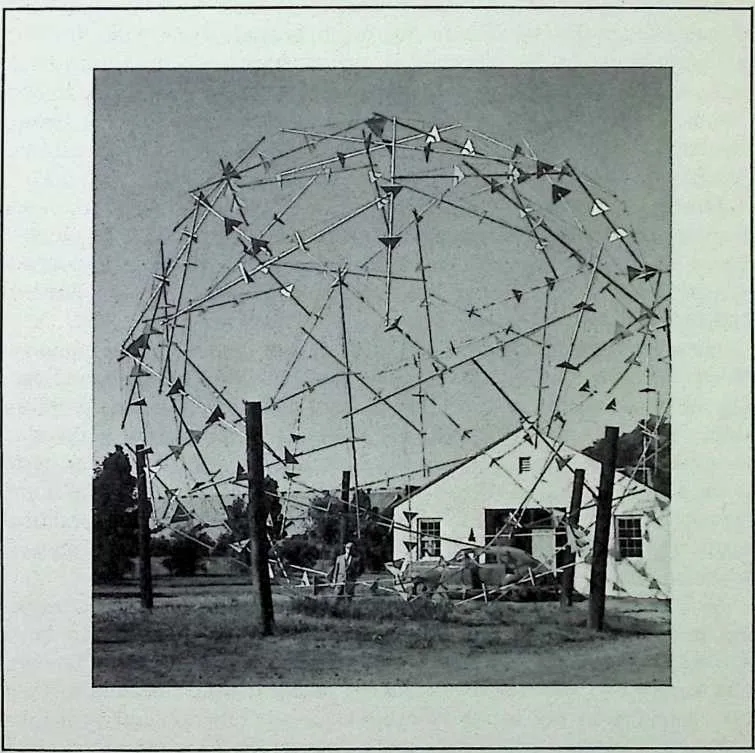
60 This type of construction still relied on the triangular components, but instead of the compression members or struts being joined at their vertices as in the classic dome, they were hollowed out and strung on a wire (or string) tensional network. The diagonals of cubes form tetrahedrons. If you eliminate the cubes and run tensional wires through compression members from the centers of gravity along the radii to the vertices you get a tetrahedronal structure in discontinuous compression and continuous tension. Struts thus seem literally to float in the air, though held in place with enormous strength (for their weight) by the tensional network.
61 Snelson’s 10-foot mast worked brilliantly. It could be raised vertically or held out horizontally, inducing much greater stress with never a quiver. It could be forcibly twisted out of shape, only to spring back like a dimple pushed in a derby hat, with its hollow sticks, apparently devoid of support, triumphantly maintaining themselves like the Indian rope trick. Even someone looking right at it could not believe it was possible. It was, in one student’s words, “an act of faith.”
62 Despite the ominous atmosphere in which it began, the Summer Institute was a great success. Bucky’s only setback was when he chose a young student to read aloud one of his two-hundred-page technological-metaphysical poems. It is recorded that by the time the man finished half the audience was asleep and the other half wished they were.
63 However, when Bucky himself spoke, no one slept—or even coughed. No matter how long the discourse or how recondite, students and faculty alike sat on the edges of their chairs with rapt attention to every word. This was in part due to the charisma which suddenly invested this stocky little man as he carried his audience with him from earth to the ultimate nebulae of the cosmos, then brought them whirling home through intergalactic space to a safe landing on earth with the practical applications of the universal principles he had explored. As always, when he lectured, he was “thinking out loud.”
64 Most of all, the excitement Bucky engendered was due to his inspiring message that man was intended by the Great Designer to be a success, as was every other feature of that elegantly intricate, finite system known as Universe. If humankind failed, it would be due to their own stupidity in not acting in accordance with the general principles governing Universe, which they could discover by using their God-given intellects. If they should fail, it would be no more than a slight setback for the Great Designer because there were, without a shadow of a doubt, trillions of other intellects working on billions of other planets to forward His ultimate purpose.
65 However, Bucky did not anticipate failure for humanity. They were, he told his audience, designed to succeed and they were well on the way. In an exhilarating peroration to one of his talks he said, “Man has now completed the plumbing and has installed all the valves to turn on the infinite cosmic wealth [of inexhaustible energy].”
66 Like those other students of the previous summer, the boys and girls who listened to him in the echoing wooden assembly hall found their youthful cynicism dissipated, their lives made meaningful, and their minds expanded. This last was important above all because the mind is one thing on earth which, once enlarged, never again quite retracts.
67 Another thing that enchanted those boys and girls was that when Bucky came down out of the empyrean and off the platform he became one of them. Because he believed in them far more than he did in the sages of society, and because back there in Chicago in 1927 he had cleared the rubbish of outworn stereotypes from his mind and relearned how to look at things with the sensitivity of a child, he was forever young—their compatriot, not their senior. He played with them and joked with them and he genuinely loved them.
68 As Bucky drove away from Black Mountain for the last time, young V. V. Richard stood by the roadside with the others, waving frantically; feeling something important gone from her life yet always to be with her, enriching her years however many they might be. “I can see him still,” she said, “in the back of that old, open convertible, waving good-bye to us with one bare foot.”3