
2 Beloved Island
1When Richard Buckminster Fuller, Jr., was born on July 12, 1895, in the Fullers’ big, rambling wooden house in Milton, Massachusetts, his father was at the peak of his business success, and life was very comfortable. The Fullers could afford a number of servants and a yardman—not an extravagant household since a good cook was paid twenty or twenty-five dollars a month and the maids proportionately less.
2 Until he was four years old Bucky’s world was confusingly nebulous. His eyes were crossed and completely unfocused so he saw only masses of color with no distinct outlines. He did not know what his father or mother, his older sister Leslie, or his baby brother Wolcott, looked like. They were mere shapes that he recognized by their size and their voices. Being a very loving child he was completely devoted to them and eager to please, but it was inevitable that he appeared annoyingly stupid and clumsy. Then he was fitted with a pair of glasses.
3 That was the moment of Bucky’s first revelation, the beginning of his long love affair with Universe. He has said, “For the first time I saw leaves on a tree, small birds, and lovely butterflies; I saw the stars and the shapes of clouds and people’s faces. It was a time of utter joy as though all these things had been newly created just for me; in a way they belonged to me.
4 “I was filled with wonder at the beauty of the world and I have never lost my delight in it.”1
5 Once equipped with glasses, Bucky soon showed that, whatever his other failings, he was not stupid. Indeed, from being rather slow he became irritatingly bright. He was immensely curious and unwilling to take things on a grown-up’s say-so; he always wanted to know the reasons for everything, especially the things for which there were no good reasons except that they were traditional or customary. Thus he often appeared to be challenging adult wisdom and authority.
6 Bucky showed his inventiveness early. In the autumn of his sixth year he was sent to kindergarten where he was given some toothpicks and dried peas to play with. Working with intense concentration he used them to construct a tetrahedronal octet truss.2 He had no idea why he did it or what good it was—he just knew it pleased him by its symmetry and strength. He remembers his teacher calling others to come and admire it.
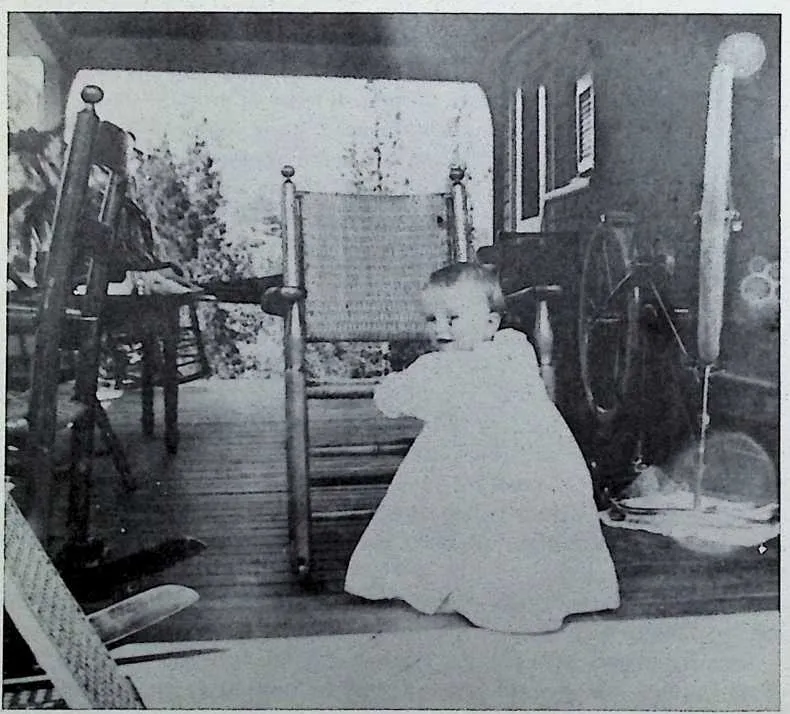
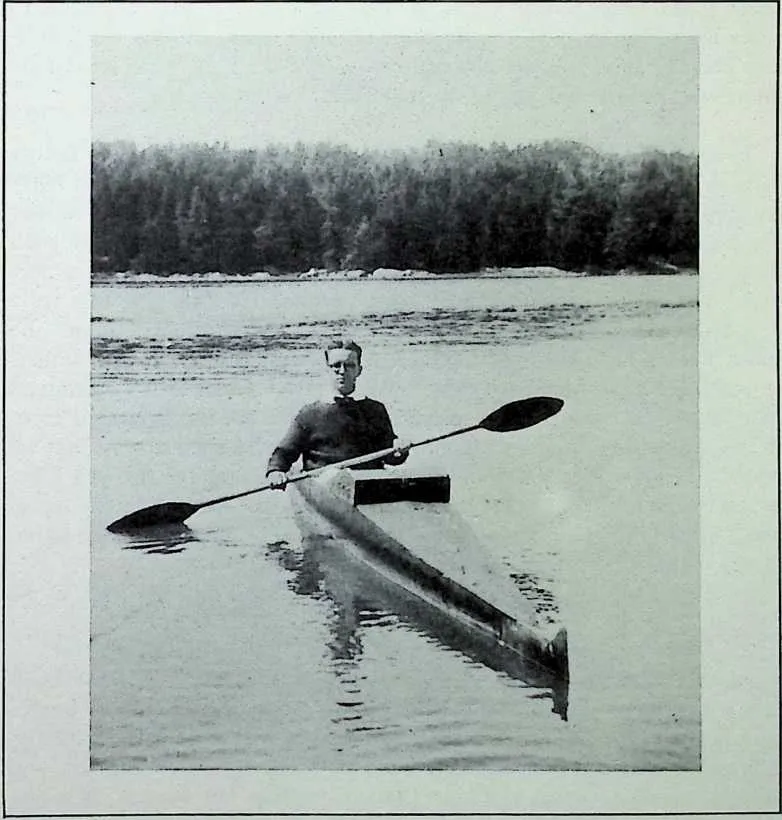
89Bucky at Wiscasset, Maine.
102 Three squares combined to make eight triangles, patented in 1961 by R. Buckminster Fuller as the Octetruss.
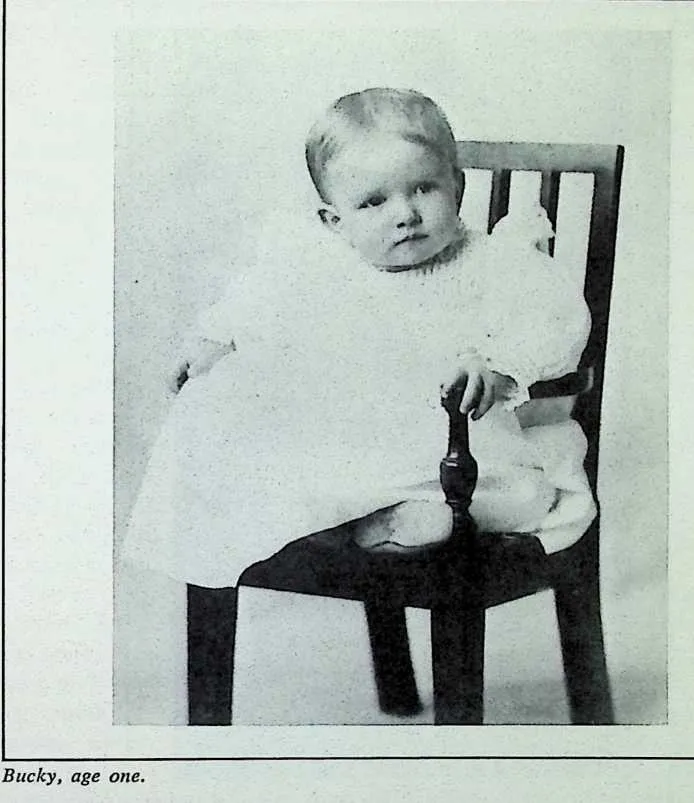
12 Bucky must have been a very sensitive child, perhaps hypersensitive. His eagerness to please, his intense need for approval and love, were in conflict with his stubborn independence of mind which put people off. In addition, the thick lenses of his glasses magnified his hazel eyes to owl-like proportions, giving him an air of precocious wisdom which could be annoying. Thus his attempts to win affection and praise were frequently rebuffed.
13 For example, Leslie, who was three years older, consistently tried to suppress him. Until Bucky came along, she had been the focus of love and attention in the household; suddenly she was displaced by a newcomer—and a boy at that! In those days almost nobody made an effort
14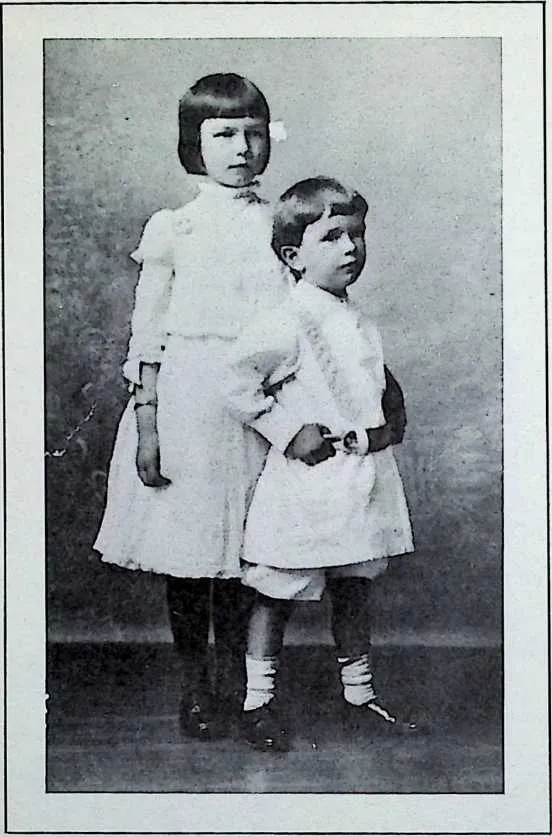 Bucky with his older sister, Leslie, who consistently tried to suppress him.
15 to disguise the fact that boys were more important than girls. Looking back on it Bucky feels that his sister’s concealed or unconscious hostility was perfectly natural. Her assumption of superiority, as when she would say, “Bucky, when I was in first grade I was able to do the work very easily, but you will find it hard,” was, he realizes, purely defensive. But when he was five or six it crushed him. He says, “She had a very powerful influence on my life.”
16 On the other hand, Bucky felt no sibling rivalry for his younger brother, Wolcott (known as Woolly), but loved him dearly. However, three years difference in age made real companionship impossible until they both grew up. Nor was Bucky very close to his mother, who never quite understood this changling child of hers, with his strange combination of mental precocity and emotional immaturity.
17 The object of Bucky’s utter devotion was his father. Mr. Fuller was a lovable man. He had grown up in that heterogeneous household at 13 Hilliard Street, the youngest but one of all those brothers and sisters, half-brothers, half-sisters, stepbrothers, stepsisters, and double first cousins, so he had learned early to get along with people. The fact that his father died so young at Fredericksburg doubtless made him an object of special tenderness to his siblings and he returned their love.
18 Dick Fuller grew up to be a rather delicate young man. He entered Harvard with the Class of 1883, but his health gave way after two years, and he went to Arizona to recuperate. Though he never was formally graduated from Harvard, he was so well liked—and so well read—that on his return from Arizona he was voted his degree. During his brief time at Harvard, he made many staunch friends, as Bucky learned after his father’s early death. “For love of him,” he says, “they were willing to do anything they could for me, particularly when I was in trouble, which was quite often.”
19 Though most of his progenitors had been ministers or doctors or lawyers, Richard Fuller had become a merchant, importing teas and fine leathers from India and the Argentine. Bucky thinks that he would have preferred to follow the family tradition, but he felt he needed to do something to refurbish the Fuller fortunes. Though he was a gentle person, totally lacking the flinty character supposedly necessary for business success in that time and place, he made a moderate fortune.
20 In 1891, Richard Fuller married Bucky’s mother, Caroline Wolcott Andrews of Chicago. She, too, was of New England ancestry, being descended from Roger Wolcott, the Royal Governor of the Colony of Connecticut, and his son Oliver Wolcott, a signer of the Declaration of Independence, who became the first governor of the State of Connecticut. Oliver’s grandson, Christopher Wolcott, went west and married the daughter of Colonel John Kinzie, commanding Fort Dearborn. This was the first marriage between Americans in Chicago. Their daughter, Caroline Wolcott, married John Andrews of Birchwood Farm on Lake Michigan about five miles north of the growing city. Bucky’s mother was born there, and as a little girl watched the splendidly terrifying spectacle of the Chicago fire from the cupola of the farmhouse.
21 Bucky describes his mother as “very loving but extraordinarily devout.” A high-church Episcopalian, she often took Bucky to the big Episcopalian church in Boston where the ritual was almost as elaborate as in St. Peter’s.
22 On most Sundays Bucky walked to the Episcopal church in Milton with his father. Mr. Fuller had been brought up as a Unitarian, but had become an Episcopalian to please his wife, and was a vestryman of the Milton church. Bucky vividly remembers walking beside his father while the latter earnestly talked to him about God and urged him to become a minister when he grew up. “I remember how extraordinarily loving he was to me,” Bucky says.
23 He also recalls going for Thanksgiving dinner at 13 Hilliard Street with all his ebullient relations. Even though the huge family had grown up and scattered, they all tried to return home for that great New England feast day.
24 When Bucky was five, in 1900, his mother took him to Chicago to visit her family at Birchwood Farm. There she showed him the land where her old house had been and from which she had watched the fire. Bucky stood there, enjoying the magnificent view of the lake with ore-laden steamers making white tracks on the blue water as they headed for the great inland port, and the creamy sails of fishing boats and yachts catching the sunset light. He loved ships more than anything.
25 Bucky went to Chicago again in the summer of 1903; by train to Buffalo and then on a big, white paddle-wheel steamer to Chicago; a most exciting experience. He and his mother stayed with the Rockwell Kings on Hawthorne Street. His Aunt Lucy King, his mother’s older sister, was his godmother. “Uncle Rock” owned the Western Cold Storage Company with a plant he had built on Kinzie Street, a few blocks west of where his wife’s great-grandfather had lived. Every weekday morning he drove downtown in his buggy, and sometimes took Bucky with him. The eight-year-old enjoyed the three-mile drive through the pleasant, quiet streets, for that part of the city was still almost like a country town. There was very little traffic, just a few delivery wagons and the smart carriages of the rich people who were building their big, ugly brownstone houses northward along Lake Shore Drive. When they reached the plant, Uncle Rock would tie the reins around the whip in its socket on the dashboard and give the horse a smart slap on the rump to find his way home alone.
26 Always interested in machinery, Bucky was fascinated by the big stationary steam engine—with its steel pistons slipping silently up and down in the tall, vertical cylinders—that supplied the power to drive liquid ammonia through miles of frosty pipes that cooled the storage rooms hung with the dressed carcasses of pigs and steers and sheep.
27 Most summers the Fullers spent a month or more at the seashore, at first in Marblehead, then in Wiscasset on the coast of Maine, where they took a cottage on Peache’s Point. Bucky’s father was frequently away on business trips—to the Argentine, which took four or five months, and once to India when he was gone a whole year. Bucky likes to point out the enormous advance in man’s mobility that has taken place in his lifetime—now he goes to India four times a year.
28 Mr. Fuller’s long journeys only served to increase his son’s love for him; the world turned drab when his father left, radiant when he returned.
29 The summer of 1904 was a landmark in the life of Bucky Fuller and, indeed, in that of all his family. Grandmother Andrews came east with the Rockwell Kings and their seven children to join the Fullers in Boston, whence they took the Eastern Steamship Company’s walkingbeam side-wheeler, City of Rockland, to Rockland, Maine. There they chartered the small steam packet Juliet to take them to Eagle Island in the mouth of Penobscot Bay where they spent the entire summer in John and Hattie Quinn’s boardinghouse. The children, and the adults, too, had a perfectly glorious time.
30 That part of the Maine coast is where the Appalachian Range, the spine of America’s east coast, plunges at last into the Atlantic. Penobscot Bay is filled with dozens of small, rocky, tree-clad islands, which are, in fact, mountaintops rising above its surface. That summer Bucky, his siblings, and cousins explored and picnicked on almost every island, most of which were uninhabited. They were exhilarated by the strong, salt winds, which blew straight off the Atlantic, and loved swimming in the icy cold waters that lapped the stony beaches.
31 Their elders were so happy that Mrs. Andrews decided to buy an island in the bay, where the whole family could come together every summer.
32 She and the others unanimously decided on Bear Island,2 the focal center of a microarchipelago consisting of Bear, Little Sprucehead, and Compass islands, lying near the mouth of Penobscot Bay six miles north of Cape Rosier. It is nearly a mile long and from a quarter of a mile to a few hundred yards wide, bound and defended from the waves by rocky shores rising to a sixty-foot cliff at the seaward end. Rare in such an island, it has a deep, narrow harbor completely protected from the Atlantic gales by almost perpendicular bluffs and a natural rock breakwater.
33 Bear Island has probably been inhabited for hundreds of years. Norse fishermen may have dried their catch on its sun-hot rocks; certainly Indians had lived on it, for the soil is full of arrowheads. An eighteenth-century owner of Little Sprucehead found it so idyllic that he named his children Adam and Eve. In the nineteenth century Bear Island was taken over by Latter-Day Saints. Over a hundred years ago a sect of the Mormon Church interpreted scripture as indicating that, at a certain hour on a certain day, the end of the world would come. Their elder, Jonathon Eaton, further prophesied that the most favorable place to enter heaven was the highest point on Bear Island. At the appointed time Latter-Day Saints from far and near came to the island, in schooners, sloops, rowboats—anything that would float. Elder Jonathon Eaton, somewhat ungallantly, climbed the highest tree so as to be the first one through the heavenly portals. When nothing happened except a superbly chromatic Maine sunrise, most of the Saints went away disappointed.
34 But apparently not Elder Eaton, for Mrs. Andrews bought the island from the Eaton and Parson families, who then moved to Pulpit Harbor on North Haven Island.
35 Bucky says, “My grandmother acquired Bear Island in the hope that it would serve through many years to hold her family and descendants together. That was part of her dreaming, and of my mother’s dreaming, and my father’s. And so it has happened. After my grandmother died in 1906, my mother carried on powerfully, holding the island together. After that my little sister, Rosey, held it, which was hard because we had so little money then; and finally I have been able to help. We have made it into a company in which all the members of our families hold shares. Many of them come here still, a dozen of the younger generation, that is, my grandchildren, great-nephews, and nieces.”
36 At the time Mrs. Andrews bought Bear Island, Bucky’s father and Uncle Rock bought Little Sprucehead and Compass islands. Bucky now owns Little Sprucehead, having bought out the other heirs.
37 When Mrs. Andrews acquired Bear Island there were several wells
and three cottages on it. In the spring of 1905, she had one of the cottages painted and improved
to accommodate the family. Another was rebuilt to encompass the main dining room, kitchen
with a big, iron wood-burning stove, storehouse, laundry, and servant quarters, with a toolhouse,
woodshed, icehouse, and coalroom adjoining it.
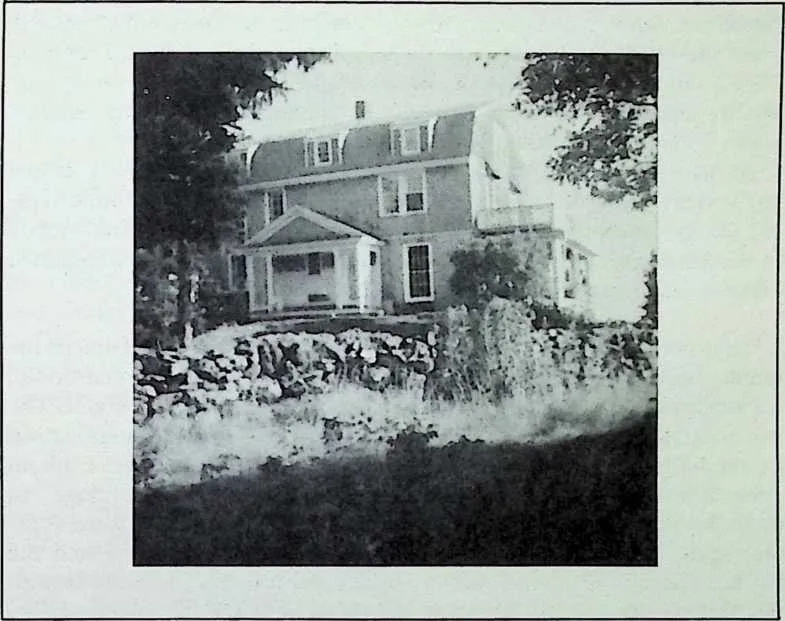
39 Bucky always remembers the Fuller’s first journey to what was now their own island because it set the pattern for all the subsequent trips he made as a boy. He and Woolly were awakened by the deep-toned whistle of the City of Rockland as she passed Owl’s Head Light at the entrance to Penobscot Bay. They dressed quickly and went up on deck in the still darkness to watch the ship steam through the bay. She passed Rockland Breakwater Light about four a.m. and, with much shouting, backing and filling, and heaving of hawsers, tied up at the pier. The gangplank was rigged, and the boys ran down it to the dock to watch the long process of unloading the steamer. First came piles of luggage; then many beautiful carriages with their teams and saddle horses were led ashore. They belonged to the rich summer “rusticaters,” as the Maine people call them, who lived in the famous Maine resorts, such as Bar Harbor and Northeast Harbor, North Haven, Eagle Island, and Blue Hill.
40 The horses and the carriages were reloaded on the smaller steamers Catherine, Juliet, and Sieur des Monts, which fanned out from Rockland, while the big Boston boat went on to call at Camden, Bristol, and up the Penobscot River to Bangor. In the bright morning light, Bucky and Woolly could see all those steamers as diminishing, faraway, smoke-plumed silhouettes against the bright blue water.
41 In his unpublished memoir of Bear Island, Bucky wrote, “All of the last seventy years of his life, the exquisite sensorial thrill of nine-year-old Bucky’s receptiveness to the sight, sound and smell, and the touch of the wind on his skin, at that Penobscot dawn-moment has remained his most memorable concept of nature’s beauty.”
42 That summer on Bear Island was sheer delight to Bucky. Though the families were rather crowded in the low, two-story, white-painted house, it did not matter for there was plenty of room to roam on the island. The two older King boys, McGregor and Andrew, lived in the house down by the harbor, which became known as the Boys’ House, and Captain John Johnson, Bear Island’s first “captain,” had another cottage. In those days the island was not as wooded as it is now. There were vegetable gardens, big hayfields, and workhorses to pull the plow and the big farm wagon. Captain Johnson farmed and fished for a living to supplement the money the family paid him to care for the island. There were, of course, no modem conveniences such as indoor plumbing, but deliciously cold water was hauled in buckets out of one of the wells. Later, cisterns were built at the corners of the houses into which rainwater ran down pipes from the roofs. This was used for washing.
43 At first Captain Johnson’s fishing boat was the Bear Islanders’ only means of reaching the mainland. Then came a sloop with one of the earliest auxiliary gasoline marine engines which required “gallons of sweat relevant to priming the engine, testing the spark and rolling the flywheel” to get her started. And soon the little harbor was filled by a fleet of small sloops and catboats belonging to various members of the two families. A bit later, Mrs. Fuller bought the Wego, a small cabin cruiser with a marine gasoline engine. In 1905, Bucky had a little sailing dinghy called the Sea Bird in which he rowed or sailed to Butter Island or Eagle Island to get the mail. It was about a two-mile trip each way, an arduous row for a young fellow just ten years old, especially as there were strong tidal currents and frequent fogs which required navigation by compass.
44 This produced Bucky’s first practical invention. He thought rowing with his back to where he was going, constantly looking over his shoulder to correct his course, a very inefficient way of moving a boat through the water. And he thought of the white jellyfish who shoved themselves through the sea by spurting out small jets of water. This led him to imagine and construct a “mechanical jellyfish” to push his boat along. It was a web-and-sprit cone mounted like an inside-out umbrella on a pole that could be pulled and pushed through a ring mounted on the stern board of his dinghy. When pulled through the water the cone would close, thus offering very little resistance; when pushed back it opened, giving the boat a powerful thrust ahead, driving her along far more quickly than the oars. Sitting in the stern shoving his boat through the sea, Bucky was always looking ahead, a thing he has done all his life.
45 Dick Fuller gave his son his first real boat in 1906. It was a lovely little keel sloop, eighteen feet overall, stone-ballasted, fast and able, built for him by Captain Johnson. When she was ready for launching Mr. Fuller asked Bucky, “What would you like to call her?”
46 “The Cuspidor,” Bucky said eagerly.
47 Mr. Fuller was shocked by this piece of vulgarity on the part of his son. He furiously told Bucky that he did not deserve to have such a boat and almost took it away then and there. In tears, both at the prospect of losing his boat, and even more upset by having angered his father, Bucky explained that he did not even know what a cuspidor was. He had been thinking of the old sea chanty in which “the good ship Cuspidor sailed from Baffins Bay,” so the word had a heroic sound to him. Mr. Fuller, delighted with his sort of innocence, was appeased. They conferred about other names and finally settled on Ursa Minor, the constellation of the Little Bear.
48 The crowded conditions that first summer, and the birth of Bucky’s little sister Rosamund, made the Fullers decide to build a proper house on the island. During the winter of 1906, Dick Fuller’s Harvard classmate, Henry Wadsworth Longfellow, Jr., known as Waddy, designed it for them. In the spring Mr. Sewell, a contractor from Cambridge in whom they had justifiable confidence, was engaged to build it. Sewell chartered the schooner Polly, a historic relic built in 1805, which had fought the British in the War of 1812. Into her he loaded all the lumber, nails, copper gutters, glass, hardware, and tools he needed together with his crew of carpenters and laborers.
49 On June 6, 1906, the Polly anchored off Dining Room Beach on Bear Island where she lay for three months, serving as a warehouse for the building materials and quarters for the workmen. The Big House, as it is called, was built on the edge of the high cliff on the southeast promontory of the island, close to where Elder Eaton climbed that tree. Mrs. Fuller supervised every stage of its construction. Bucky, fascinated by the technique involved in building the first house he had ever seen rise from bare earth, was constantly on hand.
50 When completed it looked quite grand; for it dominated the whole island before the shingles weathered to blend with the gray rocks, and friendly trees grew up around it. It was typical of the big summer cottages of the era; two stories tall with an attic under a hipped roof. One long living room with a big fieldstone fireplace, built by Mr. McDonald of Castine, dominated the ground floor with two bedrooms off it, one of which was occupied by Bucky’s parents. Grandmother Andrews had the large southeast room on the second floor, and the Rockwell Kings had the big northwest room. Smaller rooms were assigned to Marjory King, Leslie Fuller, and baby Rosey. The southwest room, now used by Bucky and Anne Fuller, was the guest room, first occupied by the Ellery Sedgwicks of Boston. Bucky and Woolly had the whole unpartitioned attic. They often ran races around it, which, when done too early in the morning, brought frequent spankings.
51 Almost every room had a porch or balcony commanding superb, 360-degree views of the island-dotted bay and the Atlantic beyond. At night one could see six lighthouses flashing, each in its special time sequence for mariners’ identification.
52 McGregor and Andrew King still lived down at the Boys’ House, a good half mile away. Bucky was grateful for this arrangement, for the King boys, being three and six years older than he and strong and handsome, were lords of the island. They treated Bucky with friendly contempt, bossed him, and hazed him. Bucky says, “They were a very powerful influence on my life experiences as a kid. I don’t think they thought very well of their eastern cousins, and my mother was eager for them to harden me up and make me into something they thought would be an acceptable character.”
53 In fact, he was quite strong and resilient for a boy of his age; able on the sea and efficient at making things with his hands. When he was only thirteen he built a cabin for himself out of lumber and shingles left over from the Big House. He named it Birch Lodge and, considerably enlarged, it is used today to house some of the eager young people whom Bucky’s fame and unbounded hospitality attract to the island. He also made various pieces of furniture for the Big House, and invented a record cabinet to hold Victor records upright in easily accessible divisions like those sold commercially many years later.
55 Bucky thinks the King boys’ rather contemptuous attitude was partly due to Midwesterners’ general disposition to regard Easterners, and particularly New Englanders, as effete. Of course, this was a riposte to the Easterners looking on anyone from west of the Alleghenies as crude. “There was really a very strong feeling in those days between Chicago and the East,” said Bucky. “It persisted for many years. When I first went to live in Chicago in 1925, it was still apparent. At the Sunday Night Club, which was a meeting place for out-of-towners, our Chicago hosts would sometimes get up and talk disdainfully about ‘the effete East.’ Later, when the King boys went to Harvard and used to come to our house in Milton for Sunday lunch, their attitude was modified considerably, though not entirely. However, they were extremely interesting people and played an important role in my life.”
56 Those first happy days at Bear Island were soon clouded by family sorrow. Grandmother Andrews died in the winter of 1906, and in 1907 Bucky’s father suffered a severe stroke. The medical profession had not yet learned of the preventive methods that make repetitions of such things less likely, and Mr. Fuller’s first stroke was followed by others which rendered him progressively more helpless. To Bucky it was truly a heartbreaking experience. “It was a very extraordinary thing,” he said, “having been so loved and really well looked after by this father, to suddenly have him have these strokes. My mother was determined that he should have the best possible care, and not be separated from us, so she simply fixed up a room in our house in such a way that he would not have to go to a hospital. This meant that for the years between ten and thirteen I was leading my own father around by the hand, and to have this man, whom I loved so much, be unable to remember things or to speak to me, was a very extraordinary matter.”
57 So Bucky tells it, but the ever-ready tears gather in his eyes as he does so.
58 His father’s illness and death threw heavy responsibilities on Bucky’s shoulders. With the medical expenses and her income from the business cut off, Mrs. Fuller had to cut costs to maintain the kind of household she had been used to in Milton. Among the first to go was the handyman who tended the furnace in winter. Bucky inherited the job and other household chores. Stoking the fire, rolling out barrels of ashes, cutting grass, and raking driveways involved an enormous amount of muscular work. Bucky says, “The operation of a big house was a very prodigious matter; most people today have no memory of what it took to keep one of those big houses going. We did not have electricity because mother could not afford to install it. We used candles and kerosene lamps which had to be filled every day. I didn’t object to these things at all; it was a very, very rich part of my life experience to learn so much about how houses were run. I imagine this must have affected a lot of my feelings about what needs to be done to make things work.”
59 Thinking about those old-fashioned houses and his early experiences of them, Bucky observed that many people seem to relish the smell of old houses, the scent of decaying wood. “I did not like the way they smelled,” he said, “and incidentally, the smell of schools I thought was absolutely awful. The teacher would go and open the windows sometimes, but the whole thing seemed to stink to me—and the smell of the lavatories and toilets!
60 “I was also bothered a whole lot by the way the houses looked when I was young. The white ones were pretty, but many others were painted drab gray, or brown and yellow. The General Grant style of architecture, those big, grand mansions, did not seem grand at all to me. I found them formidable. The people in them were not, I felt, as kindly as they could be—in fact, they were pretty hard. These were the people who were being successful, making money, and so forth. It was an era of considerable hardness and they were not gentle. I identify that with the looks, feelings, and smells of those buildings.
61 “As for the city itself; Boston, I thought it horribly stinky. Yet I was in awe of it, and I explored it and I wanted to know what it was about. I was not afraid of it, I just didn’t like it but I was terribly eager to understand it.
62 “That is why I love Bear Island so much. I came here as a child of freedom. The island was so big you could get away from people—exploring beaches and wooded places. It has been a wonderful characteristic of Bear Island that mothers have never been afraid to let their children roam—a child doesn’t just walk over a cliff; he doesn’t make that stupid sort of blunder. So no child has ever gotten hurt here because of the boldness of it!”
63 Thus there was this great contrast in Bucky’s young life between the city and its suburbs, which he felt to be so formidable as to adversely affect the very souls of the people who lived there, and the freedom and simplicity of the island life—“the goodness of life here compared to that other…
6465That, Bucky believes, was the beginning of his interest in improving housing; the spark plug of his desire to make it possible for people to dwell in houses which, instead of stultifying their characters, would enlarge their spirits and liberate their natural goodness.