
17 Accelerated Toing and Froing
1Most of the millions that Bucky made out of the domes were promptly poured back into his expanding research organization for discovering further general principles of Universe and applying them for the betterment of mankind. The most elaborate of these efforts was the World Game,1 a survey of all the resources of the local subsystem of Universe known as earth. Virtually none of the money remains in his possession. The last ambition he would hold would be to leave a large estate.
2 However, Bucky was not yet so totally dedicated as to neglect having a lot of fun spending some of the proceeds on himself and Anne, and also in making generous gifts to his less pecunious friends. Finding the author watching a black-and-white television set, he promptly asked permission to buy him the most expensive color set on the market, which offer was gratefully declined.
3 Suddenly Bucky turned up driving very expensive, fast foreign cars, though he continued to live in the little apartment in Forest Hills. The houses on Bear Island were completely rehabilitated (modernized? The Great Intelligence forbid!). He also bought Little Sprucehead Island and a share of Compass Island in his “microarchipelago.”
4 Bucky’s most extravagant purchase was the Nagala, a superb Swedish-built, thirty-square-meter sloop. Twenty-nine feet on the waterline, forty-three feet overall, with a tall, slightly raked mast and a highly polished wooden hull, she was so beautiful as to stop your heart. Being built expressly for racing, she had but a tiny cabin, sleeping two. When Bucky proudly showed her to Anne and his small grandson, Jaime Snyder (Allegra’s son), the little boy looked at her accommodations and asked, “Where are you going to sleep, Grandma?” assuming that he and his doting grandfather would occupy the cabin.
5 Anne laughed and said, “It’s all right, Jaime. I’m not going along.”
6 The truth is that Anne cares as little for sailing as she does for roughing it. On the rare occasions when she consents to go out on the luxurious Intuition, a yacht Bucky bought in 1969, she promptly goes down to the cabin and reads a good book.
7 Needless to say, Jaime and Bucky had many marvelous sails on Nagala, and Bucky frequently raced her in his “thoroughgoing” all-or-nothing fashion in the New York Yacht Club cruises and against the fleets of the local Maine yacht clubs.
8 When Bucky traveled, which he did, and does, a great deal, averaging at least 100,000 miles a year, he lived far more luxuriously than at home in Forest Hills—he always stayed at Claridge’s in London and, until he became so ascetic in recent years, ate copiously and well. Nevertheless, he once fed me one of the worst dinners it has ever been my misfortune to confront. We were all in London in the summer of 1963, and Bucky invited us to dine with him at a new Indonesian restaurant on the Brompton Road. The point was that its interior had been designed in a strikingly original manner by an architectural protege of Bucky’s.
9 The company, besides Bucky and ourselves, was Bohemian—a tall, heavily bearded youngish man wearing corduroy pants, a sweater, and a black beret, who turned out to be Reiner Bonham, editor of the British Architectural Forum, the world leader in its field; his brilliant and charming wife, who happened to have lost a leg, and a group of topflight students of both sexes, various races, and variegated taste in costumes.
10 The conversation was quite literally out of this world; but the food should have been thrown out of it. The British are scarcely known for culinary perfection even in their native dishes; when they attempt the exotic it is a major disaster. Even Bucky, flying high in dithyrambic discourse, was forced to notice it. In an apologetic tone he said to me, “This is pretty bad. I’m sorry, I could just as well have taken us all to Claridge’s.”
11 My boggling mind tried to picture our entrance into that famous restaurant where everyone wears black tie at night—Bonham in his beret and corduroys; Mary Bonham stumping along on her crutches, and me on mine, followed by the assorted students in their bathless brilliance. Yet I was convinced that Bucky—and only Bucky—could have got away with it.
12 Bucky’s chronofile records the steeply ascending graph of his worldwide recognition during those years. From Moscow to Tokyo and all places in between, he was in tremendous demand; his lecture fees rose to $5,000, most of which he poured back into research. Those who paid it got their money’s worth, for he seldom talked for less than four hours and more frequently for five or six.
13 This remarkable recognition was not entirely due to the domes, though their publicity value gave it the initial impetus. Rather, it was due to the substance of his discourses. In a disillusioned world in which the thinking was preponderantly negative, his unique view of Universe, untrammeled by outworn platitudes of which he had disinfected his mind long ago, was gloriously inspiring, especially to students the world over. One thing that made his lectures so exciting was that they were never a repeat performance. He never knew what he was going to say; he just walked out on the platform and began to think out loud. Absolutely anything could come out.
14 Of course, his theme would always be consonant with the general principles he had discovered, or the inferences he drew from them. But each time he spoke he would add new refinements, and inferences he had not previously drawn would suddenly come clear. Rarely, but with electric spontaneity, he would actually glimpse a new general principle as his vocal thinking ranged far into the ultimate mystery of the cosmos. As he has said, “Development is programable; discovery is not.” It is not something a computer or the human brain can make through calculation or ratiocination, for “knowledge is of the brain and wisdom is of the mind; discovery comes to the weightless, metaphysical mind as a flash of transcendental light. It is synergy, a sudden comprehension of the behavior of a whole system, totally unpredictable by the behavior of any of its components or subsystems, and therefore cannot be sought by empirical methods—since the brain cannot know what it is looking for—but only apprehended it as revelation by ‘exquisitely prescient minds.’ ”2
15 The ultimate mystery of the universe is too profound and too complex ever to be grasped in its entirety by the human mind. It is “the maximum synergy of synergies.” But each bright insight vouchsafed to man’s intellect, each generalized principle recognized always accommodates to and works with, never contradicts, all previously discovered general principles. This proves the existence of an Intellect beyond the powers of our apprehension. It is because this is so that the mystery will remain, but each true insight increases the leverage of humanity and their chance of becoming a success in Universe.
16 Thus these occasional insights that Bucky has when thinking out loud are not only tremendous occasions for him but for his entire audience. Even their explication after the event to other audiences, at second hand so to speak, are almost equally exhilarating. For each time he thinks about them he sees more clearly; and his listeners, hearing them for the first time, are enthralled by the freshness of the concept, which makes it all tremendously worthwhile.
17 In 1958, on his first trip around the world, Bucky stopped off in India where he had numerous speaking engagements. One day he made three speeches in New Delhi, in the morning, afternoon, and evening. At all three meetings he noticed a striking youngish woman dressed in exquisite saris, who usually sat in or near the front row listening intently, her large dark eyes refulgent with intellectual excitement.
18 At the evening lecture, Bucky used a little tensegrity sphere model, only about six inches in diameter, made of string and small turnbuckles. After the lecture he was presented to the lady, Mrs. Indira Gandhi, Prime Minister Nehru’s daughter. She was so interested in the model that he gave it to her. Mrs. Gandhi asked him if he would come on Saturday to meet her father at their house. Bucky says, “I did meet him and we had a very extraordinary time.”
19 At the appointed hour Bucky drove up the broad Teen Murti, the splendid avenue lined by imposing government buildings and official residences built by the British at a time when they expected their empire to last forever. At one end of it was the huge Vice-Regal Palace, with its golden dome and wide spreading wings, which had become the Indian president’s house. Nehru lived at the other end in the former British Commander-in-chief’s residence, a massive red sandstone palace whose architecture has been described as “British monumental.” Bucky passed through high, wrought-iron gates, which stood open all day long, and up a long driveway which curved around in front of the house between lawns and beds of brilliant flowers. Indian servants in white uniforms showed him into a high-ceilinged hall beyond which he could see another imposing hall, with long windows looking on a garden of splendid trees, green turf, and gay beds of English flowers. To his right was the receptionist’s lobby with a round table and a statue of Mahatma Gandhi; on the left through great double doors was the huge room where early every morning Nehru received the plain people of India who came to ask for his help, or for justice.
20 The servants led Bucky up a monumental staircase and through other elaborate public rooms to the smaller reception room of Nehru’s private suite. There he was left quite alone.
21 Presently the door opened and Nehru slipped into the room. The “George Washington of India” was a slight, gentle man with a long, sensitive face. He was wearing the long white tunic with a rosebud pinned on it which has become known throughout the world as a “Nehru jacket.” Silently he bowed to Bucky, making the Hindu sign of greeting with his hands folded palms together before his face.
22 Bucky made his formal, stiff little bow in return and, sensing what was expected of him, began to think out loud. Just what he said that day no one will ever know, for it was, as always, purely spontaneous. Nehru, who probably remembered it, is dead and Bucky cannot recall his words.
23 Though he has the deserved reputation for speaking at unconscionable length, Bucky is capable of holding to a time limit when circumstances enforce it. On this occasion he realized that the Prime Minister had a limited respite from the pressure of other business, so he held his discourse within reasonable limits. In the time he allotted himself he endeavored to give Nehru the essence of his philosophy and the logical reasoning on which it was based. During the entire period Nehru stood quietly intent, absorbing Bucky’s words.
24 At the end of an hour and a half Bucky stopped talking. Once again Nehru bowed with folded hands and left the room. He had not spoken a single word.
25 Odd though this might seem, Bucky understood perfectly that Nehru wanted to keep his mind clear and uncluttered by irrelevant courtesy sounds to meditate upon the thoughts he had heard. It was the highest compliment the great Indian leader could have paid him.
26 As Bucky was leaving, Mrs. Gandhi stopped him and said, “Come to see us whenever you are in India.”
27 So he had several other, more convivial meetings with Nehru, who was at pains to tell him that he had read all Bucky’s books and admired him greatly. In fact, the unusual combination of scientific expertise and mysticism in Bucky’s thinking accorded empathetically with Nehru’s English-trained, Asian mentality—the concept of personal survival as an indestructible pattern of integrity is not unlike Karma.
28 Bucky was in India in the winter of 1964, when its people were stricken by the news that Jawaharlal Nehru had suffered a stroke. He telephoned Mrs. Gandhi at once, who said: “Will you please come over right away? I’ll send a car.”
29 Even the Prime Minister’s car had difficulty getting through the incredible mass of people outside the great iron gates, now closed, and packing the wide Teen Murti almost to the limits of vision waiting for news. Bucky hurried up the steps and through the rooms, peculiarly desolate now in their grandeur.
30 He was shown into Mrs. Gandhi’s private sitting room. In Bucky’s words: “Indira Gandhi came into the room with tears in her eyes and told me about her father’s stroke. She was really absolutely forlorn.”
31 Bucky gave her what consolation he could, speaking of his admiration for Nehru and their empathy. Then he says: “What do you talk about with somebody under those conditions? I said to her, “If your father were not to recover would you try to carry on his political work?”
32 “She said, ‘Oh, no! I would not think of it; and I’m not suited to it. I do know much about it because I have been with him through it all, but I do not want to try to replace him.’ It was clear to me that she meant it.”
33 This emotional talk with Mrs. Gandhi gave Bucky one of his “strange insights.” He felt that he had looked into her soul and found it pure.
34 When Nehru died in May of that year, Lal Bahadur Shastri tried to fill the vacuum his death had created in Indian leadership. He begged Mrs. Gandhi to accept the post of Minister of Information and Broadcasting in his cabinet. Nehru’s sister, Krishna Nehru Hutheesing, has written: “This was the first time Indira broke down. Weeping, she told Mr. Shastri that she did not want any place in the government; she only wanted to work for her father’s memorial.”3
35 But Shastri was insistent. The Congress Party was in disarray; he needed Indira’s name for the sake of unity, and at last she consented.
36 When Shastri died suddenly less than two years later, in January 1966, the situation was even worse. Strong men of the Congress Party like Krishna Menon and Morarji Desai, who had little in common with Nehru’s ideals, were avid to seize power. To preserve her father’s lifework, Mrs. Gandhi ran for Prime Minister and was elected.
37 Bucky says: “They sucked her in. I wrote to her saying that because of my having had that extraordinary moment of being with her, I knew that what she was doing was not due to political ambition. Exactly the opposite! That she was doing it simply because of her dedication to her father and the wonderful ideals he had brought her up with, and her commitment to them.”
38 Bucky added: “I realized that Mrs. Gandhi is not there with the usual drive that politicians have, the feeling that ‘I can handle people’s problems better than others can.’ That was one of these two strange insights I have had—about Einstein and about Indira Gandhi.”
39 So to Bucky Mrs. Gandhi remains the one politician whom he trusts and loves. It is indicative of his political innocence that it never occurs to him that after years of power she might have changed. So completely does he accept his “insights” as revelation, so total is his loyalty once given, that no matter what she did he would never think of applying Lord Acton’s aphorism about the corrupting effect of power to her.
40 For him she remains as pure as Joan of Arc. But however much he may now be in error, it is certain that, in the emotion-charged moment in the Prime Minister’s house, he saw her truly as she then was.
41 It is significant that Bucky’s favorite politician is a woman. He regards women as being more in tune with Universe than men, more important to its functioning. Nature, he says, employs “discontinuous compression and continuous tension; for this reason compression is plural, tension singular.” Life begins within a woman, with early life overlapping its mother’s, the new wave emerging from within the older wave. Women are in continuous tension. Males are in discontinuous compression, fighting, jabbing, spearing…
42 Women were the inventors of civilization, Bucky believes. While the men were off hunting, exploring, having fun, and bringing home the kill, women kept the hearth fires going; planted crops, spun and wove, dried the skins and combed the wool for apparel, invented pottery; in fact, “they invented industrialization” by organizing the different tasks, inventing the tools to perform them, and consolidating the gains.
43 As long as primitive economy existed, men were important as providers and as fighters to protect these islands of civilization. But as industry became ever more complex and efficient, hunting grew more obsolete, while men’s superior fighting ability was offset by the invention of gunpowder and then the revolver—the great equalizer. Thus men’s functions became less important. So what did they do then, those discontinuous villains? They took woman-invented industry and ran it themselves as “a competitive weapon for augmenting widely ranging exploitations and plunder.” Women were downgraded to the “sad state” in which they found themselves in the Victorian era.
44 However, Bucky believes that this situation is rapidly being reversed. For the last half-century women, particularly in America, have inadvertently taken over ownership control of a majority of the shares of the great corporations simply by outliving their husbands and inheriting the corporations. But they still let men run them through powers of attorney, trusteeships, and so forth.
45 Bucky believes that it is going to be different from now on: “Woman is now entering the ownership management of commerce and industry to an ever more important degree. By the twenty-first century she will have taken over full management of Spaceship Earth.”
46 Bucky views the prospect with satisfaction. He writes, “Twenty-first-century woman will retain her tension-integrity continuity and will yet cohere the Universe. . . 4
47 In 1959, Bucky changed his base of operations. He accepted an offer from Southern Illinois University in Carbondale to become Research Professor there at a salary of $12,000 a year and perquisites. The perquisites were far more important than the insignificant salary. They included an office and staff and a building in which to conduct his experiments and research, and to house his ever-accelerating chronofile, which he tentatively presented to the university.
48 In return Bucky agreed to deliver a few lectures and to hold seminars for students—at his convenience. There were virtually no limitations on his “toings and froings,” as he called his dizzying circumnavigations of the globe. What Southern Illinois mostly profited by was the reflected splendor of his name. This was no small item. During Bucky’s thirteen years there the university’s student enrollment went from about 5,000 to over 30,000, only partly due to him, of course.
49 When the Fullers’ apartment in Forest Hills was burned out, Bucky built a dome on a small
corner lot in Carbondale as a home for himself and Anne. It was a small (thirty-nine-foot
diameter) structure of blue and white plywood with tall door-windows facing in four directions.
Privacy was obtained by a high board fence around the lot. There was a spacious living room
ceiled by the airy hemisphere of the dome. The
kitchen-dining room and utility rooms were under a cantilevered halffloor on which
were the library-balcony, the two bedrooms and baths (not Dymaxion), and clothes
closets.
50 The dome house was furnished in an odd blend of the very best modern-design furniture and some of Anne’s beautiful antiques. It would seem a discordant combination, but it was not. Instead, the effect was serenely beautiful, even luxurious. Bucky explained this paradox: “Anything that is exquisitely well designed of any period harmonizes with things that are equally well designed no matter when they were crafted.”
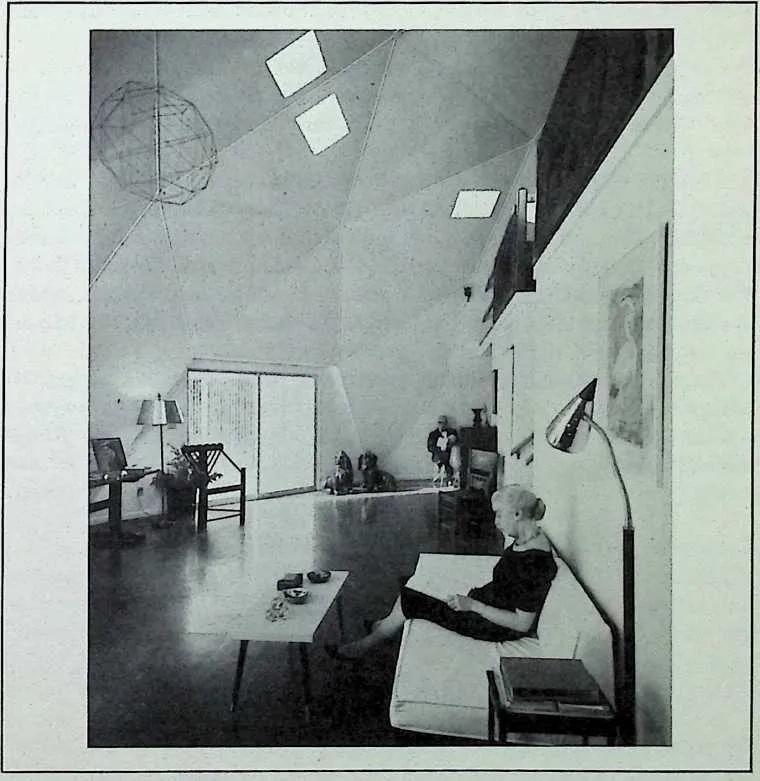
52 When Anne was asked what living in a dome was like, she said, “Well, of course, the only thing different is that you don’t have flat walls. We had circular bookcases around the balcony; they were nice. The bad thing was you could not hang paintings because they would be just sort of dangling out from the curve. The only place I could put them was on the flat partition wall between the living room and the kitchen.
53 “The dome was very nice because we had enormous windows around the whole circle. We had the garden with a fence you could not see through although the air could come through, and there were lots of trees that screened and shaded us. So we used to be outdoors a lot. We would spend Christmas with Allegra in California and we always went away in the heat of summer.”
54 Asked how she kept all those windows clean, Anne said, “Well, of course, I could reach them. So I used to have squeegies and spray the hose on them. It took about five minutes for each door. Those squeegies were great.” 5
55 Though Anne found her dome convenient and comfortable to live in, she was never exactly enthralled with Carbondale which, apart from the university contacts and resulting intellectual excitement when Bucky happened to be home, lacked most of the amenities of civilized living. For any sort of contact with the world of art, music, and theatre, which she enjoyed, she had to journey across the flat prairies and the Mississippi to St. Louis, or, preferably, even farther.
56 Bucky, who resembles Kipling’s cat—“all places are alike to him”—except, of course, Bear Island—was so delighted at last to be living in one of his own domes that he wrote a parody of Home on the Range which he would sing, off key, at the slightest excuse:
5758Let architects sing of aesthetics that bring
59Rich clients in hordes to their knees
60Just give me a home in a great circle dome Where the stresses and strains are at ease.
61Roam home to a dome, where Gothic and Roman once stood Now chemical bonds alone guard our blondes And even the plumbing looks good.6
62 Naturally, Bucky spent very little time in Carbondale, a nonconsecu-tive month or six weeks a year at most. Universities and learned societies all over the world were recognizing the profoundly original thinking of this man, who in ordinary academic terms had no education at all, only honorary doctorates and other intellectual honors. The very first one to jump on the Fuller bandwagon was North Carolina State University, which gave him the honorary degree of Doctor of Design in 1954. Michigan University made him a Doctor of Arts in 1955, and Washington University gave him a doctorate of science in 1957. Other degrees followed thick and fast—doctor of fine arts, Southern Illinois, 1959; humane letters, Rollins, 1960; letters, Clemson, 1964; three more doctorates in 1964, and so forth and so on. The year 1970 was a banner one with doctorates from the Minneapolis School of Art, Park College, Brandeis University, Wilberforce University, and Columbia College. That year Oxford University gave Bucky the ultimate accolade by making him a Fellow of St. Peter’s College—a don. According to the old limerick, this meant he was entitled to a swan. But the honors Bucky prized most were those he received from his sometime alma mater, Harvard. As we have seen, he first lectured there in 1950. He was there again in 1960; this led to a rather amusing incident.
63 On that occasion his Harvard classmate and cousin-through-the-Fullers, novelist John P. Marquand, sat beside him on the platform. Years before, Marquand had been asked to contribute memories of Bucky for an article in The Saturday Evening Post. Influenced by his recollections of Bucky’s less-than-glorious career at Harvard, and the family opinion of those days that Bucky was a no-good, irresponsible nut, Marquand wrote the Post a very derogatory letter. Bucky says, “He obviously didn’t think much of me, but he said some very amusing things.”
64 The night of Bucky’s lecture at Harvard, it appeared that Marquand had not changed his views. He was fairly sweating with a terrific attack of stage fright on Bucky’s behalf, fearful that he would disgrace the family. Bucky humorously described the scene: “John kept holding my hand. As more and more people crowded into the great hall, he kept saying to me, ‘Bucky, do you realize that all these people are coming to hear you?’
65 “He clearly was trying to comfort me and strengthen me, and expected me to make an awful fool of myself. He only knew about my cars and my dome, and probably thought I was just a mechanic and could not possibly talk to these people.”
66 Bucky did talk to “all those people” for about three hours. When he ended he received a standing ovation, not exactly a usual thing at Harvard.
67 Summing it all up Bucky said, “This apparently completely changed John’s attitude toward me because he wrote a letter to our cousin Richard Fuller saying, ‘I was completely mistaken about Bucky. He seems to be the greatest member of the family.’ ”
68 Harvard’s change of attitude from 1914 was emphasized in 1962, when they invited Bucky to accept the Charles Eliot Norton Chair of Poetry. At the same time, the Harvard Chapter of Phi Beta Kappa voted to give the former dropout the golden key.
69 The extraordinary variety of Bucky’s honorary doctorates—science, design, letters, law, arts, etc.—clearly indicates the universality of his disciplines. His recurrent theme, that the mistake of modern education is the production of specialists when what the world needs is men who see things whole, is never better exemplified than in his own self. The cliche of comparing him to Leonardo and Benjamin Franklin is so obvious that it is made in dozens of articles every year. But its banality does not vitiate its truth. Though he may never achieve their historical fame, the comparison remains valid.
70 Other recognitions of Bucky’s accelerating fame came in invitations to join professional societies all over the world. Being an inveterate joiner—it makes him feel wanted—Bucky accepted many of them. They are as various as his disciplines, embracing astronautics, geography, metals, machinists, engineering, semantics, philosophy, ecology, ekistics, science, education, and the arts. Naturally, he belongs to numerous architectural societies, from the Royal Institute of British Architects to the Royal Society of Siamese Architects, et cetera, et cetera, as a former monarch of that country is reputed to have said.
71 Bucky’s world-around traveling also accelerated. He was particularly popular in Russia and Japan. The fact that he was so apolitical and regarded politics as completely irrelevant enabled him to work harmoniously with people of any ideology. He says: “I am persona grata with all political camps because I am transpolitics. In fact, I could get out a joint manifesto with many extremists of both camps, radicals and conservatives, because they think alike in many things, and they think like me in many things.”
72 In 1972, Bucky gave the baccalaureate address at the University of Virginia, the only time it has been given by a man who was not a Virginia graduate. He spoke of the sentimental attachment of the students to Jefferson because of his founding of the university. Most people nowadays pooh-pooh Jefferson as an old-fashioned liberal. “On the contrary,” Bucky said, “Jefferson’s truths were so far ahead of his time that Jefferson has not died. He is very much alive on the campus because his truths are still alive, and now becoming more manifest in the world.”
73 Then Bucky gave them his favorite quotation from Jefferson, “The truth is not fearful.”
74 At the dinner after the ceremony Bucky met William F. Buckley, certainly no Jeffersonian. However, as they talked they found many areas of agreement. Then Bucky in his blunt way said, “I would have assumed that I would not like you, but I find you charming.”
75 Buckley laughed and said, “We should get out a joint manifesto.”
76 “The extremists in both camps want to change things,” Bucky says, “and in certain cases they are both right. Entropy, the second law of thermodynamics, implies change. It is the essential quality of an expanding universe and therefore should not, and cannot, be opposed. I think of Tennyson’s verses:
7778“Not in vain the distant beacons. Forward, forward
79let us range.
80‘Let the great world spin for ever
81down the ringing grooves of change.’ ” 0
82 Bucky continued: “It is the customs and traditions that seem so fine and valuable that may bring about bloody revolutions because nobody wants to change them. And yet they stand in the way of progress. Eventually, the United States will have to go, just as all great nations will have to go. If there is enough of everything to go around, fighting for patriotic reasons becomes murder instead of a praiseworthy thing.”
83 With this philosophy it is no wonder that Bucky got along well with the Russians, even though he deplored their rigorous restrictions on independent thinking. This was particularly manifest at the Dartmouth Conference in Leningrad in 1964, where writers, philosophers, political
- 6.
- Locksley Hall, Alfred Lord Tennyson. economists, and scientists from both countries met to discuss world problems amicably in the hope of finding joint solutions.
84 Among the Americans present was Norman Cousins, liberal author and, at that time, editor of the prestigious Saturday Review (now of Saturday Review/World magazine). Bucky and Cousins became and remained “very great friends.” Cousins gave the author a vivid description of the beginning of their friendship and of Bucky’s principal contribution to the conference:
85 “Bucky and I sort of paired off at the conference. I had my daughters, aged fifteen and nineteen, with me and one of the things that fascinated me was the way Bucky was able to develop an empathy with them in a very short time; he completely hypnotized them. I remember coming into the hotel dining room in Leningrad for breakfast. After the greetings Bucky continued to explain to the girls some new theories in regard to electromagnetic lines of universal force. I was lost but they were not.
86 “At the conference, one evening was set aside at which each group would put up its futurist for the purpose of looking at life after the year 2000. The Russians were represented by Eugene Federov—spelled F-e-d-e-r-o-v—the head of the Soviet Academy of Science. Of course, the Americans put up Bucky—I’ll spell that, too—G-E-N-I-U-S.
87 “It was a sort of intellectual gladiatorial contest and obviously each side wanted to show to advantage. The Russian spoke first. Federov was very good, as very methodically and very systematically, with supporting data, he talked about life in the year 2000—what the world population would be; what the world resources would be; and what the demands on those resources would be. It was a very impressive, cold turkey approach to the problem.
88 “Then Bucky spoke. As he usually does, he put his head forward, closed his eyes, clasped his hands and went soaring—and we went with him, piggyback on his magic carpet. He spoke for at least an hour and a half. Federov, who sat next to me, was entranced.
89 “Then, when Bucky completed his rarefied journey, Federov looked at me and said, ‘The Americans win. No question about it! Mr. Fuller was magnificent. Never have I heard anything as daring, as really wonderful as this. Now tell me, what did he say?’
90 “This illustrates my point,” Norman Cousins continued, “that it is not necessary to know exactly what Bucky says in order to grasp his essential meaning or to be elevated by his message. There is a quality of inspiration, and inspiration always transcends information. A quality of inspiration comes through in Bucky’s presence or his words, especially when you have the two in combination, that has quite an independent meaning.
91 “I would hate to be asked to summarize after Bucky gave a talk because that would be essentially the least important part of the transmission. The most important part is not transmittable, except by Bucky. And that is the sense that he clearly conveys, that it is possible to have a better world than we have today. That the universe is waiting to cooperate with us if only we know how to tune in properly to it and understand its laws as well as its allures.
92 “This is in the sense that there is a universal citizenship, or a citizenship of the Universe, beyond our existing parochial citizenships. And that there is a realm of cognition far beyond our limited horizons. Bucky becomes a master guide to this realm. I know no man who makes you feel so perfectly at home in the Universe as he does…”7