
19 Anne’s Taj Mahal
1In the mid-1960s, Bucky felt he was slowing down. By anyone else’s standards he was still a lightning bolt, but this was not good enough for him. Taking stock of his situation he reasoned, “Either it is old age, in which case I can do nothing about it; or I am overweight,1 in which case I can.”
2 Seeking a method by which he would lose weight without loss of energy, he considered the various foods available to him. He reasoned that the energy of the sun was transformed into vegetation by photosynthesis. This process was then carried a step further by vegetation being eaten by cattle and transmuted into high-protein meat. Ergo, he would get maximum energy with minimum calories if he ate virtually nothing but lean beef.
3 The diet he adopted consisted of three-quarters of a pound to a pound of steak for breakfast, lunch, and dinner. At the two latter meals he ate a little raw salad and fruit for vitamins, f The cut of beef he prefers, because it has the least fat, is London broil. It is usually served in thin strips because it is so tough, but Bucky cheerfully chomps great hunks of it with his magnificent teeth.
4 The Fuller diet worked for Fuller. As the pounds dropped off, his youthful energy returned in its plenitude. He now weighs a trim 140 pounds, exactly the same as when he was a young lieutenant in the navy.
5 It might be supposed that this eccentric diet would prove quite a strain for Bucky’s hosts in a time of astronomical prices for beef; but he is a most considerate guest. He insists on going to town and buying his own steaks in four-pound pieces—two days’ supply. Furthermore, he cooks them himself in a frying pan. The author recalls going out to his kitchen one morning to find Bucky tending the sizzling pan and doing a soft-shoe dance in front of the stove in sheer youthful exuberance.
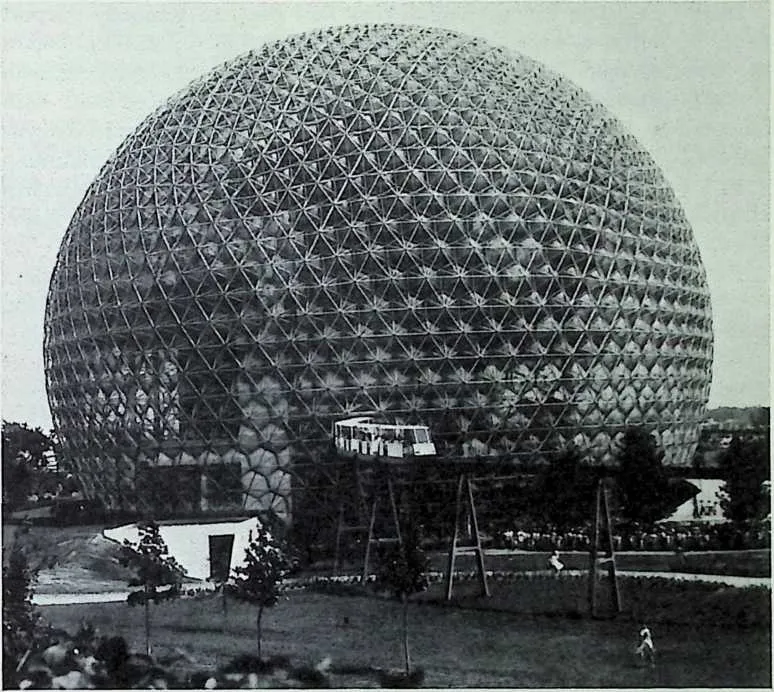
6 The year 1967 was the best and the worst for Bucky. That was the time when the most beautiful of all the geodesic domes so far built was opened as the United States Pavilion at Expo ‘67 in Montreal. Back in 1965, the U.S. Government had asked Bucky to help them plan their exhibit. He had proposed a giant World Airocean Map showing all the resources of the world, the peoples, their conditions and needs in a bird’s-eye view such as he later envisioned for his World Game. When this was turned down he simply designed the great geodesic dome for them.
7 Bucky and Shoji Sodao, assisted by young architects and engineers from MIT, worked on the plans. Bucky had met Shoji when the young Japanese, then a student at the Cornell Architectural School, led Bucky’s project of building a miniature earth on top of the Electrical Building at the university. They became fast friends and then partners in the dome-designing firm of Fuller and Sodao, Inc., at 12 Arrow Street in Cambridge.
8 Shoji, who was a summa cum laude graduate, has become Bucky’s right-hand man whom he takes with him on all his most important design projects. He was a rather somber young man, though full of goodwill, always helping other students and completely devoted to Bucky.
9 Though Shoji is so modern in his architectural ideas, he is a great traditionalist in his personal life. For example, when he decided to marry he went about it in the ancient Japanese way even though he was bom in America and fought in the Nisei Division in Italy in World War II. He contacted a go-between in Japan who made the arrangements with the prospective bride’s go-between. “Go-betweens are like seconds in a duel,” Bucky explained. Photographs were exchanged; then a meeting was arranged, and they became engaged.
10 That engagement lasted for twelve years. “I thought they would never do it,” Anne Fuller says, “but Shoji came to Japan last year while we were there and suddenly the marriage took place. Shoji was forty-four; his bride was forty-two.”
11 According to Bucky, it is an entirely fortunate marriage. “She is a queen,” he says; “and from being so somber and serious, Shoji has become happy and carefree.”
12 The plans Fuller and Sodao drew for the huge “skybreak bubble,” as the three-quarters sphere of the Expo Dome was called, were like no other plans the builders had ever seen. For, except for a few details of the hubs where the compression members were joined in hexagonal radii, there were no drawings at all, simply tables of figures with which to index the machine-tools that so accurately stamped out the stainless steel alloy components. From there on it was merely a matter of riveting them in place according to the color coding; it was all done with mathematics.
13 Since there could be no convenient bridge for the workers, as in the Ford Rotunda Dome, finding steelworkers willing to work two hundred feet above the ground without the security of a conventional steel-beamed structure under their feet presented a problem. It was solved by employing Mohawk Indians who did not mind dizzy heights with only the distant ground below seen through the delicate lattice of omnirepetitive triangles.
14 Another problem was the matter of overheating from the sun. This was ingeniously solved by Bucky. Instead of the customary plastic skin, the covering was made of thousands of separate triangular plexiglass panels so they could turn individually. They were operated by over two hundred and fifty electric motors hitched to a computer that was programmed to open or shut them in response to the weather conditions outside. Other panels were equipped with light sensors that raised or lowered shades as the sun in its diurnal passage commanded. The dome theoretically weighed approximately 600 tons; however, in conformity with Bucky’s theory of the buoyancy of large domes, the weight resting on its foundations was considerably less than the total weight of its components when the air inside was warmer than the surrounding atmosphere.
15 The elevated monorail train, which carried visitors around Expo, ran right through “Bucky’s Bubble,” as some people called it: and the interior was filled with exhibits mounted on platforms staggered at different levels, carrying out the theme the U.S. Government had chosen: Creative America. The millions of visitors cared little for these sideshows; for they realized that the dome itself was the most creative thing America had produced in the last fifty years. Two hundred and fifty feet in diameter, tall as a twenty-story building, the great, iridescent bubble dominated the entire exposition. Imposing as it was from the outside, it was even more awesomely beautiful from within.
16 As one looked upward through its enormously high, clear hemisphere, which clouds and sky seemed almost to touch, the slender tracery of its structure looked as ephemeral as gossamer filaments.
18 On May 28, 1967, Bucky and Anne went to Expo ‘67. They were overjoyed by the acclaim they received, and particularly by overhearing the enthusiastic comments of the crowds as they walked through the dome’s glittering interior. Bucky says: “It was a wonderful thing for the year of our fiftieth anniversary. To Anne the Expo Dome seemed to give validation to the extraordinary backing she had given me. To me it proved that the revolution on Spaceship Earth and the salvation for mankind that it would bring about would be gained primarily by design revolution and not by political revolution.”
19 To Anne, Bucky said, “I have inadvertently brought about the production and installation of our own Taj Mahal as pure fallout of my love for you.”
20 In this euphoric frame of mind they flew back to Kennedy Airport on Long Island and took a taxi to New York. On Queens Boulevard the cab smashed into the back of a truck and they were thrown violently against the front windows. Rotund Bucky bounced back with only a few bruises. Anne struck her head and was dazed. Crowds gathered, police cars and ambulances arrived with sirens screaming.
21 In a few. moments Anne’s head cleared and she shakily said she was all right. So, instead of going to a hospital, they went on to the St. Regis Hotel.
22 But Anne was more badly hurt than she knew. In the next few days she developed excruciating headaches and dizzy spells. Finally, she realized that something was terribly wrong.
23 Fortunately, Doctor T. I. Hoen, one of the great neurosurgeons of America, was a close friend of the Fullers. The moment Doctor Hoen was told of Anne’s condition he ordered her to the New York University Hospital, of which he was the head surgeon. There tests showed that she had suffered a massive brain hemorrhage. Armed with his fantastic skill and inspired by his deep affection for his patient, Doctor Hoen opened Anne’s skull and with infinite care drained off the coagulated blood and made delicate repairs. No one, not even Doctor Hoen, knew whether she would ever regain consciousness, whether she would live or die, or should she live, if she would be an inanimate heap of flesh.
24 Bucky was almost out of his mind. For all his dedication to his great mission, he felt he could not go on without Anne; she was, and always had been, his balance wheel, or in his sailor’s phrase, his “anchor to windward.” In this traumatic period, Gene Fowler wrote him a beautiful letter which gave him exceeding comfort:
2526Dear Bucky:
27Anne is a woman of considerable strength. She will not leave you to continue alone. I have known for a long time that Anne’s strength, beauty, and grace were in your work. It makes sense that this skybreak bubble should be, not a monument, but an embodiment of your love for her.
28You have constructed something slightly tougher than a human being, but with the same beauty and grace; and knowingly set into materials torn from earth and shaped through our fires and minds a memory to outlast one remembered and then once remembering; knowing a woman large enough to be seen from space; and knowing men may enter and share.
29More than the Taj, Bucky!
30With love
31Gene
32 Anne did not leave Bucky. Doctor Hoen’s skill prevailed and She completely recovered to fly with her husband to further triumphs in what poetically speaking men still call the four comers of the earth, though they know these are but geodesic lines on the surface of a sphere.
33 Of their later life together Bucky, somewhat incoherent from emotion, says: “Anne is a woman who has constructed a world of her own, that she really feels right in, and she does not try to know how man learned words or what might be the construction of the universe. She has a universe of her own that works very well for her. And very deep faith. And an absolute commitment to love—when she loves she loves forever.
34 “Her universe contains many very beautiful conventions. In a sense I have sometimes violated what those conventions hold for her.
35 “For there is a force in me that makes me have to be comprehensive, to understand all the things I can about Universe—my universe that is so different from Anne’s. I have heard people, whom I consider very good observers, say that when two people, who are as diametrically different as Anne and I, get married, it either cracks up right away, or turns out to be fantastically good. That is the way it has been for us.
36 “You have got to understand what’s going on. She has knocked a lot of the nonsense out of me. Certainly one of the most beautiful things about our marriage is that each day now it gets more beautiful. We both are really just having a happier and happier time in life. It’s very, very beautiful; you know, a fantastic kind of time.”