
16 The Apotheosis of the Dome
1Early in 1949, prior to his last summer at Black Mountain, Bucky and Anne were driving down to North Carolina State College, where he was to give a series of lectures. As he drove expertly at high speed along the narrow Virginia roads, he was thinking out loud. “I am absolutely confident about the geodesic thing now,” he said. “After our experiments at the Chicago Institute and the completion of my calculations, I know it really works. But I have exhausted all our money and we are not getting enough from this lecturing to move very far—I keep spending it all. I don’t know how to go on.”
2 “How much will it take to get the thing going?” Anne asked.
3 “About thirty thousand dollars,” Bucky answered.
4 “Then go to me,” Anne said. “I can lend it to you.”
5 In Bucky’s words, “Anne had inherited another legacy. So she sold all her IBM stock for $30,000 and loaned the money to me. Had she kept it she would have been a millionairess now. On the other hand, on two different years when the radome program was at its height, our income was over a million dollars; and since then I have been averaging two hundred thousand dollars a year. Every bit of it I continually put back into my work—the World Game and the other research projects. But Anne realizes that we’ve had much more than if we had a million dollars. What really counts is what we have done for humanity. That is the payoff and it is incalculable.
6 “Somehow or other Anne was sure that I had really learned how to do this thing, and that it would really count. Boy, she was great!”
7 Almost lyrically, Bucky described his progress from then on: “For the first time I was really independent, not having backers to bother me with their greedy demands; and I said, ‘I will now undertake to go ahead.’
8 “Only $30,000, but it made all the difference. Out of this came the bigger domes that proved my theories. I would buy two or three thousand dollars’ worth of material and the students would help me build them—bigger and still bigger domes.”
9 In 1946, Bucky had chartered the Fuller Research Institute dedicated to implement:
10 “Commonwealth pertinent, individually conceived, intuitively urged and spontaneously joined search, research and enterprise in the borderline realm of ‘just not impossibles,’ where transcendentally in alto-cumulous thought—cloud, orderly trending concepts accrue, differentiate and integrate…1
11 Into this Institute Bucky channeled most of his lecture earnings. In 1949, he organized Geodesics, Inc., which was to handle manufacturing and patent royalties of the domes. Later came Synergetics, Inc., which dealt with design and research for private industrial operations; and Plydome, Inc., his personal research and development company.
12 In February, 1949, the U.S. armed forces were first made aware of the geodesic dome when a small, thirty-one-great-circle necklace structure of tubular beads and a continuous internal cable net was set up in the garden of the Pentagon. It could be folded up in a small package, or rapidly erected by tightening the cables, which caused it to rise into a hemispheric dome. It attracted a great deal of attention but no orders for the time being. This was all right with Bucky, who was not ready for commercial operations.
13 The first really big dome (50 feet in diameter) was built in Montreal in 1950 by Bucky’s former students at the Chicago Institute, Don Richter and Jeffrey Lindsay, assisted by Ted Pope, under the auspices of the Canadian Division of Fuller Research. Canada was chosen because aluminum alloys, which were still under wartime rationing in the United States, were decontrolled there. Other domes were built of wood, plaster and wood, and later of plywood or cardboard. They all worked.
14 People were beginning to take note of the domes and consider them for actual use. In 1951, a small two-frequency hyperbolic-parabola dome with an outwardly tensed “Hypercoat” skin, especially designed for Arctic conditions, was sent to Baffin Land, Labrador. It was high time to get a patent.
15 Bucky described the process: “I went to Donald Robertson, who had succeeded in getting me the first real patent on the World Airocean Map. He is a very brilliant patent attorney who had been chief attorney for the Aluminum Company [Alcoa]. He got some beautiful patents on the geodesic dome. The first patent was applied for in December 1951, and was granted in June 1954, but, of course, the dome was protected from 1951 on.
16 “It was a fantastic patent. The moment domes became big business, the great companies like General Electric and Kaiser wanted to build them; and came to see me about doing so on a royalty basis. I sent them all to Robertson. He told me that each of their patent attorneys had said to him, ‘Of course, the first thing my clients wanted me to do was to find a way to get around the geodesic patents, but I couldn’t do it; they are so superbly drawn.’
17 “If I had not had those patents,” Bucky said, “you never would have heard of me.”
18 The very first big break Bucky ever got came in 1953, which happened to be the fiftieth anniversary of the Ford Motor Company. Out at the great River Rouge Plant stood the perfectly circular Rotunda building around a court that was open to the sky. During his last years old Henry Ford had spoken wistfully of building a dome over it so that the court could be used in any weather. In 1952, his grandson, Henry Ford II, conceived the idea of building such a dome as a tribute to his grandfather and a commemoration of the anniversary. Young Henry consulted his engineers, who scurried off to confer with the leading architects. The answer was, “It can’t be done.” The most efficient conventional dome with the ninety-three-foot diameter needed to span the circular court would weigh 160 tons. The steel-framed, stuccoed, fluted walls of the Rotunda would collapse under such weight.
19 Ford was not a man to give up easily; surely in these times of engineering miracles a way could be found. Someone suggested calling in Buckminster Fuller.
20 This was not as desperate a measure as it would have seemed five or even two years before. For Bucky’s stature had been growing steadily. Not only had the experimental domes aroused a great deal of interest in architectural and engineering circles, but Bucky’s synergetic geometry and his cosmic viewpoint were commanding serious attention. In 1951, for example, he had given major addresses at no less than twenty-four universities and institutes, among them such towers of prestige as Harvard, the Boston Architectural Center, the U.S. Air Force Institute of Technology, American Institute of Architects centers in Detroit, Cleveland, and Chicago, and the University of Illinois. In addition, for the past four years he had conducted courses at what Time magazine called “the archbishopric of practical science in America,” the Massachusetts Institute of Technology. Bucky arrived there each time dragging a carload of models, tools, domes, and other items. The Architectural Forum had recently published an enthusiastic technical article about the geodesic domes.
21 So Ford engineers came to Bucky to ask if he could build a clear span dome ninety-three feet in diameter, and how much it would weigh. Bucky answered the first question immediately; of course he could. The second question took a little time while he conformed his two-years’ series of calculations to the specific problem. Then he gave them a figure they almost refused to believe—eight and one-half tons.
22 The deal was made. Bucky gave the Ford Motor Company the right to manufacture the dome under his direction on a royalty basis. When the matter came before the Ford Board of Directors they—and many of the Ford engineers as well—were “gravely and most visibly skeptical.” Fortunately, Henry Ford II had some of the venturesome spirit and open mind that had led his grandfather to dare such innovations as a car for the masses, the first automobile assembly line, and the “revolutionary” concept of paying a minimum wage of five dollars a day, which, of course, eventually made the whole mass-production American industrial economy possible. Ford rammed the contract through.
23 Bucky was never happier than in his work for Ford. Way back in 1918, old Henry Ford had become the only industrialist he really admired because of his imaginative solutions of the problem of mass-producing the Eagle Boats and his humanistic attitude toward his employees. Now Bucky found the grandson equally admirable.
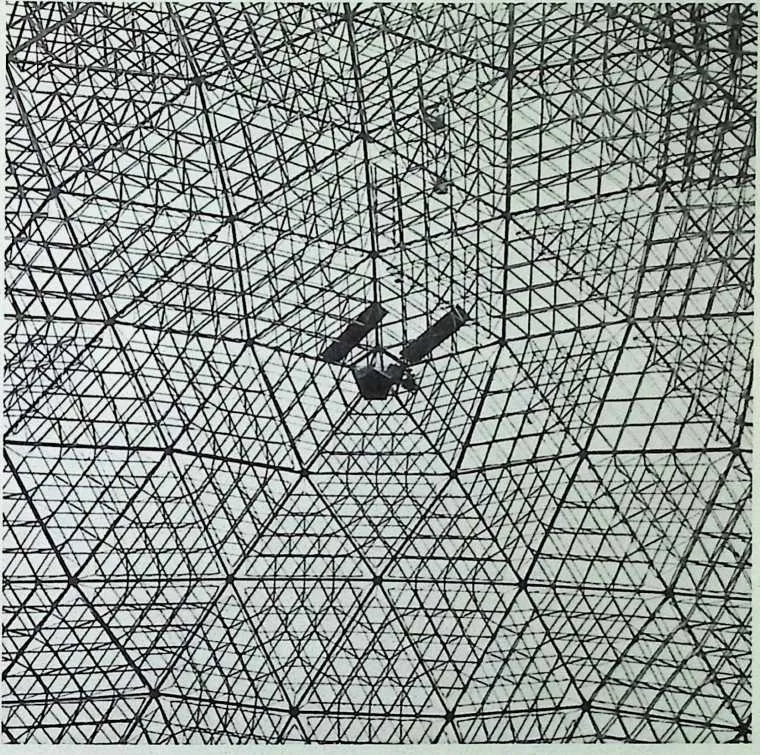
24 The Ford contract did not give him much time. Signed in January, 1953, it called for the dome to be in place in time for the stockholder’s meeting in April. Bucky’s figure of eight and one-half tons was, he thought, heavier than it needed to be, but on this first big contract he could afford to take no chances. Instead of the simpler great-circle-grid construction he decided to use the octet truss—a word he coined from octahedron-tetrahedron. This consisted of struts joined by X-shaped terminals united in such a way as to weave around the hub nuclei, forming the four planes of a vector equilibrium so that a load applied to any one point was immediately distributed radially outward in six directions and thence throughout the entire system. Bucky had made the first octet truss with toothpicks and dried peas in kindergarten in 1900; he patented it in 1961. These octet trusses were then riveted together to form the triangular or tetrahedronal elements of the great dome.
25 Bucky’s calculations indicated that the Ford dome would require 19,680 struts about a yard long, each weighing five ounces. The holes at the ends for the rivets had to be spaced within a tolerance of five one-thousandths of an inch—normal tolerances in building construction are one-eighth of an inch. This was done by making up special punches on indexing lathes to an accuracy beyond the capacity of the human eye. Once made, the punches perforated the struts at high speed. They were color-coded with bits of tape so all the workmen had to do was to rivet them into triangles and join these to larger triangles.
26 Like so many of Bucky’s structures the dome was built from the top down as a rotating, hydraulically elevated umbrella. The workmen stood on a wide bridge thrown across the Rotunda court from the surrounding circular roof. No great cranes or heavy machinery were required since twelve-foot sections of octet truss complexes ready to be riveted into place weighed only four pounds.
27 The dome was completed in four months, two days before the deadline. Covered with a transparent skin of polyester fiberglass, it came to just under the calculated eight and one-half tons. It weighed only two-and-a-half pounds for each square foot covered. Even this was clumsy compared to a transportable dome Bucky later designed for Ford, which was twice the diameter of the Rotunda Dome, and weighed only five ounces per square foot covered.
28 The Ford directors and stockholders at the meeting and the thousands of tourists who came to see it were enchanted by the Rotunda Dome. Seen under the clear fiberglass cover against the blue of the sky, the lacy network of concentric rings balancing compressional and tensional forces in elegant mathematical perfection of structure had the ephemeral grace of a gigantic spiderweb. It was as beautiful as the groining of a Gothic cathedral, perhaps more beautiful, because it did so much more with less.
29 Suddenly, it seemed, all the world wanted geodesic domes. Bucky was not in the least surprised—he reckoned that people had at last caught up with his thinking. His friends were dumbfounded to see one of Bucky’s fantastical inventions really hit the jackpot.
31 All during this time of intense work on the domes, Bucky’s family life was very stable and happy. Anne was living contentedly at Forest Hills, and Bucky was able to be home a great deal more than he had been during the years of the war and Wichita. When he went off to give his courses at MIT or to his lectures Anne often went with him, and in summer he was frequently able to get to Bear Island for a month or more, and sail the boats he loved so much.
32 In 1947, he had bought the Nitana in which to teach Allegra to sail. She was a racing sloop eighteen feet on the waterline, twenty-nine feet overall, which had been champion of the M.B. Class in Buzzards Bay from 1932 to 1936. Bucky and Allegra had great fun in her.
33 After two years with Balanchine’s Ballet, Allegra began to “hunger for further intellectual development.” She found that at Bennington College, which was then inaugurating an experimental educational program, she could major in the history of the dance. Bucky, who had lectured at Bennington and knew the president and many of the professors, easily arranged to get her a scholarship.
34 Allegra had a brilliant scholastic record at Bennington. Her final thesis, which made Bucky inordinately proud, was on the dance as a means of communication. In it she theorized that the dance had originally been used by small savage tribes as a means of indicating to possibly hostile strangers their intentions, either peaceful or warlike, or their specific needs. And she discovered that in cold northern countries the signaling movements were generally made by the legs of the dancers, while in warmer countries, particularly in Asia, these ideas were conveyed by arm movements. When other means of communication superseded the dance it became formalized into religious rites and aesthetics.
35 Allegra’s most original contribution to the subject was the idea that now, when television made possible the almost instantaneous projection of images throughout the world, the dance might again become an important means of communication, overcoming the language barrier that kept peoples apart, by telling each other what they really felt, not what the politicians were saying.
36 Bennington’s new system, later widely copied, had an “in period” when the students studied on campus in the conventional way, and an “out period” when they went out into the world, got a job, and learned by doing. Following her natural bent, Allegra decided to spend her out period in moving pictures. She got a job with the International Film Foundation where she had as her cameraman Kenneth Snelson, who had built that first tensegrity mast at Black Mountain. More importantly, she met and fell in love with a brilliant young director named Robert Snyder, who later became an Oscar winner. This caused some unusual discord in the Fuller family.
37 Anne did not like the idea of her beloved daughter marrying Snyder. Bucky says, “It certainly was not antisemitism.” But of course, he could be wrong. For Anne had been brought up in Lawrence, one of the most violently antisemitic communities in the entire world, and while intellectually she was entirely free of that sort of prejudice, deep in her subconscious may have lurked a residue of her childhood indoctrination.
38 Bucky feels that Bob Snyder may have offended her by his first approach to her about marrying Allegra. “He went to her, not to me,” he says, “and he talked to her in a way that the Old World does talk about what parents might be able to do for a young couple when a good man takes their daughter as his wife.”
39 More likely, however, what really disturbed Anne was the idea of her daughter marrying into the moving picture world. For she had never known it, and was filled with the natural prejudices aroused by lurid stories of Hollywood life, and the “ephemeralization” of the institution of marriage in that community. In the society to which she belonged by birth, and even among the serious artists and writers she had known, and among the scientists who gathered with her husband, there was a generally contemptuous attitude toward Hollywood. People who went there were often thought of as having “sold out.”
40 In any event, Allegra did marry Bob Snyder at Bennington on June 30, 1951, with her father’s approval and her mother’s rather reluctant consent. It turned out very happily, although, according to Bucky, “Anne gave Bob a tough time for several years.” But she finally came around.
41 From 1953 on, the dome business was booming. Many of the great universities in the United States put up domes, either for experimental or practical purposes. These domes were made of various materials from plyboard to plastics and even paperboard. Bucky designed other domes for special purposes such as the fifty-five-foot dome built under license by Berger Brothers of New Haven for the Air Force. It had a quilted double skin filled with air which provided such excellent insulation that a smaller version of it was later floated on an ice island to the North Pole, providing a comfortable shelter for personnel carrying out important scientific experiments.
42 Small playdomes for children to climb on were put into mass production in 1957, and became a regular feature of schoolyards and playgrounds all over the country. Other special designs included a corrugated aluminum structure built by Bucky and students at the University of Natal at Durban, South Africa, for the Zulus, whose grass-thatched huts were constantly being eaten by their cattle. Many small domes were built by campers seeking seclusion in forests where other structures were impracticable—you could put up a dome in a tenth of the time it took to build the crudest log cabin.
43 In the nature of things Bucky’s biggest customer was the Defense Department. In 1954, at Orphan’s Hill in North Carolina, Bucky watched a Marine Corps helicopter lift a thirty-foot-diameter wood and plastic dome off the ground and fly away with it at fifty knots. There was no trouble caused by wind resistance because of the dome’s natural streamlining. Thus he finally accomplished his 1927 dream of completed shelters delivered by air.
44 That first Marine Corps dome was followed by over three hundred others, including a design that was assembled by untrained marines on a beachhead in 235 minutes, and a three-helicopter hangar that one helicopter flew from the deck of a ship to the beachhead. Others especially designed were two domes installed at Wilkes Land, Antarctica, and another situated at the South Pole during the geophysical year of 1957.
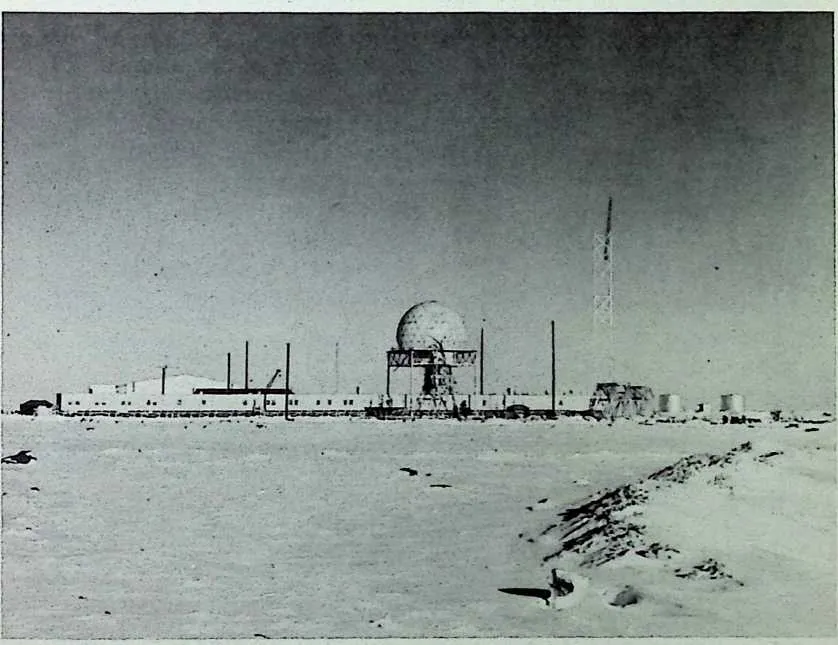
45 Bucky’s very best customer became the United States Air Force. In the 1950s, the cold war with the Communist countries became steadily icier, and, as Russia developed the hydrogen bomb and her giant missiles to deliver it, the Defense Department began to build the DEW Line (Distant Early Warning) 4,500 miles long just above the Arctic Circle in Canada, to provide at least fifteen or twenty minutes warning of a surprise nuclear attack. These radar installations required housing to shelter them from the fierce polar storms. This was very difficult to provide because the structures enclosing the large revolving radar scopes had to be free of metal so the microwave beams could freely penetrate them. At first the Air Force tried pneumatic igloo-shaped housing, inflated with compressed air. When the hurricane-speed gales hit them, the wind-created vacuum sucked them out as you would blow out a candle, ruining all the equipment.
46 In 1954, the Air Force turned to Bucky to ask if he could design a dome of materials pervious to microwave beams, which could withstand winds up to 200 mph, could be flown in a package to the construction sites, and be erected in twenty hours, which was all the time that they could count on between storms. Geodesics, Inc., came up with a dome made of diamond-shaped polyester fiberglass struts and a fiberglass skin. A small, thirty-foot-diameter dome was built by Lincoln Laboratories, the developer of the DEW Line for the Air Force, and erected on Mount Washington. In a two-year test it withstood winds up to 182 mph, and did not ice up. Radar beams went through it without distortion.
47 This test proved that geodesic domes were the answer to the DEW Line problems. Bucky says: “The program was going to be a very big thing entailing enormous amounts of money, and some of the big corporations wanted to be in on it. The Air Force people came to me and said: “We have to get these things into mass production. What are you going to do about it?”
48 “I told them I did not have the capital to manufacture the domes and they said, ‘We know that. That’s why we want to know what you propose.’
50 “I said, ‘I’ll license any reputable manufacturer to make them, and I will make the royalties very reasonable so it won’t block you at all.’ They said, ‘That is such a generous attitude that we [as government] will back you in protecting your patents.’ ”
51 So the deal was set. General Electric became the prime contractor. The “radomes,” as Bucky named them, were fifty-five feet in diameter and forty feet high. They were mounted on high steel platforms built over the operators’ huts. The first one was erected by an Air Force crew in fourteen hours, thus beating the specifications by six hours. Not one of them has collapsed in the Arctic storms.
52 Industry was not long in following government in finding uses for geodesic domes. Don Richter, who had gone to work for Henry J. Kaiser, had set up a microdome in his office. Kaiser saw it and asked, “What’s that?”
53 Richter explained at some length, giving an enthusiastic account of the domes already in use and their enormous possibilities. Henry J. was sold. As a result the Kaiser Aluminum Company acquired the right to manufacture the domes on a royalty basis.
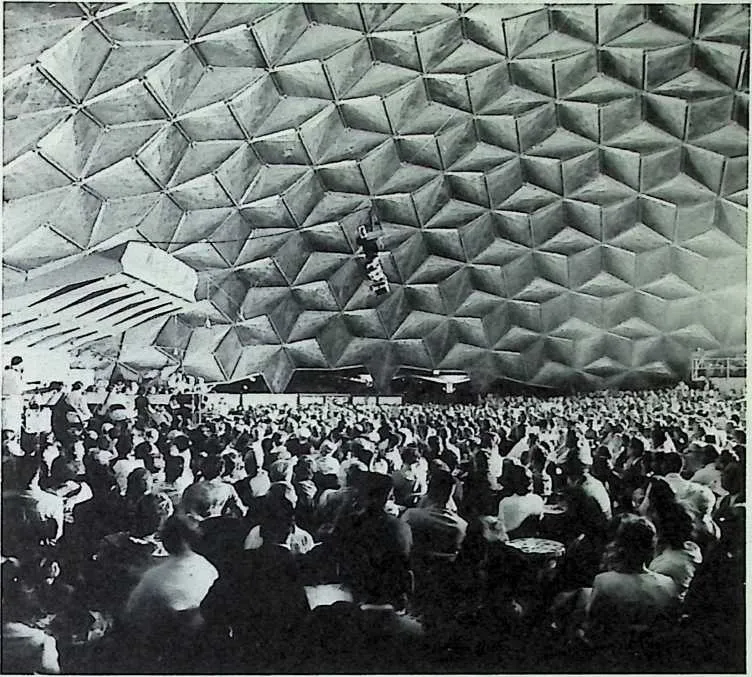
54 The first Kaiser dome was designed as an auditorium for Henry Kaiser’s Hawaiian Village in Honolulu. It was an aluminum-skinned structure 145 feet in diameter, manufactured at the company’s Oakland, California, plant. When Kaiser heard the dome had arrived in Hawaii he took a plane to Honolulu in order to see it go up. He was too late. By the time he arrived the dome was already built and filled with an audience of 1,832 people listening to a concert given by the Hawaiian Symphony Orchestra.
55 The statistics are: The dome was erected in twenty-two hours and within twenty-four hours of the arrival of its components in Honolulu the concert was over. The conductor said the acoustics were “the best in my experience.”
56 Kaiser Aluminum built many other domes at prices ranging from $50,000 to $190,000, among them the municipal auditorium at Virginia Beach, the Citizens State Bank in Oklahoma City, and the elegant Casa Manana Theater-in-the-Round at Fort Worth, Texas.
57 Many other companies applied for licenses to construct geodesic domes. By the end of 1959 there were more than a hundred licensees. One of them, North American Aviation, built a 250-foot-diameter dome for the American Society for Metals at its Cleveland, Ohio, headquarters.
59 This “roundhouse” was the largest clear-span structure in the world at that time, with a diameter of 384 feet and a height of 128 feet. Its enclosed volume of 15,000,000 cubic feet is about twenty-three times that of St. Peter’s Dome and it covers an area of 115,558 square feet. Yet it only weighs about 1,200 tons, approximately two ounces per square foot covered, and it cost less than ten dollars per square foot covered. That really is ephemeralization!
60 Meanwhile, domes began to be in demand throughout the world. This was partly due to the United States Government policy of using them as U.S. pavilions at various world fairs; a policy that made sense since they were not only the cheapest way of covering large areas, but the only uniquely American contribution to architecture since the skyscraper. The first one was planned for the International Trade Fair at Kabul in Afghanistan. The United States Department of Commerce signed a contract with Synergetics, Inc., on May 23, 1956. Designs, calculations, and engineering drawings for a dome one hundred feet in diameter with a nylon skin were completed in a week. By June 30, it was manufactured and packaged and shipped in a DC-4 to Kabul. Untrained Afghan workers under the direction of one of Bucky’s engineers, using the color-coding system, erected it in forty-eight hours. It was the hit of the fair, outdrawing all the other exhibits, on some of which work had been in progress for months and at a far greater cost. The Afghans loved it because, they said, it was a modem version of the Mongolian yurt (tent) of their forefathers.
61 Though Bucky recognizes how much trade unions have done for labor and is himself a card-carrying member of the Machinists Union, he could not help contrasting the fast work on the Kabul dome with that on an exact duplicate of it built in St. Louis. Where the unskilled Afghans had taken forty-eight hours, skilled members of the Machinists Union, at $5.50 an hour, took six weeks. Bucky describes them sitting in pairs under beach umbrellas, smoking and talking while members of other unions carried things up to them or wasted time on other jobs. Then they would leisurely arise, stick in a few bolts, screw on the complementary nuts, and relax for another twenty minutes.
62 Bucky says that this is a method of distributing wealth without adding commensurate value to the product. But he does not blame the union men so much as the whole economic system which requires people to earn a living, often by false “make-work,” when in his world of plenty they would automatically have an abundance of everything they needed and could take just pride in fast efficient work. In his words, “Production would no longer be impeded by humans trying to do what machines can do better.”
63 The Kabul dome was such a marvelous advertisement of American know-how that the government began flying it, and other domes like it, hither and yon to fairs all over the world. They turned up in such unlikely places as Poznan, Casablanca, Delhi, Rangoon, Bangkok, Tokyo, Osaka, and many others. Two paperboard domes made by the Container Corporation of America and sent to the Tenth Triennial Design Exhibit at Milan won the Gran Primo, the highest award given to any participating country. When these domes began to melt in the steady rain, Bucky saved the day by ordering them covered by “bathing caps” of vinyl or aluminum foil.
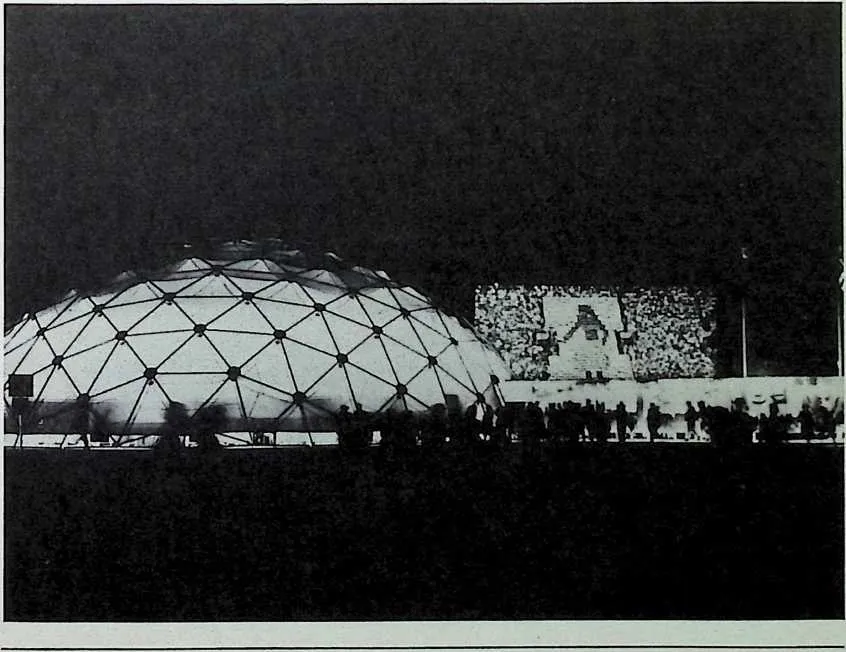
65 The most publicized dome of this period was the 200-foot-diameter “golden dome” built by Kaiser Aluminum as the United States Pavilion at the American Exchange Exhibition in Moscow in 1959. On seeing it Khrushchev made his much-quoted remark: “I would like to have Mr. J. Buckingham [sic] Fuller come to Russia to teach our engineers.” Bucky has since spent a good deal of time in Russia working with scientists and engineers.
66 It was in the ultramodern General Electric and Whirlpool kitchens in the Moscow Dome that Khrushchev had his famous argument with then Vice-President Nixon. Donald Moore, who designed the Whirlpool kitchen, later became one of Bucky’s assistants and closest friends.
67 The Moscow dome was purchased by the U.S.S.R. from the United States government and is now a permanent exhibit in Moscow’s Sokolniki Park. The Russians were so interested in Bucky’s ideas that in 1958 he was appointed by the State Department to visit Russia as a representative for engineering in a protocol exchange. At a dinner the Russians gave in his honor they said that they had been following his work for twenty-nine years, a long time before he was taken seriously in the United States.
68 By 1959, the geodesic dome had, indeed, been recognized, not only as a unique American contribution to architecture, but, in the words of Time magazine, “a kind of benchmark of the universe, what 17th-century mystic Jakob Boehme might call “a signature of God.” 2