
14 Bucky Turns His Back
1Even though Bucky believed that all wars were irrational and unnecessary and that World War II, like the others, had been brought on by the intrigues of Fincap maneuvering for control of the fictitiously scarce resources of the earth, he was sufficiently shocked by the genocidal policies of Hitler and the barbarity of the Japanese, and also influenced by his latent patriotism, to want to play a part in the defense of his country. In addition he could see that the design revolution would be set back by centuries if the totalitarian powers won.
2 Impressed by the success of the Dymaxion Deployment Unit and the interest in the Airocean World Map, people in high places were at last beginning to take Buckminster Fuller seriously. Late in 1942, he was offered the important post of Director of the Mechanical Engineering Division of the Board of Economic Warfare. He eagerly accepted it.
3 Leaving Anne in their apartment in New York because Allegra was still at Dalton School, Bucky headed for Washington. The capital was jammed and running over with people brought there by the immense expansion of wartime government activities. Bucky could not find a place in which he could afford to live, which bothered him less than it would most people. “You might find an empty barn or warehouse or something like that,” a friend said to him.
4 “That’s all right,” Bucky said cheerfully. “I brought my bathroom with me.”
5 He had driven over in the Dymaxion bathroom truck.
6 Bucky eventually wound up in an apartment over the garage of the Yugoslavian Embassy, 2222 Decatur Place. Anne stayed on in New York until Allegra finished the year at Dalton School, and then joined Bucky at Decatur Place. The following year Allegra went as a day scholar to Miss Madeira’s fashionable school in a Washington suburb.
7 The work at the Board of Economic Warfare was challenging and Bucky performed it efficiently. In 1944 he was promoted to Special Assistant to the Deputy Director of the Foreign Economic Administration. However, it was neither sufficiently creative nor did it consume enough time to fully utilize his prodigious energy output. Midway in 1943, he embarked on an exciting creative project which saw him working in Washington by day and moonlighting in New York nights.
8 Some time before this, Gerard Piel, who had written two stories for Life on Henry J. Kaiser, had introduced the great industrialist to Bucky. Kaiser was evidently greatly impressed by Bucky, for soon after the latter went to Washington Kaiser called him up and asked if it would be possible to design a car that would have certain specifications such as a high rate of acceleration, seat four people, and greatly undersell the cars then on the market. Bucky said, “Will you hold the wire while I do a little calculating?”
9 In a short time he told Kaiser, “Yes, it is possible.”
10 A few days later Kaiser called Bucky at home late one night and told him that at a dinner for important industrialists he had told them that the big thing after the war was automobiles, and that he was going to go into the business with a brand-new type of car. “Now, I’ve committed myself,” Kaiser then said. “You said it could be done and I want you to design it for me.”
11 Bucky said, “Give me twenty-four hours and I’ll let you know.”
12 The next day he went to Milo Perkins, Executive Director of the BEW, and asked if he could do the job for Kaiser in his spare time. Perkins had no objection, though he thought Bucky would find it impossible to get engineers to help him.
13 So Bucky accepted Kaiser’s proposal. In New York he interested Walter Saunders, a young engineer, and the latter’s architect partner, in the project. They had a beautiful house they had rebuilt on 72nd Street and were willing to work at night with Bucky. After the day’s work in Washington, Bucky would take the five o’clock train to New York, work with his partners all night, and return to Washington on the first morning train. He slept on the trains. Bucky says, “That is all the sleep I got.”
14 In exactly one month the three men had made all the engineering drawings and had constructed a full-scale mock-up of the car. It was a three-wheel design, which had front-wheel as well as rear-wheel steering, so it could move sideways like a crab into a parking space. It was to be powered by individual, very light, hydraulic turbine engines, which Bucky had designed, mounted on each wheel.
15 At Kaiser’s suggestion Bucky set up the mock-up and laid out the drawings in a suite Kaiser had rented in the Waldorf. Then the industrialist, his son, and top engineers came to inspect it. They were all enthusiastic and Kaiser said, “I’m going to go ahead and produce it.”
16 After some excited planning, Kaiser asked Bucky how much he owed him so far. In his almost willful financial innocence Bucky said: “I am not in business. I don’t feel like doing it that way. I’ll simply give you my costs.”
17 He added up the amount he had paid his assistants for their night work, the rent of the office where they had worked, and the amount of his fares back and forth to New York. The entire cost of producing the completed design and the full-scale mock-up came to approximately $2,500. “When I think back on it,” Bucky says, “so small an amount was really preposterous.”
18 Then Kaiser said, “You have designed this thing for me, and have charged nothing for your services. How do you want to share in it?”
19 “I’ll just leave that up to you,” Bucky replied.
20 Very warmly Henry Kaiser said, “My best friends have all said that to me at one time or another.”
21 It was then arranged that Kaiser would build a prototype out on the Coast and that Bucky would join him there when he was ready to start, if he could get Milo Perkins’s permission to go. “Everything looked fine to me,” Bucky said, “but when Kaiser walked out that door, it was the last time I ever saw him.”
22 Milo Perkins considered that building a car with such advanced technology would be a very important initiative for American industry after the war. He agreed to give Bucky leave of absence whenever Kaiser sent for him. Bucky waited for the word, and waited and waited…
23 The only contacts Bucky had with the Kaiser Company were through young Kaiser and a company representative named Schleptner. They told him that Kaiser’s method of operating was to set up the original project, after which his representatives and engineers would follow through. Kaiser, they said, paid no attention to what happened after the inception of a project. This naturally made Bucky uneasy.
24 Then he learned from Milo Perkins that Kaiser had hired Alexander Taub, the man who had designed the current Chevrolet engine, to work on the project. Furthermore, Taub proposed to put an engine of his own design into the car. Bucky was horrified. The engines he had designed weighed only a few pounds; the Taub engine weighed six hundred pounds—more than the whole car as Bucky had designed it. With that weight everything would be out of balance; the specifications for parts too weak. It simply would not work.
25 Then Bucky got queries from the Kaiser engineers concerning his springing plans for the wheels; his design for the steering mechanism, etc. —evidently they were designing something.
26 Bucky telephoned Gerard Piel, who had meantime left Life to become head of Kaiser’s Public Relations Department. “Gerry,” he said, “you introduced me to Henry Kaiser; and something very strange is going on out there. I designed this car; I didn’t get paid anything for doing it except expenses. I was supposed to go out there and build the prototype. I’ve had experience in this because I have built prototypes of three cars and I would know how to do it. Quite clearly they are working on a car because the engineers have been calling me and that makes me feel that something very wrong is going on.”
27 Piel said, “I’ll talk to Kaiser.”
28 Following this conversation Piel wrote to Bucky that absolutely nothing was going on. Then came more inquiries which made Bucky protest to Piel that he was sure they were producing a car. The next letter Bucky received came from Henry Kaiser himself in which he said, “I’ve called the whole thing off and I am taking my losses like a man.”
29 Bucky did not learn the whole story of the double-cross until after the war when he read a magazine article about the new Kaiser car—a purely conventional vehicle which was a disastrous failure. The article said that Kaiser had tried to build a Dymaxion car designed by Fuller and that it had run into a tree and been smashed up, proving that it was no good.
30 Bucky felt, quite rightly, that he had not only been defrauded but traduced. Of course the car was no good—with that big engine it had to be. But in addition to the deceit and bad faith, the use of his trademark and name on a car he had not built had brought discredit upon it—and Bucky. He had no redress. For one thing he was too busy by then on other, more important projects. Bucky was especially hurt by Piel’s betrayal of their friendship. He said, “It was a bitter kind of thing…
31 When he finished the design of the Kaiser car, Bucky’s social life in Washington became very interesting. To take the place of the Three Hours for Lunch Club there were the Thursday Luncheons at the Cosmos Club. There he became very friendly with Vannevar Bush and other scientists from the Manhattan Project, and various exiled Europeans who were working in the American war effort. Of course they did not talk about their supersecret projects, but they could discuss general principles. Bucky found them intellectually stimulating and they reciprocated. It was another step in his self-education, which was continuing and, perhaps, will not end even after he becomes an indestructible “pattern in integrity.”
32 In the Board of Economic Warfare Bucky learned of a very serious problem that threatened the vital production of war planes. At the start of the mass production of the fighters and the big four-engined bombers, the techniques of automobile manufacture had been tried. It turned out a lot of airplanes but they were not really first class. Bucky says: “It was absolutely preposterous to build airplanes by the Detroit method of having huge dies to smash metal into the desired shapes. You could not do it as accurately as was necessary. In England and Germany there had been an enormous war-accelerated improvement in design and our first planes were just not as good as theirs. There were enormous losses when they first went into action.”
33 As a result, manufacturing was returned, as far as possible, to the regular airplane companies, especially for the great new superfortresses —the B29s. Large factories were hastily built by Boeing in Wichita, Kansas, where there were already smaller airplane companies. Wichita went from 100,000 inhabitants to 200,000 in one week. People had to sleep in three shifts in beds. The factories were running twenty-four hours a day, and so were the moving picture theatres, to accommodate workers who came off the evening shift at midnight, had a bite of dinner, and went to the movies at 3 a.m. It was a crowded, miserable existence for them and, even more important, the workers felt insecure. For they realized that when the war was over there would be no need for so many planes and they would be out of a job. “Why put up with this lousy life and end up on the street when we can go somewhere else and get a job that has a future?” they asked themselves.
34 Because of this reasoning the ratio of quits over hirings, as the manufacturers called it, became so precipitous that it threatened the maintenance of production schedules. It looked as though the B29 program might founder. Something had to be done.
35 Bucky learned of this situation first from his old friend Grover Loening, who had built Vincent Astor’s plane and gone on to great success with the Loening amphibian. He had sold his company, which had become Grumman, and he was now head of the Aircraft Production Division of the War Production Board. Indeed, everybody there was terribly worried about the situation in Wichita; they were searching anxiously for something that would give the airplane workers a sense of job security.
36 The 4D Dymaxion house suddenly became the answer. Bucky could redesign it so it could be manufactured by an airplane company with comparatively little retooling. There would be a gigantic need for housing after the war. It might become a great new industry in which thousands of skilled workers would find jobs. It was a natural.
37 Bucky became the man of the hour. His old friend Clare Boothe Luce had introduced him to Herman Wolf, who was a public relations man for labor on the War Production Board, and Wolf arranged a meeting with Walter Reuther of the CIO as well as Harvey Brown, president of the International Association of Machinists, the airplane workers’ union, and other labor leaders. The IAM council was particularly enthusiastic about the project as they were not only patriotically concerned about falling production in Wichita, but worried about the fate of their members after the war. Bucky consulted with them as to which airplane company had the best labor relations. They told him Beech Aircraft of Wichita.
38 In the summer of 1944, Bucky and Gregory Bardacke, who was also a labor representative on the War Production Board, went to Wichita to see Jack Gaty, who was vice president and general manager of Beech Aircraft. Gaty was a slim, trim, expensively dressed man in his early forties with strong features, voltaic gray eyes, and a precision-machined mind. Contrary to wartime usage he would not allow the federal government to purchase the great machines which Beech Aircraft needed to fill the huge war production orders, but insisted on merely renting them. He wanted Beech to be under no obligation to government. He was such a strong proponent of free enterprise and so fanatically opposed to governmental interference with business that he and his company kept free and clear of such a “socialistic” subsidy.
39 One would suppose that Gaty’s extreme right-wing views would produce an immediate conflict with Bucky’s antiestablishmentarianism. It did not. For Bucky was so completely apolitical that he admitted no difference between left and right. To him all politics were both so corrupt and so totally irrelevant that he completely ignored them, and could work happily with men of all shades of opinion so long as they knew their job. He and Gaty became, and remained, warm friends.
40 At the moment of their first meeting Jack Gaty said that he was profoundly uninterested in manufacturing “prefabricated houses.” Bucky was profoundly irritated by the implication that his was a prefabricated house. He says, “It was evident that Jack Gaty thought of me as an industrial designer, who would take an airplane and make the seats more comfortable and change the decor and paint stripes on the sides to make it look prettier.”
41 So Bucky began to talk at the rate of seven thousand words an hour —maybe eight. And he talked for at least four hours, by the end of which time Gaty had changed his opinion of both Bucky and his house. He was impressed by Bucky’s bathroom; and by the plans for the house; by Bucky’s knowledge of the kind of tooling that would be needed and his knowledge of production engineering. Most of all he was impressed by that Niagara of ideas.
42 At the end of four hours Jack Gaty said, “I’d like you to talk to my workers.”
43 He called a quick meeting of the shop stewards and all the workers who could get into the Wichita headquarters of the International Machinists Association. After Bucky had talked to them for several hours everyone agreed that the project was worthwhile if a prototype could be produced at Beech. After this discussion Gaty said: “What are we waiting for. Let’s go!”
44 A preliminary agreement was signed that night.
45 Bucky went back to Washington and, in his spare time, incorporated the Dymaxion Living Machines Company—later changed to Fuller Houses, Inc. R. Buckminster Fuller was chief designer and engineer. The president was Herman Wolf. Other officers were Gregory Bardacke and Bucky’s secretary at the BEW, Cynthia Lacy, whom he made vice president and secretary of Dymaxion Living Machines. The company was capitalized with 15,500 shares of stock at $10 par value. Fuller held 5,500 shares, Beech was given an option on 1,000 shares, and the remaining 9,500 were sold to “the public,” which public consisted mostly of friends of the officers, among them several members of Herman Wolf’s family and many people he knew in the labor unions. Harvey Brown became a member of the board of directors. The charter was so worded that Bucky’s 5,500 shares gave him a veto power over production of the house. He frankly said: “If, and when, adequate time and money and know-how have been put into the Dymaxion houses, they will be installable anywhere in the world as quickly as a telephone. But it will take time, probably until 1952. Ergo, whatever we can do in 1944 must be thought of as gestative functions. The time is premature to think of this new industry as a commercially exploitable undertaking.”
46 Therefore, the stock was sold on the basis of “consider your money thrown away.” The sales argument was that its purchase was to be considered a contribution toward solving the postwar housing problem and not a financial investment. In other words the “ice cream soda clause.”
47 In October, 1944, the officers of the company resigned their government jobs and moved en masse to Wichita. There Bucky had another conference with Jack Gaty in which they settled the details of the production of a prototype. Bucky says: “Jack did not want his own production upset, so he agreed to fix up a disused building that was in rather poor shape. They put in new beams so the roof would not fall on our heads. It was big enough to build the prototype inside.”
48 Remembering his experience at Bridgeport, where his mechanics had staged a slowdown for fear of losing their jobs, Bucky said to Gaty: “I want six of your best mechanics. You have 20,000 people working for you so you can spare them. And if they are your very best they will not be in fear of working for me, for they will know they can have their old jobs back.”
49 Jack agreed that this was reasonable. After various other points were settled a formal contract was drawn up and signed. Then Gaty had Bucky talk to the workers again, not only just those at Beech but to as many of the other workers as possible. Such was his enthusiasm that they envisioned not only building a prototype at Beech, but a great new industry of housing that could be produced in airplane factories.
50 A few weeks after Bucky got to Wichita, Jack Gaty called to him. “Come here! I want you to see this curve. It’s an absolute must.”
51 Gaty showed him the graph of hirings and quits. The down-curve that had made everybody so concerned had swung upward so sharply that it looked like a mountain peak rising from a valley of despair. In Washington the Air Corps people were ecstatic. That was one problem solved.
52 With an Air Corps contract for two prototypes and the highest priority for materials, work was begun. Bucky imported Arthur Hewlett from Lawrence in a managerial capacity and his young friend Edgar J. (Sonny) Applewhite as director of personnel. For Bucky was an incorrigible nepotist, not from greed or to spread the wealth among his family, but simply because he trusted those he loved.
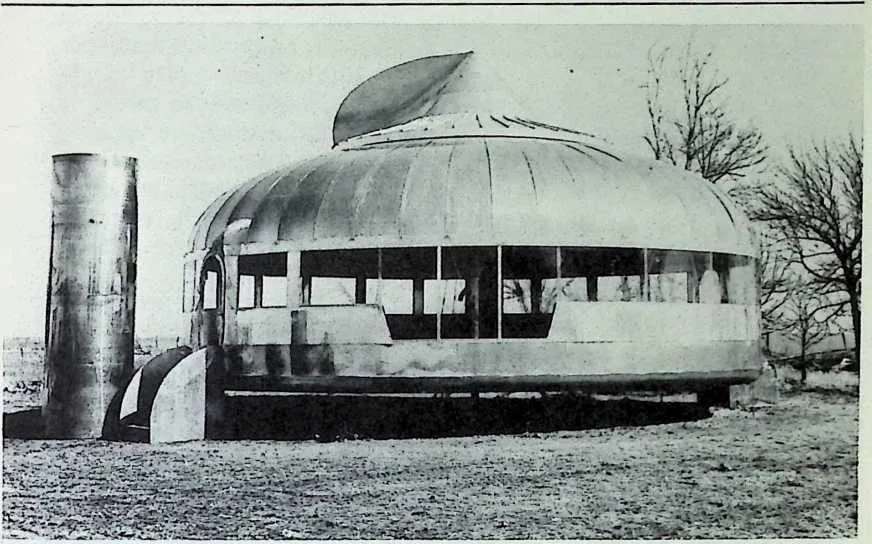
53 As it was built under Bucky’s direction, the new Dymaxion Dwelling Machine was a vastly improved version of the original 4D house. It, too, was hung from a mast by steel cables, the ends of which were anchored in the ground, but instead of being hexagonal it was perfectly round, 118 feet in circumference. The walls were made of sheet aluminum stamped out by dies designed by Bucky with the help of Beech engineers. Completely around the house at eye level was a broad sheet of plexiglass slightly tinted to obviate glare, with pull curtains for privacy. The domed ceiling was sixteen feet high. On top of the outside of the dome was a big, streamlined ventilator, which swung with the wind like a weathercock, designed to furnish natural air conditioning like the Deployment Unit, but much more effectively.
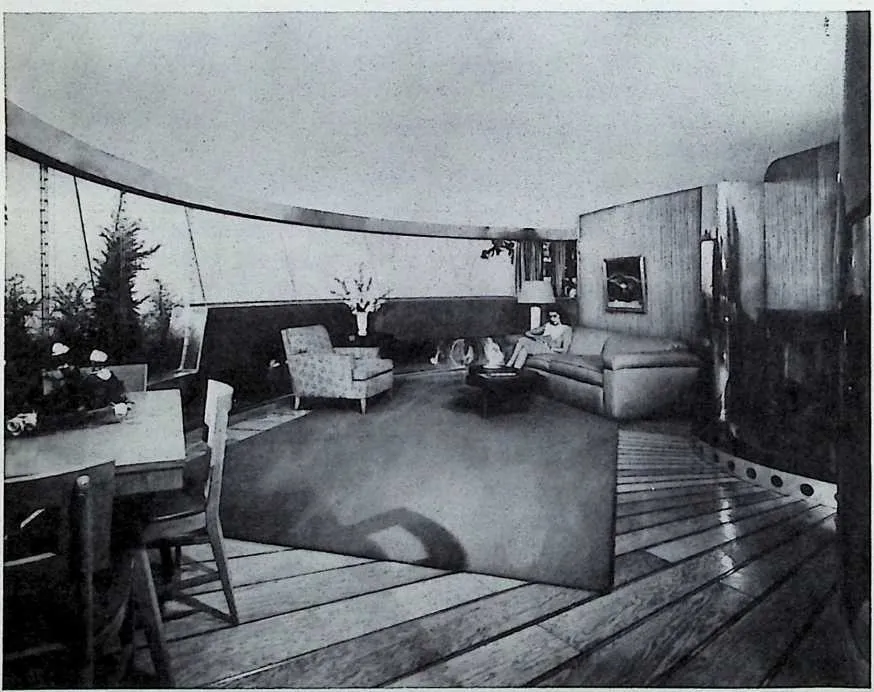
54 The bow-shaped living room, occupying about a third of the interior, had a stainless steel fireplace—because Bucky loved open fires and recognized their contribution to the ambiance of a house. There were two bedrooms, each with a Dymaxion bathroom, and a small kitchen. Ample closet space was provided and an unusual amount of storage space on motor-driven revolving shelves. The floors were made of tapering plywood strips between converging aluminum floor beams. The color of the neoprene silver lining of the ceiling dome and walls could be changed at whim by colored lights directed at it from oval drumheads in the partition units. There was an infinite number of amenities and engineering refinements invented by Bucky’s fertile brain to make housekeeping easier and protect the interior environment.
55 He had originally figured that the 4D house should weigh 6,000 pounds. The Wichita prototype weighed almost exactly three tons.* * A conventional house of the same size weighs about 150 tons.
57 No single component, no beam or rib or panel, weighed more than ten pounds and each could be lifted by a man with one hand, leaving the other free to fasten it in place. All the components of a disassembled house, including the mast, could be packed in a packing case of less than 300 cubic feet for shipping by air to any place in the world. The retail price of the house would be $6,500, about a dollar a pound, or the cost of a Cadillac, at that time.
58 The amazing thing about this Dymaxion Dwelling Machine, in spite of its dismally mechanistic name and its mass-production components, was its elegance and cozy comfort. The blue-tinted aluminum of its circular exterior seemed to harmonize with the sky, while its carefully planned and mellowly decorated rooms were both pretty and surprisingly welcoming.
59 Another surprise to everybody—including Bucky—was the quality of its acoustics. Marian Anderson, who tried them out by singing in the prototype, said that never before had she heard the sound of her voice flow around a room.
60 The Dymaxion Dwelling Machine was exhibited to the public in Wichita in October, 1945. Between then and February many thousands of people from all over the country came to see it and applaud. Publicity was widespread and enthusiastic. Fortune featured it in an article illustrated by luscious color photographs. All this produced an amazing flood of 37,000 unsolicited orders, many of them accompanied by checks. The stock of the renamed Fuller Houses, Inc., went to twenty dollars a share on the over-the-counter market. Naturally, this was when Bucky’s troubles began.
62 His difficulty was that everyone suddenly saw a chance to make big money. A highly successful Philadelphia entrepreneur named William Wasserman bought a thousand shares and temporarily became chairman of the board for the purpose of arranging the financing for mass-producing the house. Herman Wolf and the labor people were as anxious as the capitalists to profit by the bonanza they saw glittering before their eyes. Due largely to Bucky’s integrity—intransigence they called it—the glitter was fool’s gold.
63 The Beech engineers figured that to begin mass production—machinery, sales organization, setting up dealerships, the whole intricate, expensive business of starting a big new industry—$10,000,000 capital must be raised. The financiers decided to do this by recapitalizing Fuller Houses, Inc., by issuing 750,000 shares at a par value of $1 a share. The original shares were exchanged at a ratio of one for ten, leaving 595,000 shares to be sold to the public at $10 a share, automatically making the original issue worth $100 a share—a nice profit! This would produce $5,950,000. The rest could be had by borrowing from the banks or selling first mortgage bonds. The U.S. Government was ready to help with a big loan. If Bucky had chosen to sell out at this point he would have made half a million dollars.
64 Everyone apparently ignored Bucky’s genuine moral repugnance for this type of financing and they had forgotten his original statement that building the prototype must be thought of as “a gestative function. The time is premature to think of this new industry as a commercially exploitable undertaking.” As usual, they did not think he mean it. But he did.
65 The story of just what happened to Fuller Houses depends on whom you talk to. Bill Wasserman says: “No matter how hard we tried or what pressure we used, we could never get a finalized plan from Bucky. Every time we thought we had one, he would come in with a whole new variation on the design. For instance, if there were rumors of unrest in the plumbers union, he would insist on his self-contained, shit-packaging john, which nobody had invented yet, not even Bucky. I admire his brilliance and humanitarian philosophy; he’s a great man; but he was impossible to work with.” 1
66 To get rid of Wasserman, Bucky offered to buy him out at par. Wasserman gladly accepted and told all his friends to unload Fuller
67 Houses, which most of them did, including Jack Gaty who sold out Beech’s 10,000 (new) shares at a handsome profit.
68 Bucky was deeply disturbed by this attempt to capitalize on his invention. Because the whole thing was premature he considered the financial shenanigans nothing more than an attempt to bilk the public, or, at best, a deluded effort to anticipate the necessary time sequence of gestation which, by his reckoning, was twenty-five years from his 1927 conception of the house, which would therefore not be viable until 1952. He says:
69 “What I was really developing was a good prototype which was fine for the Air Force, who could handle it. But it was not ready for the general public. People wanted to buy; but there was no industry to distribute the houses. In a sense what went on was almost scandalous. Legally there was no fraud whatever intended, but to me it seemed inherently very corrupt because of what I knew about it.
70 “There were a number of people who wanted to come in and take over the business and put up the ten million. The politicians in Washington were willing to back us to get the house into production. Herman Wolf wanted to get it going. And I kept vetoing. I said, ‘It is not ready. Here are all those orders, but who is going to install it? The present building industry won’t do it.’ The plumbers say they are the only ones licensed to hook it up to the city mains and the electricians say they are the only ones licensed to do the wiring. Both unions say: ‘If you bring in a house with all the plumbing and wiring all done we won’t have any business left. We can’t handle it unless we can take all the wiring and plumbing apart and put it together again.’
71 “Also, the houses would have to be delivered by a very special truck, rather like a telephone truck, and we had no such trucks and no capable distributors.
72 “Hundreds of people came to us who wanted to be distributors, but I kept showing them that they did not have the capability of putting this thing up. It was not premature as a demonstration of a principle, or for the Air Force; it was exactly right for them. It was technically very successful, but we were nowhere near in a position to go into mass production, and sell them to a lot of people. Because we could not deliver. And it’s just not honest to sell people something you can’t deliver.
73 “So,” Bucky says, “I was forced to do just what I had done before in Bridgeport; to shut down solvent. Nobody made any money.”
74 There was a blazing row with Herman Wolf, who felt that Bucky was deliberately preventing him and the union people he had persuaded to invest money in the enterprise from reaping their just gains. In fact, Wolf was so enraged that he made the fatal mistake of trying to drive a wedge between Anne and Bucky. He burst into the Fullers’ home one day when Anne was alone and said to her, “I think you should know that Bucky is having an affair with so-and-so.”
75 To his amazement Anne turned on him furiously, saying: “You have no right to say such things about Bucky to me. And even if it were true, it’s none of your business.”
76 Bucky has long ago forgiven Wolf, but Anne and Allegra never will.
77 Other stockholders were furious. They were justified from their point of view as, perhaps, Bucky was from his.
78 In fact, it is very difficult to assess the rights of the situation. Was Bucky completely objective in vetoing the great plans? Or was it just due to his emotional and intellectual disgust with Fincap and all its ways that made him magnify the difficulties? There was a tremendous demand for the house. The United States Government, anxious to get a new industry started to provide employment in the postwar uncertainties, and to relieve the acute housing shortage, was willing to back it with millions. Financiers were ready to provide the organization, and engineers the know-how. Might it not have been a spectacular success if Bucky had enthusiastically brought his genius to bear upon the very real problems?
79 But Bucky could feel no enthusiasm for a project primarily designed to make money. He could not force himself to play that game. There can be no doubt that he genuinely believed it would be ethically wrong for him to associate his God-given competence with that type of organization; gambling with the credulity of people on the chance that the promoters could pull it off on a heads-we-win, tails-the-public-loses, and we-win-anyhow basis. Again, as before, he felt that it would betray his ideals and falsify his covenant with himself to work selflessly to the betterment of mankind. God, or the Great Intelligence, helping him, he had to do it his way.
80 Once again he turned his back on a fortune and walked away.