
9 The House on a Pole
1One person Bucky did talk about—and to—was Allegra. He was determined not to blunt her sensitivities and not to instill fear into her; for he considered fear responsible for most of the evils of the world. This meant that he would not say to her, “Don’t do this or that, you’ll hurt yourself.” But how to keep her from injury without those prohibitions? Anne argued with him as any normally protective mother would, but seeing him so passionately concerned about this, she went along with him as much as she could. Bucky says: “Anne did something that I was unable to do. She was fantastically inventive and ingenious about introducing a subject that diverted Allegra and so was able to steer her out of dangerous actions, thus giving her a chance to see later on whether she really wanted to do them or not. Anne was brilliant at it.”
2 One of Bucky’s few relaxations at this time was to take Allegra out in her baby carriage for long walks in Lincoln Park and down by the lakeshore. Later on, when she was about two, he would point out all the different types of yachts and tell her their names. “From the earliest time,” he says, “I made up my mind never to talk to Allegra as if she were a baby. I felt that she knows more than I do; she’s less spoiled, and I’m really going to honor her absolutely impeccable intellect. She always responded because she had grown up that way with me.
3 “I think it is interesting that when she was about fourteen at the Dalton School in New York, she came to me and asked me to explain about sex; she didn’t go to her mother. I think she felt that I would be able to talk frankly about those things and her mother would not. Intuition made her do that.”
4 When Allegra was three years old, and they were back on Bear Island, Bucky began to tell her fairy stories like the story of Goldilocks and the Three Bears, winding suitably simplified scientific information into the story so that after Goldy and the Three Bears had procured ice cream sodas and were comfortably seated in their three famous chairs with Goldy in a new portable armchair, they started talking about this or that, which would always lead to the most challenging scientific subject. But the bears and Goldy never quoted mathematics or science as such.
5 In The Bear Island Story Bucky wrote, “That was the beginning of my spontaneous-thinking—out-loud discourses that I now give publicly. I became convinced that through the expansion of the fundamental experiences of the child, it would be possible to tell her about the most complex and profound phenomena.
6 “I also found that the best way to study the thoughts of whatever scientist I was reading was to test myself by disclosing what I understood to the child.”
7 There followed a six-year series of these discourses. Then one day in 1937, Allegra “realized that she no longer needed this fictitious device to initiate exploratory thought. She suddenly looked at me and said, ‘Daddy, just one more Goldilocks story!’ …we both knew that a wonderful chapter in life’s book had been completed.”
8 But much, much later, there was one more Goldilocks story, when father and daughter stood together looking at the constellations in a night sky over Penobscot Bay. Bucky pointed out the Big Bear (Ursa Major) and the Little Bear (Ursa Minor), and then brought in a third. This was Bear Island, named for the littlest bear. “Allegra was, of course, and forever will be, Goldilocks, and that night she described Spaceship Earth to the other two bears, Ursa Major and Ursa Minor.”1
9 The article in the Chicago Evening Post in 1928 started Bucky toward local recognition. He decided to concentrate on something slightly more practical than his multistory dwelling, and began designing the 4D House, later nicknamed “The House on a Pole.” It was basically a one-story version of his multiple-unit design, hexagonal in shape, hung from a strong central column, and braced by cables in tension with exterior, islanded compression struts. The mast contained the power unit and served as a distributing tube for air, light, heat, etc. The exterior of the house was made of double triangular plates of nonshatterable glass with vacuum between them (not yet invented) covered by electrically operated roll-down shutters. On top was a fifty-foot playdeck shielded by a Duralumin hood designed to stream wind over the house. Rain drained down the central mast, and the masthead contained lenses for utilizing the light and heat of the sun for power.
10 The interior was divided into four triangular rooms—two bedrooms, a utility room, and a library—and one large 40' x 20' double triangle or rhomboid-shaped living room, into which the electric grill for cooking opened. All the utilities were hung in the rooms, which in turn were separate units hung from the mast, any one of which could be removed and replaced by a newer model if desired. The two bathrooms were cast metal units hung in the bedrooms. Since, like the multiple-unit dwelling, the house was intended to be transportable, it was completely self-contained. Used water was filtered and reused, solid waste was compressed into packages and sent off to be recycled or used as fertilizer. Power was derived from solar energy. The whole “living machine,” a phrase of Le Corbusier, was designed to be mass-produced like an automobile. It would weigh only 6,000 pounds and sell for $1,500.
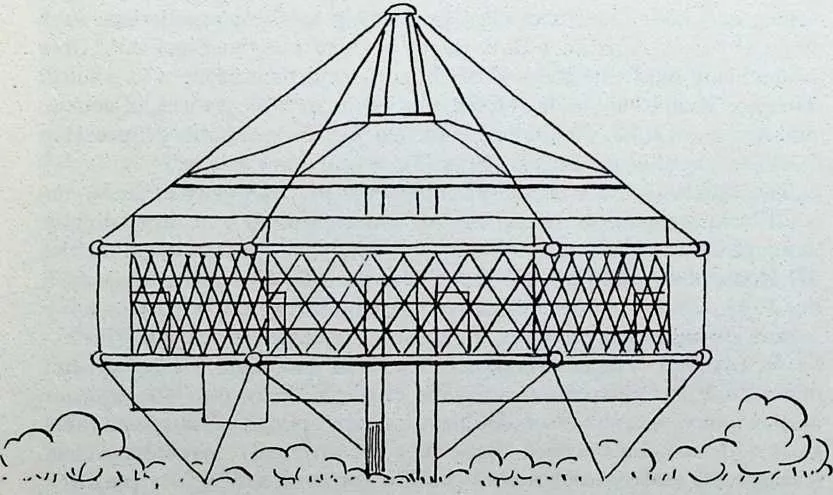
12 Bucky imagined some fine science-fiction conveniences for his house. There was a “fog gun” by which you could take a shower using only a quart of water, a washing machine that dried and pressed clothes; a dishwasher that cleaned and dried the dishes and put them away. He had revolving closets and shelves; all dusting and cleaning was done mechanically by centrally located compressed air and vacuum systems.
13 The dining-room table was hung from the ceiling. The library or “go-ahead-with-life room” was designed so children could develop selfeducation on a selective basis, with radio, television (not then invented), maps, globes, revolving bookshelves, drawing boards, and typewriters. Beds were filled with compressed air to any desired degree of hardness. Underneath the hanging house was space to garage a car and a jet-propelled, wingless aircraft (not invented even now!).
14 The publicity Bucky received from the Evening Post interested some financiers in his project, among them Russell Walcott. With their financial backing he formed the 4D Company with offices in a post office box and R. Buckminster Fuller as president; and secured patents on various features of his house. During the winter he had written 2,000 pages of a book which was in effect thinking out loud. In it appeared many of the far-ahead-of-his-time ideas concerning the future of man and his function in Universe. Since his main preoccupation at this time was shelter and the advantages of mass production of truly modern houses making use of the new technology, which the building industry had never done and has not done yet, he concentrated on this field.
15 Cut down to less than fifty pages it was presented in St. Louis to eighteen members of the American Institute of Architects, who were picked out as being broad and unselfish thinkers, with more than satisfactory results. “They praised it with astonishing remarks as to scholarly ability.”2
16 This paper, entitled 4D Time Lock, was then privately printed as a brochure. Bucky sent it to an extraordinary list of prominent people including Vincent Astor, historian Gamaliel Bradford, President Lawrence Lowell of Harvard, John T. McCutcheon of the Chicago Tribune, Roger Babson, Bertrand Russell, John Galsworthy, Richard Washbum Child, Bruce Barton, Dr. Max Mason, president of the University of Chicago, Henry Ford, Arthur C. Holden, and a dozen more who were in positions to influence public opinion.
17 In return Bucky received some extremely enthusiastic replies. Babson wrote, “It is great.” 3 Child “read it with great interest,” Holden wished “it could be published and published right away.” 4 On the other hand he got some severe rebuffs. President Lowell, according to his secretary, was too busy to read it, and Bruce Barton wrote, “Possibly there is something in Mr. Fuller’s idea, but if so, it is so well concealed in his language that I have not discovered it.” 5
18 Through Mr. Hewlett, Bucky generously offered his patents on the 4D House as a gift to the American Institute of Architects. The board of directors, not qualifying as “broad and unselfish thinkers,” turned it down with wrinkled noses, and promptly passed a resolution that stated: “The American Institute of Architects is opposed to any kind of house designs that are manufactured like-as-peas-in-a-pod.” Though Bucky had rather expected it, he was hurt as usual.
19 Meanwhile, financed by the 4D Company, Bucky had built a complete scale model of the 4D House with the help of some architectural students and was ready to show it to the world.
20 As can be imagined, Bucky had not been able to keep his Trappist vows during all these exciting developments; but he had talked as little and thought as much as circumstances permitted. His main communications had been by letter. In 1929, he really began to talk again. He has not stopped since, going at the rate of 7,000 words per hour for at least sixteen hours a day. He addressed the City Club of Chicago and then, with his model on exhibition, talked at the Chicago Home Owners Exhibition. This brought a representative of Marshall Field’s Department Store around to see him.
21 It appeared that Marshall Field had bought a large stock of ultramodern French furniture and wanted to put it on exhibition with Bucky’s model as a crowd-attracter. Bucky was delighted.
22 Marshall Field’s public relations manager, Waldo Warren, then came to discuss publicity with Bucky. It was a pleasant conversation up to a point, for Bucky has always loved publicity. However, Mr. Warren did not think highly of 4D as a name for the product and, in truth, it sounded more like a failing grade in school than a bright new world. “It doesn’t mean anything to people,” said Mr. Warren.
23 Bucky explained that it referred to Einstein’s fourth dimension—time.
24 “Who knows that?” asked Warren. “We’ll have to think of something.”
25 Bucky was very eager for the exhibition and therefore, willing, though dubious. Later in life, he would not have permitted anyone to tamper with his phraseology. Warren suggested that Bucky just talk to him about the house while he thought, which Bucky did—at 7,000 words an hour—possibly more. Then Warren went home to think it over.
26 The next day he returned with some ideas. “I noticed that you frequently use certain words that have great thrust and sound scientific,” said Waldo Warren. “They are dynamic, maximum, and ion. I have combined them into a word that seems to me to express the essence of your imaginative thinking and has, I believe, dramatic appeal.” Then he said the word—“Dymaxion.”
27 Bucky thought it was great—he always had a flair for words even if they were not his own. Warren generously presented the word to him—later had it copyrighted in Bucky’s name—and Bucky adopted it as his trademark. Wherever in the world men see that word it means to them Buckminster Fuller.
28 Anne had inherited another small legacy, so the Fullers had rented a better apartment at 426 Beimont Avenue and were living more comfortably. However, Bucky felt that now that he had gained a certain amount of recognition, it was time to return east. In the summer of 1929, they packed up and headed for Bear Island.
29 As the J.T. Morse passed Owl’s Head Light and headed for Rockland, Bucky was on deck, breathing the strong salt air of his boyhood, so delightfully different from the flat, sour smell of Lake Michigan. When they went down to breakfast Bucky stood Allegra on the table so she could look out the window at the yachts in the harbor. In high delight the little girl shouted in her clear treble voice, “Oh, my God, Daddy, there’s a ketch! Oh, my God, Daddy, that’s a sloop! Oh, my God, Daddy, there’s a schooner!"
30 She was perfectly right about the different rigs, but embarrassed Bucky decided that his conversations with Allegra had been a bit too adult.
31 Bear Island was just as it had always been, the Big House filled with family and their offspring, the Eating House manned by a sturdy local cook; the family sailboats and the Wego anchored in the harbor. The only changes were that the trees had grown up around the Big House sheltering it in a pleasant grove; and Jim Hardie had taken over as Captain of the Island and lived in the Boy’s House, which had been done over for his convenience.
32 Hardie, who was about Bucky’s age, had grown up with him on Bear Island. As boys they had competed for Mrs. Fuller’s attention and praise. Jim had helped Bucky build Birch Lodge; also the road across the swamp from the harbor to the Big House, which required tons of rocks hauled by oxen; and the clay tennis court where the Larned brothers had practiced their championship tennis and often played doubles with Bucky and Wolcott. Later, with the kindest intentions in the world, Jim ruined the court by putting in a concrete surface, which he thought would be superior to clay.
33 Jim was married now to a big, buxom Maine girl and was raising a family. His son, Pearl, was almost the same age Bucky had been when he first came to the island.
34 Woolly, too, was married—to Persis Sears Wellington, who would never come to Bear Island. She either was, or pretended to be, deathly afraid of crossing the bay, but there is reason to believe that she just did not like the primitive conditions and communal family life. But Woolly loved the island so much that he bought a house at Sunset on Little Deer Island, which was connected by a causeway to the mainland. Leaving Persis there, he would come over to Bear Island in his boat, the Giddy Gaddy, and his children learned to love it as much as he did.
35 The year 1929 was the summer of the Lady Anne. She was an old-timer originally called the Loreena, which had been used as a cargo boat and tug among the islands of Penobscot Bay. Bucky bought this antique for a small sum of money, but considering the condition of his finances she may well have been the inspiration for Roger Hewlett’s much-quoted line, “Bucky’s found a sixpence and he’s off to buy a yacht.”
36 After two years of intensive thinking in Chicago, Bucky instinctively knew that he needed the relaxation of hard manual labor—and some fun. The Lady Anne was the answer. Roger Hewlett, ready to matriculate at Harvard in the fall, was staying on Bear Island, and together they set to work to make the Lady Anne into a spruce yacht worthy of her new name. She needed new masts, so they felled two tall straight trees on the island, debarked and delimbed them; smoothed them with planes and sandpaper; varnished them, stepped them in the hull, and rigged lugsails on booms made from smaller trees.
37 She needed paint and fittings of all sorts. Somehow they scrounged the money to buy these things—seventy-five cents here, two dollars there. Her decks were a shambles, but that could be fixed with elbow grease—gallons of elbow grease.
38 Most of all she needed a new engine. Originally steam-driven, she had a tall, thin, pipelike smokestack, which served no purpose since at some point an ancient gasoline engine had replaced steam. But this was coughing its lungs out in its final stages.
39 Now it so happened that at Lamb’s Shipyard at Camden, Maine, where Bucky and Roger bought most of their marine supplies, there was a magnificent Lathrop engine, just standing in the boathouse. Roger said: “Every time we went to the shipyard, which was owned by Mr. Lamb—his first name was Charles, believe it or not—Bucky would say, ‘Gee, wouldn’t it be marvelous if we could set it right in.’ I’d say, ‘Yeah, it would be marvelous.’ ”
40 “The Lady Anne's old rheumatic engine didn’t fit Bucky’s idea of what his sleek yacht should have. And there was that long, lean, powerful, sixteen-cylinder Lathrop that would drive his old barge along like Vincent Astor’s Nourmahal. I’d say it was at the back of Bucky’s mind to beat Astor at his own game.
41 “Well, one day I was alone on the Lady Anne at Camden, just scrubbing decks and polishing brass, when a battalion of workmen came down from Mr. Lamb’s shop and said, ‘We have to put this new engine in.’ When Bucky came bouncing down I said, ‘What’s happening?’
42 “Bucky said, ‘It’s all set. It’s all set.’ He was smiling.”
43 It was a long time before Roger figured out what the deal was. It seems that Bucky persuaded Mr. Lamb to have the engine installed in the Lady Anne in return for which Bucky gave him a half interest in the boat and Lamb still owned the engine. Only instead of having the engine sit in the shop doing nothing, it would be in Lady Anne, which would make her a more salable property. Roger said: “Bucky pointed out to Mr. Lamb that his engine would be doing some good in the whole wide world; and Mr. Lamb would be the richer for it, since he would still own it and a half share in the Lady Anne as well. A real con job! And Bucky was a master at that. He could convince a silkworm that nylon was better.
44 “Well, after a full half day’s work by a crew of expert mechanics, there were Bucky and I, with this sleek purring monster in the engine room, sailing out of Camden harbor waving to a bewildered Mr. Lamb.”
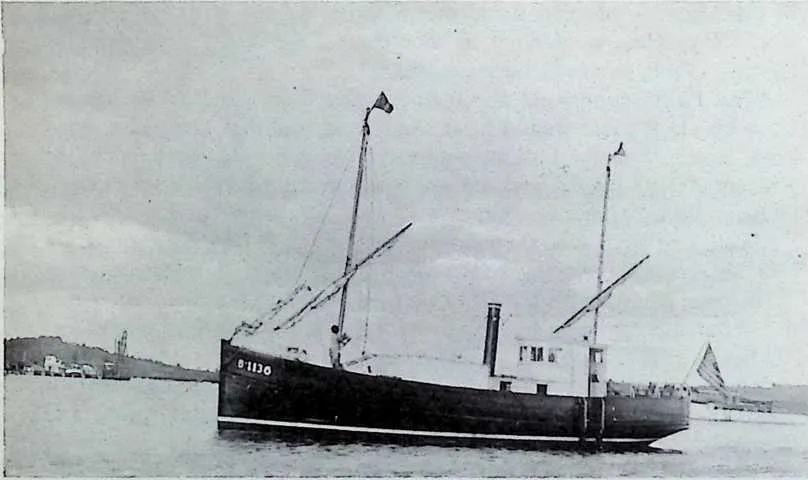
45 Roger has never been sure of what eventually happened. He thinks that perhaps Mr. Lamb got thinking it over in the quiet of a Maine winter and eventually sent Mrs. Fuller a bill for the engine. In any event, for three summers Bucky had much pleasure in the Lady Anne, a wonderful old craft, 45 feet long and broad of beam that looked a little like a North Sea trawler with her tall smokestack still in place, and her lateen-shaped lugsails filled by the nor’east wind steadying her as she dashed along propelled by sixteen splendid cylinders.
47 In September the Fullers left Bear Island. Anne and Allegra went to live in a very nice little house on the East Rockaway Road in Hewlett, Long Island, and Bucky to begin a vagabond life in Greenwich Village and traveling around the country with his model of the 4D Dymaxion House, which he carried disassembled in a huge suitcase.
48 He was getting a good deal of recognition. Mr. Hewlett arranged a one-man show for him at the Architectural League of New York. Antonio Salaemi had him lecture at his studio in the Village, where he also allowed Bucky to park his model house. Bucky gave a one-man show at the Princeton University School of Architecture and a series of lectures at Romany Marie’s tavern in Greenwich Village. The following year, 1930, he gave fifteen lecture-shows at such places as the Wadsworth atheneum in Hartford, Connecticut, the Fortnightly Club in Chicago, Carnegie Institute of Technology, Yale University Architectural School, the Columbia University Club, the Chicago Arts Club, etc. People everywhere were fascinated by “The House on a Pole,” while intellectuals were excited by the brilliant originality of Bucky’s emerging philosophy of utilizing the new technology to improve the environmental condition of the human race. He called it “New Form versus Reform.” His audiences did not believe it was possible, but they were swept along on that torrent of thought.
49 When he was not on the road Bucky lived mostly in Greenwich Village, spending weekends with Anne and Allegra on Long Island. It was during his lectures at Romany Marie’s that he met the Japanese sculptor, Isamu Noguchi, soon to be world famous, who became his close friend and constant companion. Noguchi asked Bucky to pose for a bust. Cast in brilliantly polished chrome nickel steel, it is regarded as one of his masterworks.
50 Neither he nor Bucky had any money. Bucky says: “All the money I had went into being sure Allegra and Anne were safe at home. I really lived very much on a pauper basis. My mother would ask me to come to her apartment and hope that I would have dinner with her from time to time, but I did not. I was trying to be very, very independent, much like the kids today. And to parry the challenges I had to my design revolution.”
51 Fortunately, other people helped to keep Bucky and Noguchi from starving, tactfully so it did not injure their pride. There was K Halle, a big, blond beautiful young career woman from Cleveland whose family owned a department store. K—just K she was called—had an apartment on the third floor of the Elysee Hotel with a big terrace off it. She was interested in artists and was one of the first connoisseurs to recognize Noguchi’s genius. She was fascinated by Bucky’s mind. She worried about them both.
52 “Sometimes when I had a rich beau coming for dinner,” she says,
54 “I would ask Bucky and Isamu to drop in beforehand. Then, when my beau came, I would take him aside and say, ‘I’ve done the most awful thing. I forgot I promised to have dinner with these young fellows. They are very poor so we’ll have to eat at some dreadful place, but I can’t turn them down.’
55 “Usually the beau would say, ‘Let’s all have dinner together on me.’ We would go to a swell restaurant and they would get a good feed.”
56 It was K who ingeniously gave Noguchi his big break. He had sculpted a delicately beautiful little deer which she greatly admired. “Leave it with me; I’ll try to sell it for you,” she said.
57 A few days later George Gershwin dropped in to see her and was transfixed by the deer. He asked who did it and she told him. “I’ve got to have it,” Gershwin said.
58 “You can’t afford it, George,” K said. “It’s fabulous and Isamu knows it.”
59 “I will have it,” Gershwin said. “Call him and ask him how much.”
60 K privately called Noguchi and told him what had happened. “Ask an awful lot for it,” she said. “No, more than that. Still more!”
61 Of course, Gershwin bought the deer and made a big thing of it when people came to his home. Later, when the Museum of Modern Art wanted a bust of Gershwin, the composer chose Noguchi to execute the commission. Noguchi sculpted a magnificent head in black marble and became famous almost overnight. He said to K Halle, “You saved me from joining the Communist party. Now that I have money I don’t have to.”
62 Bucky’s main source of food became Romany Marie. The year 1929 was the year of the Wall Street crash and the beginning of the Great Depression, which, of course, only confirmed Bucky’s low opinion of the captains of industry. “Everything was in a mess,” he says.
63 Just at that point Romany Marie was forced to move from her place on Washington Square South to Eighth Street, just west of the old Whitney Museum. Marie asked Bucky to decorate her new restaurant. He was eager to try out his ideas on modem interior decoration, and accepted. He lighted the place with huge aluminum cones with very powerful bulbs in them so that it was illuminated by bright indirect light, which brought out the strong colors of the decor. In addition, Bucky designed and made himself, all the tables, chairs, and other furnishings. The result was striking.
64 Romany Marie said to Bucky: “I can’t afford to pay you anything, or at least not what you’re worth, but as long as I am alive and in the restaurant business I will give you a meal every day. You can always count on a free meal.”
65 Bucky says: “I did not take full advantage of that; I did not want to bust her. But I used to go for a meal every other day, and that’s all I was eating in those days.”
66 But even when he did not eat there Bucky often went to Romany Marie’s. She wanted him there as a “table sitter,” to dress up the place and enliven it with his coruscation of ideas. He drank nothing but coffee or tea, so it cost her very little.
67 Romany Marie’s was, in fact, a marvelous meeting ground for the intelligentsia—artistic, literary, theatrical, and politically radical. Celebrated European painters came there when they were in America; the aging artists who had startled the world by their “modem” paintings at the first Armory Show and after that the Ashcan school artists, and the young men who were the wave-of-the-future, nonobjective painters, and the equivalent people in architecture, and the rising generation of writers. “It was really a great Bohemian headquarters,” says Bucky. “There has never been a large public meeting place of the artist-pioneer- explorer types since that time, to my knowledge, in America.”
68 In that strange twilight era of the early thirties when the whole economic system of the United States seemed to be breaking up and the Revolution, unlike prosperity, seemed to be just around the comer, the talk was extremely radical at Romany Marie’s. The Communist John Reed Club was just a few blocks up Sixth Avenue, and many of its members were habitues. To the strong intellectual thinkers—the self-thinkers—and to many others as they passed the seedy apple sellers on the comers and the shambling lines of beat-down men before the soup kitchens, communism seemed the only answer to the breakdown of the free enterprise system. Many of them joined the Communist party.
69 Radical though his thinking was, anti-establishment though his emotions, Bucky was never tempted to join the party. His originality of thought could not tolerate the regimentation it demanded of its members. “What I immediately observed,” he said, “was that when any of my friends who had been very good conversationalists, good thinkers, artists, joined up they stopped doing their own thinking. They had only the party line and it absolutely killed their initiative in thinking.
70 “I had very powerful arguments for my proposal for a design revolution in relation to a political revolution, and I was backed by many very bright people. They did not yet see how it could happen, but they respected me and liked me. And the kind of arguing I had with these friends helped me tremendously to know all the questions I was going to have to face up to.”