17 About Angles
1A geodesic structure contains three main kinds of angular relationships about which we may need information: (1) Axial. This is the angle between a strut and the sightline from its end to system center. It is a function of strut length and local radius. If the system is spherical (all radii = 1) each strut length has its unique axial angle, the same at either end. If the system is non-spherical, varying radii may produce different axial angles at the two ends of a strut, and still different ones for the same strut length at different positions in the system. (2) Face. The comer angles of a face triangle. (3) Dihedral. The angles between adjacent triangular planes.
2 What angles we may want to know will depend on the method of construction we envisage. The builder of a wooden frame needs axial angles to know how to cut his struts where their ends meet. Hub design requires axial and face angles. To assemble pieces of paneling into a skin with snugly butted edges, we need dihedral angles. (The crease angle we encountered in our discussion of diamond panels was a species of dihedral, easy to calculate because the diamond was highly symmetrical.) Detailed information follows.
17.1 Axial Angles
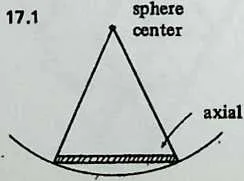
4 Diagram 17.1 shows that when the system is spherical the axial angles are at the base of an isosceles triangle whose apex is the central angle subtended by a strut. So each axial angle is 1/2(180° - central angle). And we can derive the central angle from the chord factor, which by definition is twice the sine of half the central angle. Combining these observations, we find that for a spherical system,
| (17.1) |
5 If the system is non-spherical, we need, in addition to the strut’s chord factor, the radii at its two ends, which will be in our work sheets because obtained them when we were calculating the chord factor in the first place. Diagram 17.2 shows the triangle we are now solving. If the strut is , its chord factor a, and the radii at ends and are and , respectively, then,
| (17.2) |
6 After which, more simply,
| (17.3) |
17.2 Face Angles
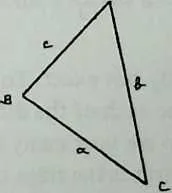
7From the freshman trig text: given the three sides of a triangle, to find its three angles. The sides are simply the chord factors of the struts that bound a face. In Diagram 17.3, if the triangle has sides and , then
| (17.4) |
9 We can use this result to find the next angle more quickly:
| (17.5) |
10 And the last one more quickly still:
| (17.6) |
17.3 Dihedral Angles
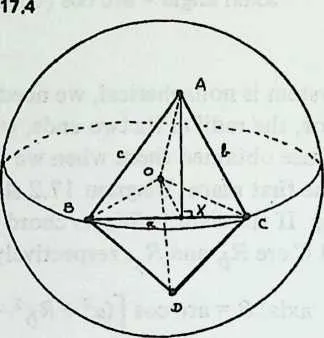
11The existence of an elegant procedure seems plausible, but so long as it continues to be elusive, we can rely on trigonometric brute force. Diagram 17.4 shows what we are trying to accomplish. We want the dihedral angle between triangle and triangle . A ‘‘normal plane’’ passes through their common edge and the system center, and it is not too difficult to obtain the angle at which each triangle meets this plane. We can then obtain the dihedral by adding these two angles together.
12 Start with triangle ABC. We know its three sides (chord factors) and the radii of its three vertices (= 1 for spheres). We know the face angle at (or know how to obtain it—see above). We also know or can obtain the axial angle at B. A perpendicular to the side marks off segment , the length of which will be cos Bf (Bf being the face angle). In the triangle we now know 2 sides, and the radius BO; the angle included between them will be the axial angle Ba, which we also know how to obtain. So we can find side , which is also a side of triangle AXO. The sideAY of this triangle is sin By, and its third side is the radius at A So we can calculate what we want to find, the angle AXO. Using data for triangle , we repeat the process to obtain angle , and add these results. The sum is the dihedral. When all radii = 1 (the spherical case) this procedure shakes down to:
| (17.7) |
13 This method is messy but exact. To see how often we must go through it, we examine each of the different strut lengths in a breakdown diagram to see how many different pairs of triangles meet across it. Each strut is the ridge of a dihedral angle, and if our system is spherical the dihedrals along identical boundaries between like pairs of triangles will be identical.
14 Diagram 17.5 shows all the triangle types in the rotated and truncated octahedron we designed in Chapter 14. Its forty-five triangles are of just four types, the ones that group in hexagons, the ones that group in squares, and the two special ones produced by the truncation process. Of the five different strut lengths, occurs on four kinds of boundaries: between and ; between and ; between and ; between and . Length occurs only between and ; length . Length never occurs between pairs of triangles, only between a triangle and the floor (more about this later). Length is found only between and .
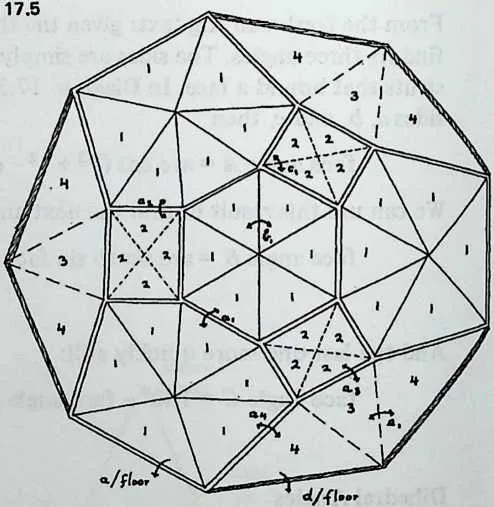
16 So this structure contains just seven dihedral angles, not an excessive number to figure if our method of construction should require them. The four triangles will have a total of twelve face angles, and the five strut lengths will have five axial angles. The complete set is tabulated herewith (Table 17.1) for the reader to check as an exercise.
17 Table 17.1 3v Octa, Rotated and Truncated
18(complete angular data)
Chord
Factor | Axial | |||
200.632456 | 2171.565037 | 22Face | 2358.799355 | |
250.671421 | 2670.384251 | 27Face | 2865.905155 | |
300.459506 | 3176.717470 | 32Dihedral all | 33154.208383 | |
350.674981 | 3670.275945 | 37Dihedral a 1 2 | 38166.094599 | |
400.607864 | 4172.306078 | 42Dihedral a 2 3 | 43169.081500 | |
44Al: | 45Face | 4661.901864 | 47Dihedral a 1 4 | 48155.487605 |
49Face | 5056.196272 | 51Dihedral 1 1 | 52158.079453 | |
53A2: | 54Face | 5546.512901 | 56Dihedral c 2 2 | 57154.688973 |
58Face | 5986.974198 | 60Dihedral 3 4 | 61156.048901 | |
A3: | 62Face | 6358.652439 | ||
64Face | 6562.695121 | 66Wall/floor, | 6792.067409 | |
68A4: | 69Face | 7055.295491 | 71Wall/floor, | 7295.739409 |
73 Note: ‘‘Face ab’’ means the face angle between struts a and b. ‘‘Dihedral a 1 1’’ means the dihedral angle between two #1 triangles where they meet along side a. For triangle numbering see Diagram 17.5.
74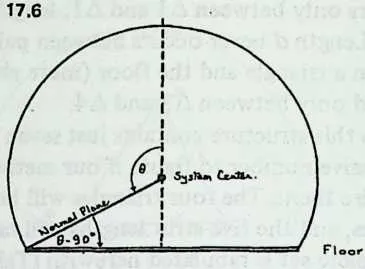 A word on the meeting of panel with floor (along strut and sometimes
strut
in this example). This constitutes a special kind of dihedral angle. Should we want to know it,
we divide the problem as before into two parts. We use Equation 1 ’l.’l to find the
angle between the triangular panel and a ‘‘normal plane’’ through system center. If we
are dealing with a hemisphere, the floor occupies this plane and the calculation is
finished. If we are not, we need also the angle between the normal plane and the floor.
Diagram 17.6 shows that this follows directly from the 0 of the truncation plane: it is
simply 6 - 90°. We add this to what Equation 17.7 gave us; the result will be the
angle between panel and floor, as viewed (like all dihedral angles) from inside the
structure—an acute angle if the structure is less than a hemisphere, obtuse if it is more.
(The acute-obtuse correction is supplied automatically by the fact that 6 - 90° will be
negative if the structure is less than a hemisphere, so the net effect of adding it will be to
diminish the dihedral.) In our rotated/truncated octa example, the truncation plane 0 is
104.963218°, so we add 14.963218° to the angle between bottom triangles and the normal
plane, giving us dihedral angles of slightly more than 90°. At 14° below the equator, a octa
structure is just commencing to display outward curvature.
75 Nonspherical dihedrals remain to be considered. It is a comfort to know that they are rarely needed. They are tedious to arrive at, both because varying radii complicate the expressions, and because there are apt to be so many different ones. Anyone engaged in the design of a high-frequency nonspherical geodesic structure presumably has a budget sufficient to rent computer time if dihedral angles are needed. What will need to be gotten through the computer’s head is a procedure essentially like that which yielded Equation 17.7, complicated however by the fact that the three radii of a triangle’s vertices are no longer equal. The discussion that accompanied Diagram 17.4 may be reread with this fact in mind.
76 By staying calm we arrive at the following procedure:
- 1.
- Obtain the axial angle Ba with Equation 17.2
- 2.
- Obtain length
as follows:
(17.8) - 3.
- Obtain Angle
as follows:
(17.9)
77 Repeat with the second triangle, and add.