5 Geodesic Subdivision
1We have been increasing the number of struts in a spherical Tensegrity system, from six to twelve to thirty. The systems have been growing more spherical, because they have more vertices, closer together, and the chords connecting these vertices (struts and tendons) are less and less different from arcs. In addition to making the spherical surface smoother, and hence easier to equip with a weather-break, the progressive shortening of structural members tends to make large structures increasingly practical.
2 Still, we seem to have reached a limit. The inventory of uniform polyhedra which are both bounded by great circles and equipped with four edges per vertex is exceedingly short. In fact, we have now employed the only three: the octahedron, the cuboctahedron, the icosidodecahedron, corresponding respectively to the six-strut, twelve-strut, and thirty-strut Tensegrity spheres. We might explore existing Zesser-circle systems; indeed we have briefly discussed the small rhombicosidodecahedron, which will make a sixty-strut Tensegrity sphere. If we make this model, or even diagram it, one disadvantage appears immediately: it has no appealing natural lines of truncation. Slicing it on the plane of a lesser circle, we acquire two relatively useless pieces: an extremely shallow saucer, and a 7/8 sphere like an inverted goldfish bowl. Another disadvantage is longer-range: we have no reason to expect the inventory of Valence-4 lesser-circle polyhedra to last much longer than the great-circle series did.
3 If we are not to be constantly frustrated by the nonexistence of the sort of polyhedra we want, we shall need a way of devising new ones to our specifications.
4 This possibility does not collide with the geometer’s contention that polyhedra come in small, finite sets. The sets are small because the geometer stipulates that faces of the same shape must be exactly alike. This imperative is rather aesthetic than structural, and once we relax it, we shall find at our disposal literally infinite arrays of nearly uniform polyhedra, as multi-edged and as elaborately faceted as we may wish. We acquire them by systematically subdividing the faces of existing polyhedra.
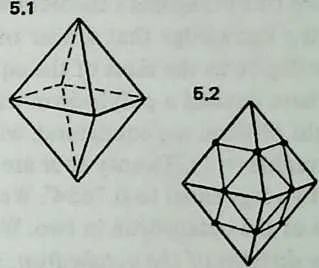
5 Diagram 5.1 shows a regular octahedron, having eight equilaterally triangular faces. Diagram 5.2 shows each face of the octahedron divided into four smaller triangles, by simply connecting the midpoints of the edges. These thirty-two small triangles are also equilateral, but the figure does not look promising as a way of generating anything spherical. The reason, of course, is that the vertices and mid-edge points of the octahedron are at different distances from its center. If we call the center-to-vertex radius 1, the center-to-mid-edge radius is only V2/2, or 0.7071.
6 But there is no reason at all why the twelve vertices that lie on the octahedron’s midedges cannot be pushed out until they are as far from the center as the eight vertices that coincide with the octahedron’s vertices. The radii to all twenty vertices will then be identical , as if the vertices all lay on the surface of a sphere, and the edges that connect them will be chords of that imaginary sphere.
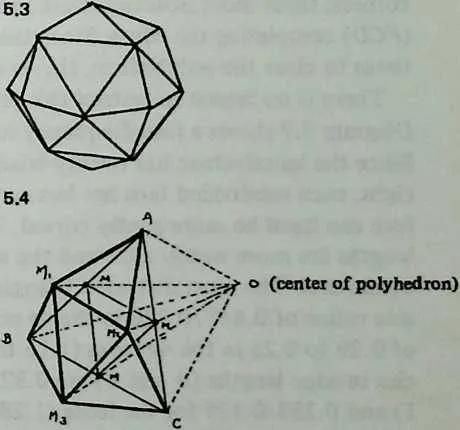
7 Diagram 5.3 shows what this would look like. Notice that we are not envisaging spherical triangles. The sphere implied by the drawing is nothing but a handy way of reminding ourselves that all vertex points are at a uniform distance (called 1) from the center of the system. The lines that bound the triangles are straight, not curved; chords, not arcs.
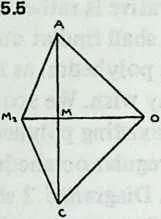
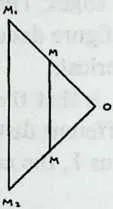
8 We can concentrate now on one octahedron face. Diagram 5.4 shows what has happened to it. The midpoints of the sides have been pushed out until their distance from the center is the same as the distance of from the center . It is clear that the triangle is equilateral, since it still corresponds in shape to the equilateral . In moving out, however, its edges have grown larger, by the same geometry which gives a larger image when the screen is farther from the projector. But has not grown by so much, since its upper end is still anchored at ; it is like an image projected on a tilted screen. The same is true of . So the top triangle, , is not equilateral but isosceles.
10 If we want data on this polyhedron, we thus have two edge lengths to calculate. Diagram 5.5 shows a way to go about it. Two applications of Pythagoras’s theorem will give us those isosceles legs, and the knowledge that similar triangles are similar in all respects will give us the sides of the equilateral central triangle.
12 So we have devised a polyhedron with triangular faces. Eight of them are equilateral, with sides equal to the polyhedron’s radius (= 1). Twenty-four are isosceles, with bases equal to 1 and two legs equal to . We obtained this by dividing each edge of the octahedron in two. We call this process a two-frequency division of the octahedron, and we call the resulting polyhedron a two-frequency octahedron ( octa for short).
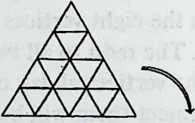
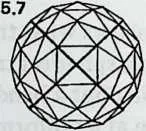
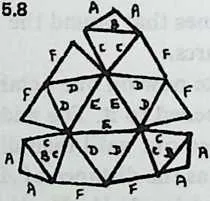
14 There is no theoretical limit to this process of frequency subdivision. Diagram 5.6 shows how to generate one face of a four-frequency octahedron ( octa) and Diagram 5.7 shows the polyhedron we obtain. Diagram 5.8 lists edge lengths for the sixteen triangles we derive from each octa face. (Ways of calculating them will occupy us later.) They are of four different shapes: one equilateral () at the center; three isosceles () at the comers; three more isosceles () abutting the center; six scalene () completing the edges. Since this pattern is completed eight times to close the polyhedron, the octa has 128 triangular faces.
16 There is no reason to restrict this procedure to the octahedron. Diagram 5.9 shows a four-frequency icosahedron ( icosa). Since the icosahedron has twenty triangles to the octahedron’s eight, each subdivided face has less curvature to supply and therefore can itself be more gently curved. Thus the different edge lengths are more nearly alike and the small triangles more nearly equilateral. The most distorted triangles, the corner ones, have side ratios of in the octa () and side ratios of 0.29 to 0.25 in the icosa (1.16 to 1). The greatest discrepancies in edge lengths ( and ) are for the octa (1.8 to 1) and for the icosa (1.28 to 1).
18 It is clear that an icosa yields less jerky polyhedra than an octa. It is also clear that, octa or icosa, the higher the frequency, the smoother the arcs and the less the tiny triangles differ.
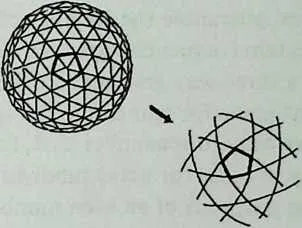
19 The acute reader will have been wondering what happened to our quest for Valence-4 polyhedra to generate Tensegrities. In the polyhedra we are learning to generate, six-way vertices preponderate, relieved only by twelve Valence-5 vertices when we start with the icosa, and by eight Valence-4 vertices when we start with the octa. Courage. The Tensegrity fan has a simple recourse, illustrated in Diagram 5.10. He has only to omit every other stripe in each of three directions on the face triangle, and lo, the Valence-4 vertices appear.
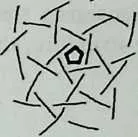
21 Following the usual Tensegrity rule of skipping every other vertex, we may insert 120 struts into six pairs of parallel lesser circles, ten struts per circle. The dip angle will be 180°/10, or 18°, and other dimensions may be computed as usual. We have only to remember that the radius yielded by Equation 3.5 is that of a lesser circle and divide it by the cosine of the lesser circle’s ‘‘latitude’’ above the equator to obtain the radius of the actual sphere. The surface pattern of the four-frequency Tensegrity icosa ( icosa) is determined by twelve pentagons, each surrounding a vertex of the icosahedron from which we started (such vertices are always surrounded, not occupied, so we do not encounter the problem of devising a five-way Tensegrity intersection). Five triangles abut the five sides of each pentagon, and five hexagons touch its vertices. Since all twelve lesser circles are alike, all struts are the same length. The six different edge lengths into which we factored the icosa face in executing the original breakdown impose no complication because most of them disappear, and for Tensegrity purposes it is unnecessary to compute them at all. (This won’t hold true of higher-frequency subdivisions.)
22 It is obvious that by extending this principle, we can generate spherical Tensegrities as complexly multi-strutted as we like. This means in practice that no matter how large a domical structure we may want to build, we can still use struts conveniently short and light. It will exhibit (assuming an icosa generator) a surface pattern of twelve pentagons per complete sphere, plus assorted triangles and hexagons. The triangles, increasingly numerous at higher frequencies, guarantee the stability of the structure. Lesser circles (and at certain frequencies great circles also) will run round the sphere in a three-way grid, and any circle we choose will supply a convenient plane for truncating the sphere to produce a dome.
23 We have only to remember that, for Tensegrity purposes, the frequency of icosa (or octa) subdivision must always be even, producing polygons of an even number of sides and permitting us to skip every other vertex when we insert the struts. If it is not a Tensegrity that we contemplate, but some other kind of geodesic structure, the restriction to even frequencies does not apply.