Appendix I: Writing Class II Method 3 Coordinates
1I haven’t been able to find an easier method than the following.
2 Diagram 1.1 shows a 6v example.
- 1.
- Divide the vertical median of a Class II triangle face into
equal parts for -frequency.
This median is:
3octahedron: 45°,
4icosahedron: , or 31.7174744°,
5tetrahedron: , or 54.7356103°.
6For the 6v icosa shown, the 3 divisions are bounded at 10.5724915 and 21.1449829. The first of these isn’t a vertex; the second gives us the 6 of 2,1. (Every second division point will fall on a vertex.)
- 2.
- Great-circle arcs from these division points meet the triangle’s left and right sides at
90°. To find the
of the intersection we use the equation
(23.1) 7Here is 1 /2 the angle at a polyhedron vertex (that is, 45° for the octa, 36° for the icosa, 60° for the tetra). So in the example, the 0 of 1,0 and 1,1 is
8Similarly, the of 2,0 and 2,2 is
9When we have completed this process we know the of every point down the right and left edges and along the vertical median. And for the icosa the corresponding values are of course 72,0, and 36, respectively.
- 3.
- All other points are obtained by rotating the Class II triangle downward the length of one diamond. Thus in the example, if the diamond 0,0-1,0-2,1-1,1 is slid downward its own length till 0,0 falls on the spot vacated by 2,1, then 1,0 will move to 3,1 and 1,1 to 3,2. To accomplish this we use the rotation formulae, Equation 14.1 and Equation 14.2, and the point we move to 0,0 is the one with the same 9 as 2,1, but lying on the 0 meridian 180° away (that is, point 216, 21.1449829). When we do this we find that 1,0 moves to 21.7718193,32.5212749, and 1,1 moves to 50.2281807, 32.5212749. These are 3,1 and 3,2, respectively, which accounts for all the points in the 6v Class II triangle.
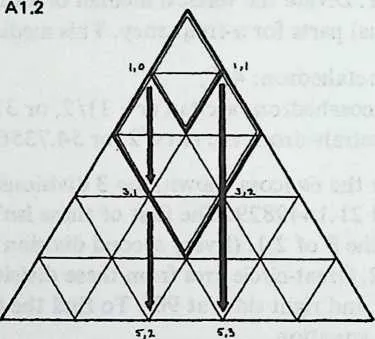
10 Diagram 1.2 shows a detail to watch. In this lOv example, we move the diamond 0,0-1,0-2,1-1,1, as before, and get 3,1 from 1,0, then 3,2 from 1,1, also 4,1 and 4,3 from 2,0 and 2,2, finally 5,1 and 5,4 from 3,0 and 3,3. What about 5,2 and 5,3? We could get them in turn from 3,1 and 3,2, but these points themselves have already been obtained by rotation, and we may have reason to be nervous about accumulating errors, if not here, certainly in some very-high-frequency example in which third- and fourth-generation rotations are conceivable. A better strategy is to move the diamond 0,0-2,0-4,2-2,2, whereupon 1,0 will give us 5,2 and 1,1 will give us 5,3. By suitable choice of a diamond, and faith in symmetry, it is always possible to avoid deriving a point from a point that was itself derived by rotation.
11 Finally, the reader should notice a quirk in the rotation formulae, of consequence only
when, as here, we are relocating points within a system but not moving the whole
system. In effect, the two equations answer the question, where does point p,q go
when another point m,n is moved to 0,0? A little reflection will convince us that this
question has an infinite number of answers, since it specifies only that the distance
between two points shall not change. When m,n is at 0,0 then the 9 of p,q will simply be
the distance that separates them; in fact Equation 14.1 is nothing but the distance
formula (Equation 9.2) with the second-power terms removed. But the 0 of p,q can
have any value whatever: p,q can lie anywhere along the lesser circle of center 0,0
and radius 9. It is only when we add a third point, r, s, that the 0 values become
meaingful, and then all they specify is that the relationship between the three points shall
not have changed; they say nothing about the icosahedron, or whatever it was, from
which we took the three points. If all three points have swung, say, 36° westward, their
private interrelations are still unvaried which is what the rotation formulae set out to
achieve—though they have all three come unmoored from the icosa face where we found them.
12 And in fact Equation 14.2 has a habit of swinging things about in this way, seeking as it does a convenient axis of rotation without consulting our preference. But since it rotates everything by the same amount, we have only to find out what it is doing and we shall know what correction to apply. In the example above, sliding the diamond 0,0-1,0-2,1-1,1 straight down the Class II triangle’s median ought to bring 0,0 to 2,1—that is, to 36, 21.1449829. In fact 0,0 ends up at 0, 21.1449829, which means that the system swings 36° westward. So we apply a correction of +36° to all values yielded by Equation 14.2.
13 This fact did not trouble us when we were using the rotation formulae to derive new chord factors for truncation planes, since we always moved both of the points involved and never referred from them to points of the system that had not undergone rotation.