4 Tendon System Minima
1Commencing with a clothesline and two poles, we have considered in turn elementary Tensegrity systems (Chapter 1), the six-strut spherical Tensegrity (Chapter 2), and twelve-strut and thirty-strut spherical Tensegrities (Chapter 3), the configurations growing ever more suitable for slicing off to yield practical domes. We are gradually deriving the structural principles of the geodesic dome from the Tensegrity sphere, of which it is a special case. The reader will reap the benefits of this approach when he arrives at the geodesic dome prepared to think of its sustaining structural continuities instead of assuming that rigid framing members exist to bear the weight of other rigid framing members, like studs in a frame house or bricks in a wall.
2 In two more steps we shall have arrived at domes in which things are bolted together instead of slung from cables. The reader anxious to get there may skip the present chapter, which refines our understanding of Tensegrities by describing in another way the forces they contain. The reader who finds Tensegrity independently fascinating is invited to tarry.
4.1 Six-strut Tendon Minima
3In Chapter 2 we derived the equilibrium condition of the six-strut Tensegrity by concentrating on the sets of opposed forces whose compromise causes the dip angle to settle where it does. In Chapter 3, by a generalized version of the same reasoning, we arrived at a simple equation for predicting the dip angle of a multi-strut Tensegrity sphere. We also learned that the dip angle governs all the other dimensions of the Valence-4 Tensegrity systems, so that knowledge of the dip angle enables us to calculate them.
4 It might have occurred to us to approach the initial problem in Chapter 2 differently. We might have reflected that when we build a six-strut system we pull all the tendons tight, so tight that they cannot be pulled any tighter. It appears, then, that when the Tensegrity is in equilibrium the total length of the tendon system is minimal. This deduction is reinforced by our discovery that however we disturb the system we stretch the tendons; hence in equilibrium they must have been as short as possible. If we could arrive at the conditions for minimum tendon length, we should have another way of calculating the critical dimensions of the system.
5 We have seen what governs change in tendon length: it is displacement of struts. We can imagine the three pairs of parallel struts all arrayed in space at some large separation, and then commencing to approach one another symmetrically. The ends the tendons will join also approach one another. Eventually the centers of the struts will cluster at the center of the system. But some time before that happens, the ends the tendons will join will have come as close together as they are going to and will have started to move apart once more. It is that moment of maximum proximity (minimum separation) that we want to fix.
6 When we came upon elasticity multiplication in Chapter 2, we discovered (Equation 2.1 2.1) that whatever the separations between parallel struts, the distance each tendon will span is . This equation is not linear (Diagram 2.10 shows that it is represented by a parabola). The rate at which the tendon length changes, levels off slowly until for a critical instant there is no change at all (the zero point of Diagram 2.10; the tendon minimum we are pursuing). Then the rate of change increases once more, slowly at first, then faster. Anywhere along the parabola in Diagram 2.10, a steep slope designates rapid change, a shallow slope slow change. At the elusive instant of horizontality (zero slope) the rate of change is zero.
7 None of this is news to the freshman calculus student, who learned on the first day of class that the rate of the change going on in an equation is described by the derivative of the equation, and a few days later was able to write the derivate of . It is . When the quantity is minimal it has momentarily ceased to change: its rate of change (hence its derivative) is zero. This will happen when , that is, when .
8 This means that when the distance between parallel struts in a symmetrical six-strut Tensegrity is , the distances to be spanned by the tendons, and hence the lengths of all tendons, are minimal.1 This half-strut-length strut separation agrees with what we learned in Chapter 2 by a different chain of reasoning. To learn the length of this minimum tendon, we have only to return to Equation 2.1 and write for .
9 Then , which also agrees with the result we obtained in Chapter 2.
10 So for a symmetrical six-strut Tensegrity system the assumption that the dip angle will be 90° and the assumption that the tendon system will be of minimum length yield exactly the same results.
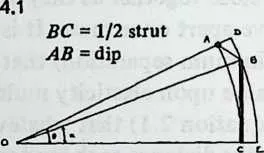
12 It is not difficult to show that this principle holds true of complex spherical Tensegrities as well. Consider Diagram 4.1, which shows half a strut with its midpoint at a distance from the center 0 of the system. is the dip, which terminates at the midpoint of another strut shown in cross section at . Since all strut midpoints are equidistant from the center, . Angle , bounded by , is obviously , where is the number of struts round a circle. The angle is half the angle subtended by a strut at the center of the system and will increase as the strut is pulled in toward the center. As this happens, point will also move in, since all struts move uniformly, and the dip will change. Hence the angle tells us how far each strut is from system center and gives us an alternative way of defining the equilibrium state.
13 We can define the dip as a function of angle :
| (4.1) |
14 Differentiated with respect to , this gives
| (4.2) |
15 Setting this equal to zero and discarding two irrelevant possibilities, we find that for minimum tendon length,
| (4.3) |
16 If we now substitute this for in Equation 4.1, we discover after some tedious routine work that when the tendon length is minimal, the dip is , which a glance at Equation 3.4 will show us is exactly what we arrived at in Chapter 3 by the dip-angle method.2 And all other dimensions follow from that of the dip.
17 So when any complex spherical Tensegrity is at its equilibrium state, all tendons, and hence the total tendon system, will be of minimum length.
18 This tells us rigorously what we may have intuited, that we bring a Tensegrity to its equilibrium state by pulling everything as tight as possible. Thereafter any outward or inward force, in attempting to make the system larger or smaller, must also strive to make the tendons longer and will be inhibited by their restoring elasticity. Elasticity multiplication will permit the system to yield more than we might expect, but it will always seek to restore itself to equilibrium.